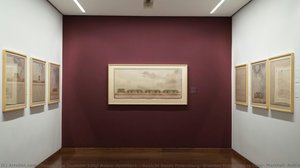
Preview
 Send
Send Share
Share
 Details

 Download
 Similars
 X-Ray
X-Ray Diaporama
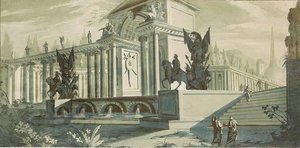
Ansicht Sankt Petersburg, Grandes Ecuries de la Cour, Marstall, Aufriss der Fassade
 1800
1800 65.0 x 148.0 cm
 Read More
Hand Made Oil Reproduction
Hand-painted oil on canvas in your size and frame, made to order by our artists. ( Buy Print Buy Image)




































Pick from our preset sizes that match the artwork's original proportions.

You may enter your own dimensions to fit a specific frame or space. If your selected size does not match the original image's proportions, we will either crop the artwork or extend the painting with additional hand-painted elements. A digital mockup will be sent for your approval before production begins.
Please note that the on-screen preview does not reflect the actual cropping or extension. Only the mockup will accurately show the final composition.
While custom sizes are available, we recommend selecting a dimension from the predefined list to preserve the original proportions.
After order, ArtsDot.com team will email client for instructions and provide a mockup preview
Worldwide Delivery () in 3/4 weeks instead of standard 5 weeks. (27 August). No compromise on quality.

Free Worldwide Express Shipping

High-Quality Linen Canvas

Full Shipping Insurance

Customs Tax Refund Guarantee

True Color Matching Guarantee

60-Day Return Policy (Defects Only)

100% Money-Back Guarantee

Bulk Discount Offer
 Glass option is only available in size under 110 CM

Ansicht Sankt Petersburg, Grandes Ecuries de la Cour, Marstall, Aufriss der Fassade
Reproduction Medium
Reproduction Size
-


Total Price
$ 263
Related Artworks







Artist Biography
Giovanni Antonio Canal, Known as Canaletto: A Master of Venetian Light
Giovanni Antonio Canal, universally known as Canaletto (1697-1768), stands as a pivotal figure in the history of Western art. More than simply a painter of landscapes – though his *vedute*, or city views, are undeniably his most celebrated works – he was a meticulous observer and a skilled documentarian of 18th-century Venice and London. Born into a family steeped in theatrical artistry, Canaletto’s journey from stage backdrop painter to one of the foremost artists of his era is a testament to his keen eye, technical mastery, and an uncanny ability to capture the essence of urban life. His legacy endures not just through the beauty of his paintings but also as a pioneer in topographical art, employing techniques that foreshadowed photography’s rise.
Canaletto's early years were spent assisting his father, Bernardo Canal, a stage designer and painter for Venetian opera houses. This formative experience instilled within him an acute awareness of perspective, composition, and the importance of accurately representing three-dimensional space – skills that would later become hallmarks of his *vedute*. He initially worked on elaborate sets, learning to render fabrics, architectural details, and the play of light with remarkable precision. However, recognizing a burgeoning demand for more permanent depictions of Venice, Canaletto transitioned to painting commissioned views for wealthy patrons, including merchants and nobility. These early works, characterized by their crisp lines and vibrant colors, established his reputation as a skilled artist capable of capturing the bustling atmosphere of the city.
The Rise of the Veduta: A New Genre
Canaletto’s most significant contribution to art history lies in the development of the *veduta*, a genre dedicated to depicting urban landscapes. Unlike earlier landscape paintings that often focused on idealized or romanticized scenes, Canaletto's *vedute* aimed for an unprecedented level of realism and accuracy. He meticulously observed his subjects, sketching them repeatedly from various vantage points before committing them to canvas. This process involved not only careful observation but also a deep understanding of perspective – a skill he honed through years of experience in theatrical design. Crucially, Canaletto didn’t simply record the physical appearance of buildings and streets; he sought to convey their atmosphere, their social life, and their relationship to the surrounding environment.
Canaletto's technique was further refined by his adoption of the *camera obscura*, a device that projected an image onto a surface. While the extent to which he relied on this tool remains debated among scholars – some argue it served primarily as a means of checking his sketches, while others believe it played a more significant role in creating his final compositions – its use undoubtedly enhanced his ability to accurately render architectural details and capture the subtle nuances of light and shadow. His meticulous approach extended beyond mere visual accuracy; he paid close attention to detail, including the clothing worn by pedestrians, the movement of boats on the canals, and the activity within buildings.
London Years and Artistic Collaboration
In 1746, Canaletto embarked on a pivotal chapter in his career: a decade-long sojourn in England. Invited to paint London for Joseph “Consul” Smith, an English merchant and art collector, he quickly established himself as a sought-after artist. Smith’s vast collection of Canaletto’s work, later acquired by King George III, significantly boosted the artist's popularity and ensured his financial security. During this period, Canaletto collaborated extensively with his nephew, Bernardo Bellotto, who served as his assistant and principal draftsman. This partnership allowed Canaletto to focus on the overall composition and color palette of his paintings, while Bellotto meticulously rendered the intricate details – a division of labor that resulted in a remarkably consistent style across many of his London views.
Canaletto’s English works are often distinguished by their slightly darker tones and more subdued colors compared to his Venetian paintings. This shift is attributed to the influence of the English light, which was perceived as less intense than the bright Mediterranean sun. He captured iconic landmarks such as Windsor Castle, Hampton Court Palace, and the Tower of London, offering viewers a detailed glimpse into the burgeoning metropolis. His depictions of London’s social life – bustling markets, crowded streets, and elegant carriages – provide invaluable insights into the city's vibrant culture during the 18th century.
Legacy and Influence
Upon his return to Venice in 1756, Canaletto continued to paint until his death in 1768. Despite a decline in his popularity following his departure from England, his work gradually gained recognition as a masterpiece of topographical art. His meticulous observations, combined with his skillful use of perspective and color, established him as a pioneer in the genre and profoundly influenced subsequent generations of landscape painters. His legacy extends beyond individual paintings; Canaletto’s techniques – particularly his systematic approach to observation and documentation – laid the groundwork for modern urban planning and architectural photography.
Canaletto's influence can be seen in the works of artists such as William Marlow and Samuel Scott, who adopted his style and continued to paint *vedute* of London. His paintings remain highly valued today, offering a unique window into the sights and sounds of 18th-century Venice and London – testaments to the enduring power of observation and artistic skill.
thomas de thomon, luigi rusca (architect)
1768 - 1859 , Austria
Quick Facts
- Artistic Movement Or Style: Veduta painting”, Rococo
- Artists Or Movements Influenced By This Artist:
- William Marlow
- Samuel Scott
- Artists Who Influenced This Artist:
- Luca Carlevaris
- Bernardo Bellotto
- Date Of Birth: 18 October 1697
- Date Of Death: 19 April 1768
- Full Name: Giovanni Antonio Canal”, known as Canaletto
- Nationality: Italian
- Notable Artworks:
- The Stonemason’s Yard
- Regatta on the Grand Canal
- Eton College
- A View of Venice from Santa Maria del Pianto
- Place Of Birth: Venice, Italy