

 Preview
 Send
Send Share
Share
 Details

 Download
 Similars
 X-Ray
X-Ray Diaporama
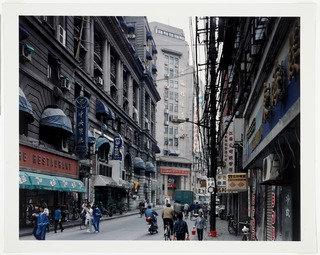
Jiangxi Zhong Lu, Shanghai 1996 (for Parkett no. 50 51)
 1997
1997 40.0 x 51.0 cm
 Read More
Purchase a high-resolution, enhanced digital image, far superior to the online preview.
Each file is meticulously prepared by our in-house specialists using advanced tools and expert manual retouching. We ensure every image has exceptional clarity, precise color accuracy, and fine detail.
The final file is delivered via email within 72 hours, optimized for immediate use in professional, editorial, and print environments. This is the same quality trusted by top-tier design studios, publishers, and galleries.
Digital Image
Download a high-resolution file for personal display, printing, and creative projects. ( Buy Print Buy Hand Made Painting)
Included in Every Digital Image Order
Expert Digital Delivery, Guaranteed
When you choose ArtsDot.com, you're not just getting an image - you're receiving a professionally enhanced digital artwork, crafted with precision and backed by a satisfaction guarantee. Here's everything that comes with your order, automatically:

Fast Email Delivery
Your high-resolution digital image file will be emailed to you within 72 hours of ordering - ready for immediate use.

AI-Enhanced Digital File
Your artwork is professionally optimized using advanced AI tools and manual editing, ensuring maximum detail, clarity, and color accuracy.

Free Lifetime Re-Delivery
Accidentally deleted or lost your file? No worries - we'll resend it to you anytime, free of charge.

No Import Fees - Ever
Enjoy your artwork instantly with zero customs, duties, or delivery fees - digital downloads are always tax-free.

Color Accuracy Guarantee
We ensure your digital image reflects the original colors as closely as possible using professional tools and color management.

60-Day Satisfaction Guarantee
If you're not satisfied with your digital image, we'll revise it or refund 100% within 60 days - no questions asked.

100% Money-Back Guarantee
Not satisfied? Get a full refund within 60 days of receiving your digital file - no questions asked.

Bulk Order Discounts
Buy 3 images, save 10% - Buy 5, save 15% - Buy 10+, save 20%. Great for creative projects, galleries, and agencies.
Related Artworks










Artist Biography
A Chronicler of Perception: The World Through the Lens of Thomas Struth
Born in Geldern, Germany, in 1954, Thomas Struth emerged as a pivotal figure in contemporary photography, not merely documenting the world around him but dissecting *how* we see it. His upbringing, shaped by the contrasting worlds of his ceramicist mother, Gisela Struth, and banker father, Heinrich Struth, perhaps instilled an early sensitivity to both artistic expression and societal structures – themes that would later permeate his work. Struth’s formal training began at the Düsseldorf Academy of Fine Arts in 1973, initially focused on painting under Peter Kleemann. However, a crucial turning point arrived with his mentorship under Gerhard Richter from 1974 onwards. It was Richter who encouraged Struth to explore photography, leading him to join the groundbreaking class led by Bernd and Hilla Becher in 1976, alongside future luminaries like Candida Höfer, Axel Hütte, and Roswitha Ronkholz. This marked a decisive shift, aligning him with what would become known as the Düsseldorf School of Photography – a movement characterized by its cool objectivity and systematic approach to image-making.From Urban Grids to Human Presence
Struth’s early work established his meticulous observational style. In 1976, he presented a striking grid of 49 photographs at a student exhibition – images captured from a centralized perspective on the deserted streets of Düsseldorf. These weren't snapshots; they were carefully constructed compositions adhering to a strict logic of central symmetry, bathed in the greyish light of early mornings. This initial series demonstrated a deliberate avoidance of dramatic contrasts, prioritizing a neutral and analytical depiction of urban space. Subsequent travels led him to document cityscapes in Paris (1979), Rome (1984), Edinburgh (1985) and Tokyo (1986). These black-and-white photographs often focused on skyscrapers, subtly exploring the relationship between individuals and the increasingly imposing modern environment. A collaboration with Axel Hütte in 1977 saw them photographing housing in East London, further refining their documentary approach. However, Struth’s artistic trajectory wasn't solely confined to architectural studies. He began to recognize the absence of human presence within these landscapes, a void he would soon address directly. This led to his exploration of family portraits in the mid-1980s, initiated after conversations with psychoanalyst Ingo Hartmann. These weren’t conventional posed images; they aimed to reveal underlying social dynamics and psychological tensions within seemingly static compositions.The Museum Photographs: A Reflection on Spectatorship
It was in 1989 that Struth embarked on his most celebrated series, the *Museum Photographs*. This cycle revolutionized photographic discourse by turning the camera not onto artworks themselves, but onto the viewers *experiencing* those artworks. He documented visitors lost in contemplation before masterpieces in prestigious museums worldwide – the Art Institute of Chicago, the Musée du Louvre, and the Accademia in Venice, among others. These images are profoundly insightful; they aren’t simply records of people looking at art, but investigations into the act of perception itself. Struth captures the subtle gestures, the focused gazes, the shared moments of quiet reverence – revealing how individuals actively interpret and re-interpret cultural artifacts. He extended this concept to churches, observing visitors engaging with religious spaces, and later broadened his scope to secular sites like Times Square and Yosemite National Park. The *Pergamon Museum* series (1996-2001), dedicated entirely to Berlin’s Pergamon Museum, exemplifies his evolving approach. Initially employing candid shots, Struth later began orchestrating the positioning of participants, subtly guiding their interactions with the classical antiquities. His *Museo del Prado* series (2005) – focusing on viewers surrounding Velázquez's *Las Meninas* – further emphasized the active role of spectators in constructing meaning.Expanding Horizons: Paradise, Groupings and Technological Landscapes
Struth’s artistic curiosity continued to propel him into new territories. From 1998 onwards, he embarked on the *Paradise* series, capturing large-format photographs of jungle settings across Japan, Australia, China, America, and Europe. These images are immersive and overwhelming, conveying both the beauty and the untamed power of nature. Simultaneously, between 1995 and 2003, he produced a series featuring groups of people gathered at emblematic locations – tourists and pilgrims alike – exploring themes of collective experience and shared cultural significance. A significant shift occurred around 2010 when Struth turned his attention to the structural intricacies of remote techno-industrial and scientific research spaces. He documented physics institutes, pharmaceutical plants, space stations, and nuclear facilities, revealing the hidden landscapes of technological advancement. In 2014, he presented a series depicting panoramic views of Disneyland and Disney California Adventure, examining altered perceptions within these carefully constructed environments. His most recent work, *Animals* (2017-2018), documented researchers at the Leibniz Institute for Zoo and Wildlife Research in Berlin, studying wildlife diversity and conservation – bringing his focus back to the natural world but through the lens of scientific inquiry.Legacy and Influence
Thomas Struth stands as a key figure within the Düsseldorf School of Photography, alongside contemporaries like Candida Höfer, Axel Hütte, and Andreas Gursky. His work builds upon the legacy of Bernd and Hilla Becher’s systematic documentation of industrial structures, but expands it to encompass broader social and psychological themes. The *Museum Photographs* are particularly significant for their exploration of perception, social dynamics, and the role of the viewer in completing a work of art. They challenge traditional notions of artistic authorship and highlight how meaning is co-created through interaction. Struth’s large-scale photographs invite contemplation on themes of modernity, technology, and humanity's complex relationship with its environment. He doesn’t offer answers; he presents observations – meticulously crafted, intellectually stimulating, and profoundly resonant – prompting us to question not just what we see, but *how* we see it. His work remains a powerful testament to the enduring power of photography as a tool for both documentation and critical inquiry.
Thomas Struth
1954 - , Germany
Quick Facts
- Artistic Movement Or Style: Düsseldorf School Photography
- Artists Or Movements Influenced By This Artist:
- Candida Höfer
- Axel Hütte
- Andreas Gursky
- Artists Who Influenced This Artist:
- Gerhard Richter
- Bernd and Hilla Becher
- Date Of Birth: October 11, 1954
- Full Name: Thomas Struth
- Nationality: German
- Notable Artworks:
- Museum Photographs
- Family Portraits
- Paradise series
- Pergamon Museum series
- Place Of Birth (City And Country): Geldern, Germany

