


 Preview
 Send
Send Share
Share
 Details

 Download
 Similars
 X-Ray
X-Ray Diaporama
Madonna and Child in an Evening Landscape


 Read More
Purchase a high-resolution, enhanced digital image, far superior to the online preview.
Each file is meticulously prepared by our in-house specialists using advanced tools and expert manual retouching. We ensure every image has exceptional clarity, precise color accuracy, and fine detail.
The final file is delivered via email within 72 hours, optimized for immediate use in professional, editorial, and print environments. This is the same quality trusted by top-tier design studios, publishers, and galleries.
Digital Image
Download a high-resolution file for personal display, printing, and creative projects. ( Buy Print Buy Hand Made Painting)
Included in Every Digital Image Order
Expert Digital Delivery, Guaranteed
When you choose ArtsDot.com, you're not just getting an image - you're receiving a professionally enhanced digital artwork, crafted with precision and backed by a satisfaction guarantee. Here's everything that comes with your order, automatically:

Fast Email Delivery
Your high-resolution digital image file will be emailed to you within 72 hours of ordering - ready for immediate use.

AI-Enhanced Digital File
Your artwork is professionally optimized using advanced AI tools and manual editing, ensuring maximum detail, clarity, and color accuracy.

Free Lifetime Re-Delivery
Accidentally deleted or lost your file? No worries - we'll resend it to you anytime, free of charge.

No Import Fees - Ever
Enjoy your artwork instantly with zero customs, duties, or delivery fees - digital downloads are always tax-free.

Color Accuracy Guarantee
We ensure your digital image reflects the original colors as closely as possible using professional tools and color management.

60-Day Satisfaction Guarantee
If you're not satisfied with your digital image, we'll revise it or refund 100% within 60 days - no questions asked.

100% Money-Back Guarantee
Not satisfied? Get a full refund within 60 days of receiving your digital file - no questions asked.

Bulk Order Discounts
Buy 3 images, save 10% - Buy 5, save 15% - Buy 10+, save 20%. Great for creative projects, galleries, and agencies.
Collectible Description
A Divine Intimacy: The Radiance of Titian’s Madonna
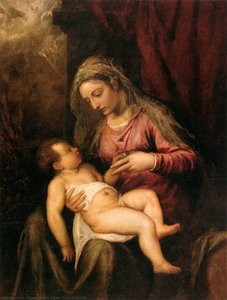
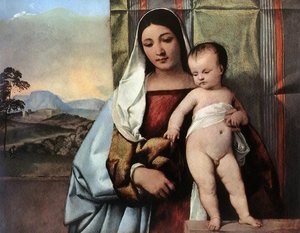
In the quietude of an evening landscape, one finds a moment of profound tenderness that transcends the centuries. Titian, the undisputed titan of Venetian color, invites us into a sacred space where the divine meets the deeply human. In Madonna and Child in an Embers Landscape, the Virgin Mary is not depicted as a distant, untouchable icon, but as a nurturing mother, captured in the intimate, rhythmic act of nursing her infant son. This scene of maternal devotion is bathed in a warmth that feels both celestial and earthly, drawing the viewer into a silent dialogue of love and protection. The composition, a hallmark of the High Renaissance, utilizes a classical balance that guides the eye through the soft curves of the figures toward a hazy, receding vista, suggesting an infinite world watched over by this holy pair.
The technical mastery on display is nothing short of breathtaking, showcasing the very techniques that allowed Titian to redefine the possibilities of oil painting. Through the meticulous application of glazes, the artist builds layers of pigment that catch the light, creating a luminous skin tone and a sense of palpable volume in the heavy, flowing drapery. The lighting is masterfully dramatic; a strong, directional glow emerges from the upper left, sculpting the forms of Mary and Jesus with deep shadows and brilliant highlights. This interplay of chiaroscuro does more than just create depth—it imbues the fabric of their robes with a tactile, silken quality that seems almost touchable, making the spiritual subject matter feel vibrantly alive.
Symbolism and the Venetian Palette
Beyond its aesthetic splendor, the painting is a rich tapestry of symbolic meaning. The warm palette—dominated by deep reds, burnt oranges, and shimmering golds—evokes an atmosphere of reverence and eternal warmth. These colors are not merely decorative; they represent the life-giving blood of Christ and the divine glory of the Virgin. The act of nursing serves as a powerful metaphor for nourishment, both physical and spiritual, representing the sustenance of faith. Even the subtle presence of a halo above Mary’s head acts as a quiet reminder of her sanctified status, grounding the emotional intimacy of the scene within a larger theological narrative of salvation and grace.
For the discerning collector or interior designer, this masterpiece offers more than just visual beauty; it provides an emotional anchor for any space. The organic shapes and flowing lines create a sense of movement and grace that can soften the rigid geometries of modern architecture. Whether placed in a sunlit gallery or a sophisticated study, a high-quality reproduction of this work brings with it a sense of historical weight and serene contemplation. It is a piece that does not merely decorate a wall but transforms an environment, inviting all who behold it to pause, breathe, and reflect upon the enduring power of beauty and devotion.
Related Artworks




Artist Biography
The Venetian Titan: A Life in Color and Canvas
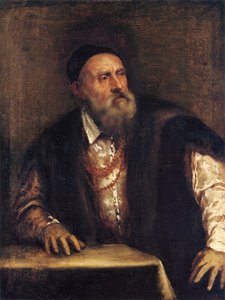
Tiziano Vecellio, known to the world as Titian, stands as a monumental figure of the Italian Renaissance—perhaps its most celebrated colorist and a master who redefined the possibilities of oil painting. Born around 1490 in Pieve di Cadore, nestled amidst the dramatic landscapes of the Venetian Alps, his journey from humble beginnings to international acclaim is a testament to prodigious talent and an unwavering dedication to artistic innovation. The details surrounding Titian’s early life remain somewhat shrouded in mystery, but we know he was one of several children born to Gregorio Vecellio, a military man, and Lucia. Recognizing their sons' potential, the family arranged for young Tiziano and his brother Francesco to apprentice with an artist in Venice—a decision that would irrevocably alter the course of art history.
Venice at the turn of the 16th century was a vibrant hub of commerce, culture, and artistic ferment. Titian’s initial training took place within the workshop of Sebastiano Zuccato, a mosaicist, followed by brief periods under the tutelage of Gentile Bellini and, crucially, his brother Giovanni. However, it was his association with Giorgione—a fellow Venetian painter whose work possessed an ethereal poetic quality—that proved most formative. The two artists collaborated on several projects, including the exterior frescoes for the Fondaco dei Tedeschi, a bustling trading post for German merchants. Even in these early works, Titian’s exceptional skill was evident, earning him recognition among his contemporaries and foreshadowing the brilliance that would soon blossom.
A Master's Evolving Style
Titian’s artistic development can be characterized by a remarkable versatility and an ongoing exploration of painterly techniques. His early works, heavily influenced by Giorgione, exhibit a delicate lyricism and a masterful use of color to create atmospheric effects. Paintings like *A Man with a Quilted Sleeve* (circa 1509) demonstrate his emerging talent for portraiture, capturing not only the physical likeness of his subjects but also their inner character. As he matured, Titian began to move away from Giorgione’s subtle tonalities and embrace a bolder, more dramatic approach to color. *The Visitation of Mary and Elizabeth* (now in the Accademia, Venice) exemplifies this shift, showcasing his growing confidence in handling complex compositions and vibrant hues.
Throughout his long career, Titian consistently pushed the boundaries of artistic expression. He experimented with different brushstrokes—from smooth, blended surfaces to loose, expressive marks—and developed a unique technique for layering colors to create luminous effects. His portraits became renowned for their psychological depth and realistic portrayal of textures and fabrics. Simultaneously, he excelled in mythological and religious subjects, imbuing them with a sensuality and dramatic intensity that captivated audiences. A prime example is *Venus of Urbino*, a masterpiece that redefined the depiction of the female nude and established Titian as a leading figure in Venetian painting.
Patronage, Prestige, and Lasting Influence
Titian’s talent attracted the attention of powerful patrons from across Europe. He served as court painter to Emperor Charles V, King Philip II of Spain, and Pope Paul III, among others. This patronage not only provided him with financial security but also allowed him to create monumental works that showcased his artistic prowess on a grand scale. His ability to adapt his style to the tastes of different courts while maintaining his own distinctive voice is a testament to his exceptional skill and diplomatic finesse.
The impact of Titian’s work extended far beyond his lifetime. His innovative use of color, his loose brushwork, and his emphasis on capturing the emotional essence of his subjects profoundly influenced generations of artists. From Peter Paul Rubens and Rembrandt to Eugène Delacroix and Édouard Manet, countless painters drew inspiration from his masterpieces. He is considered a pivotal figure in the transition from the High Renaissance to the Baroque period, paving the way for new artistic styles and approaches.
A Legacy Enduring Through Centuries
Titian passed away in Venice in 1576, leaving behind an extraordinary body of work that continues to inspire awe and admiration. His paintings can be found in museums around the world, including the Galleria Palatina in Florence, the Prado Museum in Madrid, and the National Gallery in London. To experience a Titian is to encounter a master craftsman at the peak of his powers—a painter who possessed an unparalleled ability to capture the beauty, drama, and complexity of the human condition.
Exploring Further
- Museums & Collections: Discover Titian’s works at the Scuola del Santo in Padua and San Salvador in Venice, both showcasing his breathtaking frescoes.
- Related Artists: Explore the influence of Giorgione on Titian's early style and the later impact of Titian on artists like Rubens and Delacroix.
- Historical Context: Immerse yourself in the world of the Italian Renaissance and Venetian painting to fully appreciate Titian’s artistic achievements.
Titian
1490 - 1576 , Italy
Quick Facts
- Artistic Movement Or Style: Renaissance, Venetian painting
- Artists Or Movements Influenced By This Artist:
- Western artists
- Late Italian Renaissance
- Artists Who Influenced This Artist:
- Giovanni Bellini
- Giorgione
- Date Of Birth: c. 1490
- Date Of Death: 1576
- Full Name: Tiziano Vecellio
- Nationality: Italian
- Notable Artworks:
- A Man with a Quilted Sleeve
- The Visitation
- Bearded Young Man
- Place Of Birth: Pieve di Cadore, Italy

