 Preview
 Send
Send Share
Share
 Details

 Download
 Similars
 X-Ray
X-Ray Diaporama
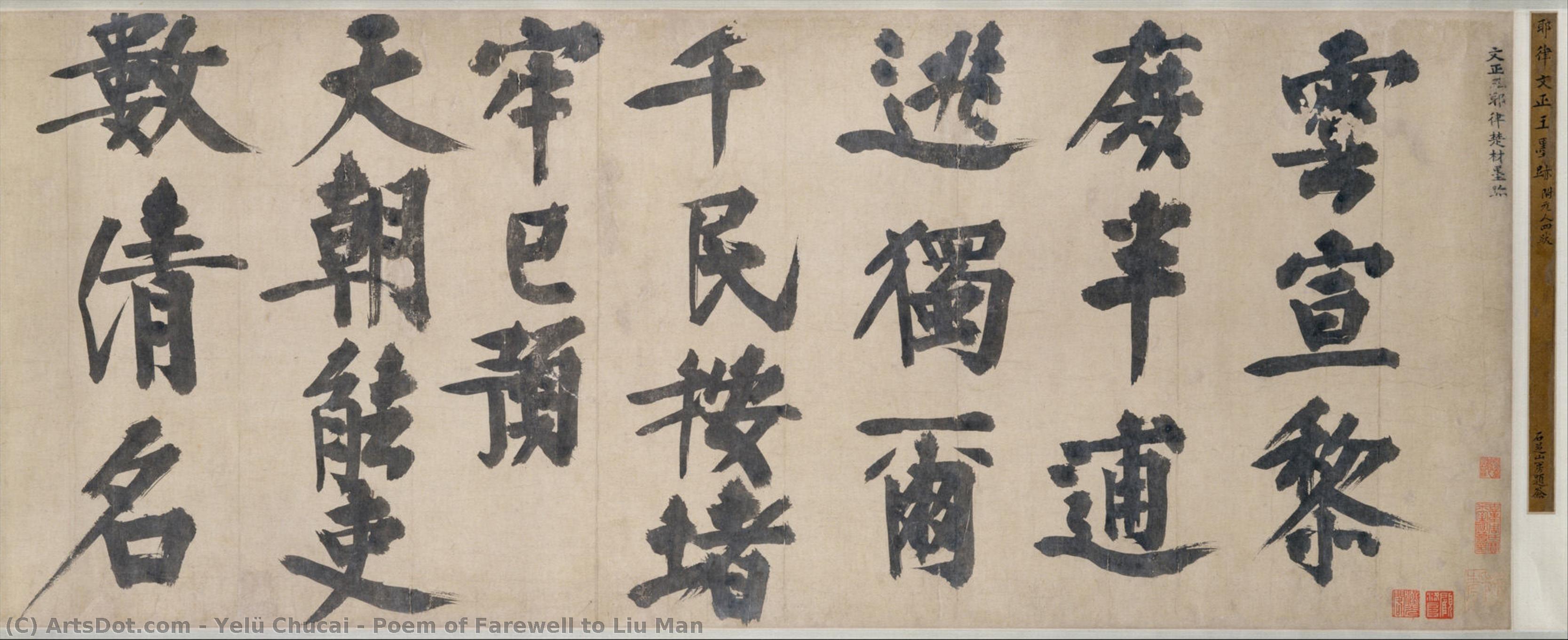
Poem of Farewell to Liu Man
 1240
1240 37.0 x 284.0 cm
 Read More
Hand Made Oil Reproduction
Hand-painted oil on canvas in your size and frame, made to order by our artists. ( Buy Print Buy Image)




































Pick from our preset sizes that match the artwork's original proportions.

You may enter your own dimensions to fit a specific frame or space. If your selected size does not match the original image's proportions, we will either crop the artwork or extend the painting with additional hand-painted elements. A digital mockup will be sent for your approval before production begins.
Please note that the on-screen preview does not reflect the actual cropping or extension. Only the mockup will accurately show the final composition.
While custom sizes are available, we recommend selecting a dimension from the predefined list to preserve the original proportions.
After order, ArtsDot.com team will email client for instructions and provide a mockup preview
Worldwide Delivery () in 3/4 weeks instead of standard 5 weeks. (30 August). No compromise on quality.

Free Worldwide Express Shipping

High-Quality Linen Canvas

Full Shipping Insurance

Customs Tax Refund Guarantee

True Color Matching Guarantee

60-Day Return Policy (Defects Only)

100% Money-Back Guarantee

Bulk Discount Offer
 Glass option is only available in size under 110 CM

Poem of Farewell to Liu Man
Reproduction Medium
Reproduction Size
-


Total Price
$ 263
Related Artworks









Artist Biography
Yelü Chucai: Bridging Cultures, Shaping an Empire
Born in the bustling heart of 13th-century Beijing – then known as Yanjing and a vital center within the Liao Dynasty – Yelü Chucai (also rendered as Yelu Chu Tsai) stands as a fascinating figure bridging the worlds of Khitan nobility, Confucian scholarship, and ultimately, Mongol power. His life, spanning from 1190 to 1244, was one of profound influence, marked by an unusual trajectory that saw him rise from a respected scholar-painter to become a pivotal advisor within Genghis Khan’s burgeoning empire. More than just a painter, Chucai embodied the synthesis of tradition and pragmatism, skillfully navigating the complex political landscape of his time and leaving behind a legacy reflected in both his artistic creations and his administrative reforms.
Chucai's early life was steeped in the traditions of the Liao Dynasty. His lineage traced back to Khitan imperial clans, affording him access to a rigorous education centered on Confucian principles. This foundation shaped not only his intellectual pursuits but also informed his artistic sensibilities – a blend of meticulous detail and understated elegance that would characterize much of his work. While details about his early career remain somewhat sparse, it’s understood he quickly gained recognition for his skill as both a calligrapher and painter, specializing in the delicate and evocative depiction of the blossoming plum blossom. This choice wasn't merely aesthetic; the plum, with its brief but vibrant bloom, became a potent symbol of resilience, beauty amidst adversity – qualities that resonated deeply within the turbulent era he inhabited.
The Painter’s Palette: Style and Technique
Chucai’s artistic style is most accurately described as “literati painting,” a genre deeply rooted in Chinese tradition. Unlike the grand, courtly styles favored by many of his contemporaries, Chucai's works prioritized subtlety, introspection, and a profound connection to nature. His paintings rarely featured elaborate narratives or dramatic scenes; instead, they focused on capturing the essence of a subject – often a single blossom, a simple landscape element, or a carefully chosen inscription – with remarkable precision and restraint. He employed a limited palette, favoring muted tones and subtle gradations of color, creating an atmosphere of quiet contemplation.
Crucially, Chucai’s work was inseparable from his calligraphy. He believed that the two disciplines were intrinsically linked, each informing and enhancing the other. His brushstrokes in both painting and writing possessed a remarkable fluidity and control, reflecting a deep understanding of balance and harmony. The use of gold leaf – particularly evident in works like “Landscape with Tower” – added an element of luxury and spiritual significance, elevating the paintings beyond mere representations of the world to symbolic expressions of higher ideals.
A Strategist’s Eye: Political Influence and Reform
While celebrated for his artistic talent, Yelü Chucai's true impact lies in his role as a political advisor to Genghis Khan. Recognizing his intelligence, diplomatic skills, and understanding of both Chinese and Khitan cultures, the young Mongol leader brought him into his inner circle in 1218. Chucai’s influence extended far beyond simply offering aesthetic advice; he played a critical role in shaping Mongol policy, particularly concerning the subjugation of the Jin Dynasty.
Perhaps his most significant contribution was persuading Genghis Khan to adopt a strategy of incorporating Chinese administrators and artisans into the conquered territories – a decision that proved instrumental in consolidating Mongol control over vast swathes of China. He argued for preserving the existing infrastructure, utilizing local expertise, and avoiding widespread destruction, recognizing that such actions would foster stability and ultimately yield greater rewards. This pragmatic approach, rooted in Confucian principles, contrasted sharply with the more brutal tactics often employed by other conquerors and demonstrated Chucai’s remarkable ability to bridge cultural divides.
Notable Works: Echoes of a Complex Era
Despite the passage of centuries, several of Yelü Chucai's paintings offer glimpses into his artistic vision and the tumultuous world he inhabited. “Poem of Farewell to Liu Man” remains arguably his most celebrated work, a poignant depiction of parting that captures both the beauty of nature and the melancholy of separation. The painting’s composition – a solitary figure contemplating a distant landscape – speaks volumes about the isolation and uncertainty experienced during times of war and upheaval.
“Landscape with Tower” showcases Chucai's mastery of perspective and his ability to evoke a sense of drama through the strategic use of light and shadow. The inclusion of gold leaf adds an opulent touch, suggesting the wealth and power of the Mongol Empire. These works, along with others like “Bamboo Grove,” demonstrate a remarkable consistency in style and subject matter – a testament to Chucai’s dedication to his craft and his ability to distill profound meaning into seemingly simple compositions.
Legacy and Enduring Significance
Yelü Chucai's legacy extends far beyond the walls of museums where his paintings are now housed. He represents a crucial link between the Liao Dynasty, the rise of the Mongol Empire, and the flourishing of Chinese art during the 13th century. His ability to blend artistic talent with political acumen, coupled with his deep understanding of Confucian philosophy, made him an invaluable asset to Genghis Khan – and ultimately, a key architect of the empire’s success.
Today, Chucai's paintings are treasured for their beauty, elegance, and historical significance. They offer a unique window into a pivotal period in world history—a time of conquest, transformation, and cultural exchange. His work continues to inspire artists and scholars alike, reminding us of the enduring power of art to transcend boundaries and illuminate the complexities of the human experience.
urtu saqaltu
1190 - 1244 , China
Quick Facts
- Artistic Movement Or Style: Literati painting, Confucian tradition
- Date Of Birth: July 24, 1190
- Date Of Death: June 20, 1244
- Full Name: Yelü Chucai (Yeh-lu Chu-tsai)
- Nationality: Khitan
- Notable Artworks:
- Poem of Farewell to Liu Man
- Landscape with tower
- Place Of Birth: Beijing, China