 Preview
 Send
Send Share
Share
 Details

 Download
 Similars
 X-Ray
X-Ray Diaporama
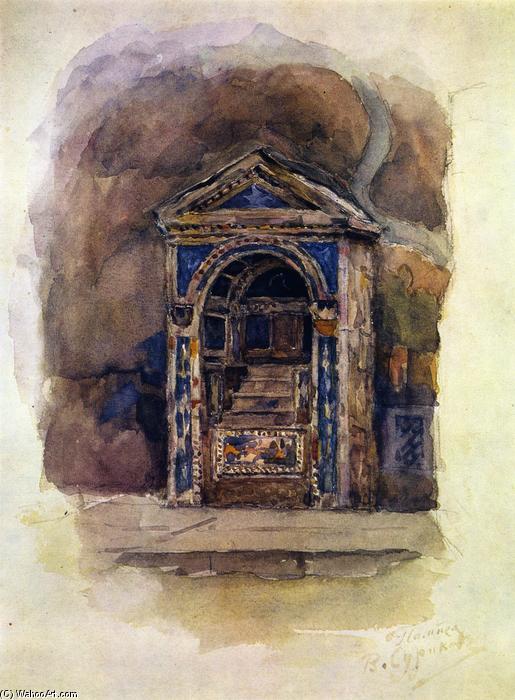
Pompeii. A Mosaic-Inlaid Fountain


 Read More
Hand Made Oil Reproduction
Hand-painted oil on canvas in your size and frame, made to order by our artists. ( Buy Print Buy Image)




P118B $10

P118H $10

P118W $10

P438Z $10

P508JH $12

P508YH $12

P805H $10

P805Z $10

P919BZ $10

P919G $10

P919XJ $10

P959ZH $10

P968JZ $12

W106C $8

W218G $10

W218JH $8

W218Y $10

W307PJ $10

W316G $10

W316PJ $8

W316Y $10

W398PJ $8

W4111J $10

W500HY $15

W500JH $15

W692G $12

W849H $8

W940BG $15

W953PJ $8




Pick from our preset sizes that match the artwork's original proportions.

You may enter your own dimensions to fit a specific frame or space. If your selected size does not match the original image's proportions, we will either crop the artwork or extend the painting with additional hand-painted elements. A digital mockup will be sent for your approval before production begins.
Please note that the on-screen preview does not reflect the actual cropping or extension. Only the mockup will accurately show the final composition.
While custom sizes are available, we recommend selecting a dimension from the predefined list to preserve the original proportions.
After order, ArtsDot.com team will email client for instructions and provide a mockup preview
Worldwide Delivery () in 3/4 weeks instead of standard 5 weeks. (26 August). No compromise on quality.

Free Worldwide Express Shipping

High-Quality Linen Canvas

Full Shipping Insurance

Customs Tax Refund Guarantee

True Color Matching Guarantee

60-Day Return Policy (Defects Only)

100% Money-Back Guarantee

Bulk Discount Offer
 Glass option is only available in size under 110 CM

Pompeii. A Mosaic-Inlaid Fountain
Reproduction Medium
Reproduction Size
-


Total Price
$ 263
Artwork Description
A Glimpse into Roman Life: Surikov’s ‘Pompeii. A Mosaic-Inlaid Fountain’
Vasili Ivanovich Surikov's 1884 painting, *Pompeii. A Mosaic-Inlaid Fountain*, offers a captivating window into the architectural grandeur and everyday life of ancient Rome. While seemingly a straightforward depiction of Roman structures, this work reveals Surikov’s mastery of Realism and his subtle incorporation of symbolic elements within a historically informed scene.Subject & Composition
The painting centers on an impressive architectural complex – likely a public bath or forum structure – featuring a prominent archway, staircases leading to upper levels, and a smaller adjacent building. The focal point is implied to be the mosaic-inlaid fountain referenced in the title, though its precise location isn’t overtly emphasized; instead, Surikov directs our attention to the overall spatial arrangement and the interplay of light and shadow across the stone surfaces. A solitary figure positioned near the right edge adds a sense of scale and invites viewers to share in their contemplative observation of this ancient space. The blue roof suggests an adaptation or reconstruction – perhaps reflecting 19th-century interpretations of Roman architecture, rather than strict archaeological accuracy.Style & Technique
Surikov’s style is firmly rooted in Realism, characterized by meticulous attention to detail and a commitment to accurately representing the physical world. However, his work transcends mere imitation; he infuses his scenes with a quiet dignity and psychological depth. The painting demonstrates Surikov's skill in rendering architectural forms with precision, capturing the texture of stone and the effects of light filtering through the archways. His brushwork is confident yet restrained, creating a sense of solidity and permanence.Historical Context & Influences
Painted in 1884, this work reflects a growing fascination with classical antiquity during the 19th century, fueled by archaeological discoveries – including those at Pompeii itself. Surikov’s training at the Imperial Academy of Arts exposed him to both Western European artistic traditions and the burgeoning Russian Realist movement, exemplified by artists like Ilya Repin and Isaac Levitan. While not directly depicting a specific historical event (as many of his larger canvases do), *Pompeii. A Mosaic-Inlaid Fountain* demonstrates Surikov’s interest in portraying scenes from the past with authenticity and emotional resonance.Symbolism & Emotional Impact
Though subtle, the painting evokes a sense of both awe and melancholy. The grandeur of the Roman architecture speaks to the power and sophistication of a lost civilization. The solitary figure suggests contemplation on the passage of time and the impermanence of human achievement. Surikov’s use of light and shadow creates a mood of quiet introspection, inviting viewers to reflect on the enduring legacy of the past. It's not merely a depiction *of* Pompeii, but an evocation *of* its spirit.For Collectors & Designers
This painting is ideal for those seeking artwork that combines historical interest with aesthetic beauty. Its muted color palette and balanced composition make it versatile enough to complement a variety of interior design styles – from traditional to contemporary. A high-quality reproduction would serve as a striking focal point in a study, library, or living room, adding a touch of classical elegance and intellectual depth to any space. It’s a piece that invites conversation and encourages contemplation, making it a valuable addition to any art collection.Related Artworks
Artist Biography
The Soul of a Nation Captured in Paint
Vasily Ivanovich Surikov stands as one of the most celebrated figures in Russian art history, a painter whose canvases capture not merely visual representations but profound explorations of Russia’s soul. Born in 1848 in Krasnoyarsk, Siberia, Surikov's early life was marked by hardship and familial struggles—a formative experience that instilled within him an unwavering dedication to portraying the realities of rural Russian society with unflutched honesty. This commitment would become the cornerstone of his artistic vision, propelling him to create monumental works that continue to resonate powerfully today.
His artistic sensibilities were nurtured by a fascination with folklore and peasant life, themes deeply prevalent in Siberian culture. His father, a teacher, instilled in him a love for literature and history, shaping his intellectual curiosity and providing the foundation for his meticulous research into historical subjects. Recognizing Surikov’s talent, his father secured him admission to the St Petersburg Academy of Arts, where he honed his skills under the guidance of masters like Konstantin Dmitrievich Makovsky and Ivan Alekseyevich Kramskoy. These influential figures championed Realism as a dominant artistic style, encouraging Surikov to depict everyday life with psychological depth and emotional resonance.
A Master of Historical Epic and Psychological Depth
Surikov’s oeuvre is characterized by an extraordinary ability to convey atmosphere and emotion through masterful technique. He employed a distinctive approach to painting, meticulously studying the nuances of light and color to achieve unparalleled realism. His brushstrokes were deliberate and expressive, capturing not just what was seen but also what was felt—a hallmark of the Realist movement’s ambition to depict human experience truthfully. His canvases are renowned for their dramatic compositions and evocative lighting, transporting viewers directly into the heart of Russia's most turbulent eras.
The artist gained wide recognition for his large-scale paintings devoted to pivotal episodes from Russian history. These works were distinguished by their immense scale, rigorous attention to historical detail, and a profound psychological expressiveness that breathed life into historical figures. Some of his most enduring contributions to the art world include:
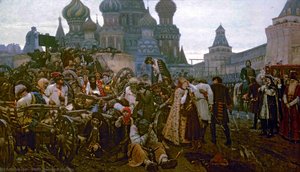
- The Morning of the Streltsy Execution: A hauntingly powerful depiction of political upheaval and human tragedy.
- Boyarynya Morozova: A monumental exploration of religious conviction and social conflict.
- Suvorov Crossing the Alps: A breathtaking scene of military leadership and epic endurance.
- Yermak’s Conquest of Siberia: A tribute to the expansion and rugged spirit of the Russian frontier.
Legacy and Historical Significance
As a prominent member of the Peredvizhniki (The Wanderers) movement and the Union of Russian Artists, Surikov played a vital role in shifting the focus of Russian art toward national identity and social truth. His work bridged the gap between academic tradition and a new, visceral realism that sought to document the struggles and triumphs of the common people alongside the grand narratives of the Tsars. Through his lens, history was not merely a collection of dates, but a living, breathing drama of human will.
Today, the masterpieces of Vasily Surikov are preserved in the world's most prestigious collections, including the State Tretyakov Gallery in Moscow and the State Russian Museum in Saint Petersburg. His influence persists as a testament to his ability to transform historical research into emotional truth, ensuring that his vision of the Russian spirit remains an indelible part of the global artistic heritage.
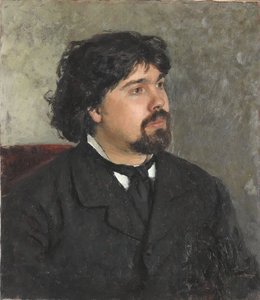
vasily ivanovich surikov
1848 - 1916 , Russia
Quick Facts
- Artistic Movement Or Style: Realism
- Date Of Birth: January 24, 1848
- Date Of Death: March 19, 1916
- Full Name: Vasily Ivanovich Surikov
- Nationality: Russian
- Notable Artworks:
- Third Ecumenical Council of Ephesus
- Old Man in a Kitchen Garden
- Place Of Birth: Krasnoyarsk, Russia
Related Articles

Vasily Surikov: Historical Epic & Psychological Realism in 19th-Century Russian Painting
Explore the powerful historical paintings of Vasily Surikov, a leading figure of Russian Realism. Discover his dramatic compositions, psychological depth & lasting influence on 19th-century art. Learn about collecting Surikov's masterpieces.
Vladimir Makovsky: Realism, Social Commentary & Russian Life in Late 19th-Century Painting
Explore the captivating world of Vladimir Makovsky, a leading Russian realist painter. Discover his insightful depictions of 19th-century life, social commentary & legacy with ArtsDot.
Romantic Realism's Finest: 10 Masterpieces for Your Home | ArtsDot
Explore 10 defining masterpieces of Romantic Realism! Discover Courbet, Millet & Daumier's powerful paintings—capturing emotion and social realities. Find museum-quality reproductions for your home at ArtsDot.com.
The Evocative Embrace of Reality: Exploring Romantic Realism in 19th-Century Painting
Explore the captivating world of Romantic Realism! Discover key artists like Courbet & Millet, masterpieces, and the social context behind this influential art movement. Expert insights for collectors at ArtsDot.

The Poetic Truth of Observation: Exploring 19th-Century Realism in Painting
Explore the captivating world of 19th-century Realism! Discover key artists like Courbet & Millet, masterpieces, and the powerful social commentary behind this influential art movement. Expert insights at ArtsDot.