 Preview
 Send
Send Share
Share
 Details

 Download
 Similars
 X-Ray
X-Ray Diaporama
Third Ecumenical Council of Ephesus


 Read More
Hand Made Oil Reproduction
Hand-painted oil on canvas in your size and frame, made to order by our artists. ( Buy Print Buy Image)




P118B $10

P118H $10

P118W $10

P438Z $10

P508JH $12

P508YH $12

P805H $10

P805Z $10

P919BZ $10

P919G $10

P919XJ $10

P959ZH $10

P968JZ $12

W106C $8

W218G $10

W218JH $8

W218Y $10

W307PJ $10

W316G $10

W316PJ $8

W316Y $10

W398PJ $8

W4111J $10

W500HY $15

W500JH $15

W692G $12

W849H $8

W940BG $15

W953PJ $8




Pick from our preset sizes that match the artwork's original proportions.

You may enter your own dimensions to fit a specific frame or space. If your selected size does not match the original image's proportions, we will either crop the artwork or extend the painting with additional hand-painted elements. A digital mockup will be sent for your approval before production begins.
Please note that the on-screen preview does not reflect the actual cropping or extension. Only the mockup will accurately show the final composition.
While custom sizes are available, we recommend selecting a dimension from the predefined list to preserve the original proportions.
After order, ArtsDot.com team will email client for instructions and provide a mockup preview
Worldwide Delivery () in 3/4 weeks instead of standard 5 weeks. (17 August). No compromise on quality.

Free Worldwide Express Shipping

High-Quality Linen Canvas

Full Shipping Insurance

Customs Tax Refund Guarantee

True Color Matching Guarantee

60-Day Return Policy (Defects Only)

100% Money-Back Guarantee

Bulk Discount Offer
 Glass option is only available in size under 110 CM

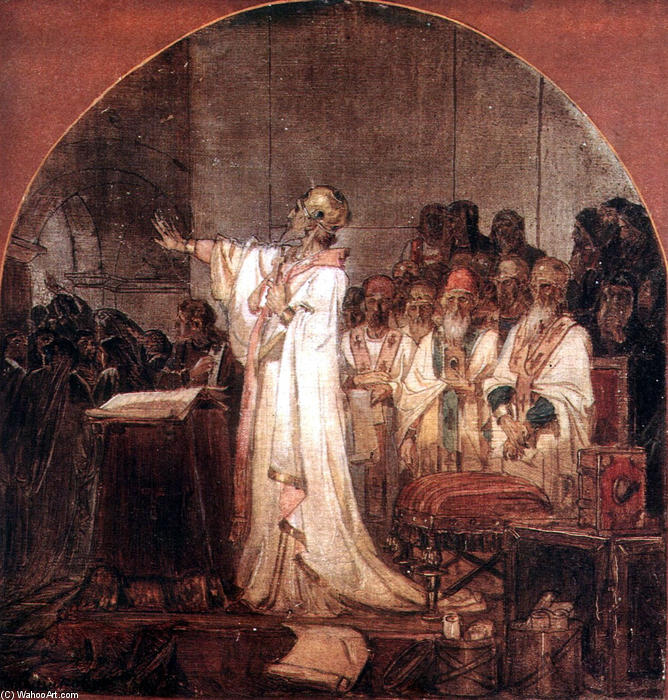
Third Ecumenical Council of Ephesus
Reproduction Medium
Reproduction Size
-


Total Price
$ 263
Artwork Description
A Moment of Theological Weight: Examining Surikov’s “Third Ecumenical Council of Ephesus”
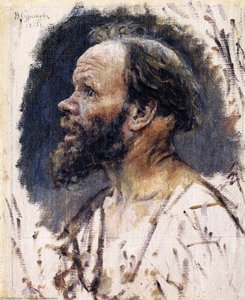
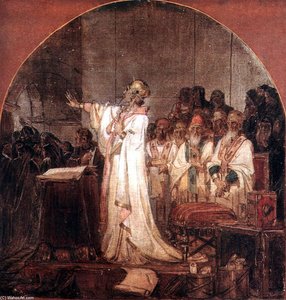
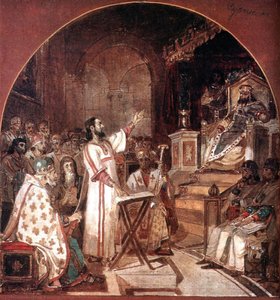
Vasili Ivanovich Surikov's 1876 painting, *Third Ecumenical Council of Ephesus*, is a masterful depiction of a pivotal moment in early Christian history. More than just a historical record, it’s a compelling study of power, faith, and the complexities of theological debate. The artwork transports viewers to 431 AD, to the council convened to address the Nestorian controversy – specifically, differing views on the nature of Christ and Mary's role in salvation.Historical Context & Subject Matter
The Council of Ephesus was a landmark event, shaping Christian doctrine for centuries. Surikov doesn’t present a simple narrative of victory or defeat; instead, he focuses on the *process* of deliberation. The painting captures the intensity and gravity of the discussions as bishops and theologians grapple with profound theological questions. It's important to note that this wasn’t merely an academic exercise – these debates had significant political and social ramifications within the Byzantine Empire. Surikov expertly conveys this weight, making it clear that the fate of religious belief hangs in the balance.Style & Technique: Realism Rooted in Drama
Surikov is renowned for his realistic approach to historical painting, and *Third Ecumenical Council of Ephesus* exemplifies this skill. He meticulously researched costumes and architectural details to create an authentic visual environment. However, Surikov isn’t simply a documentarian; he infuses the scene with dramatic flair reminiscent of Romanticism. The use of chiaroscuro – strong contrasts between light and shadow – focuses attention on the central speaker, highlighting his gestures and facial expressions. The visible brushwork adds texture and energy to the canvas, preventing it from feeling static or overly polished.Composition & Symbolism
The composition is carefully constructed around a pyramidal structure, drawing the eye upwards towards the dominant figure delivering his address. This arrangement reinforces his authority and importance within the scene. The receding figures create depth and suggest the vastness of the assembly. While not overtly symbolic, the painting’s muted color palette – dominated by browns, reds, and golds – evokes a sense of solemnity and antiquity. The light itself can be interpreted as representing divine illumination or the power of reasoned argument. The varied expressions on the faces of the listeners suggest a range of opinions and reactions, hinting at the passionate disagreements that characterized the council.Emotional Impact & Interpretation
*Third Ecumenical Council of Ephesus* is not a painting that offers easy answers. It’s a work that invites contemplation and encourages viewers to consider the complexities of faith, power, and intellectual discourse. The overall mood is one of serious reverence, but also of underlying tension. Surikov masterfully captures the human drama inherent in these historical events, reminding us that even theological debates are ultimately shaped by individual passions and beliefs.For Collectors & Designers
This painting’s rich detail and dramatic composition make it a striking focal point for any space. A high-quality reproduction would be particularly well-suited to libraries, studies, or dining rooms – spaces that encourage conversation and intellectual engagement. The muted color palette complements a variety of interior design styles, from traditional to contemporary. Its historical significance also adds a layer of cultural depth and sophistication to any collection.Related Artworks
Artist Biography
The Soul of a Nation Captured in Paint
Vasily Ivanovich Surikov stands as one of the most celebrated figures in Russian art history, a painter whose canvases capture not merely visual representations but profound explorations of Russia’s soul. Born in 1848 in Krasnoyarsk, Siberia, Surikov's early life was marked by hardship and familial struggles—a formative experience that instilled within him an unwavering dedication to portraying the realities of rural Russian society with unflutched honesty. This commitment would become the cornerstone of his artistic vision, propelling him to create monumental works that continue to resonate powerfully today.
His artistic sensibilities were nurtured by a fascination with folklore and peasant life, themes deeply prevalent in Siberian culture. His father, a teacher, instilled in him a love for literature and history, shaping his intellectual curiosity and providing the foundation for his meticulous research into historical subjects. Recognizing Surikov’s talent, his father secured him admission to the St Petersburg Academy of Arts, where he honed his skills under the guidance of masters like Konstantin Dmitrievich Makovsky and Ivan Alekseyevich Kramskoy. These influential figures championed Realism as a dominant artistic style, encouraging Surikov to depict everyday life with psychological depth and emotional resonance.
A Master of Historical Epic and Psychological Depth
Surikov’s oeuvre is characterized by an extraordinary ability to convey atmosphere and emotion through masterful technique. He employed a distinctive approach to painting, meticulously studying the nuances of light and color to achieve unparalleled realism. His brushstrokes were deliberate and expressive, capturing not just what was seen but also what was felt—a hallmark of the Realist movement’s ambition to depict human experience truthfully. His canvases are renowned for their dramatic compositions and evocative lighting, transporting viewers directly into the heart of Russia's most turbulent eras.
The artist gained wide recognition for his large-scale paintings devoted to pivotal episodes from Russian history. These works were distinguished by their immense scale, rigorous attention to historical detail, and a profound psychological expressiveness that breathed life into historical figures. Some of his most enduring contributions to the art world include:
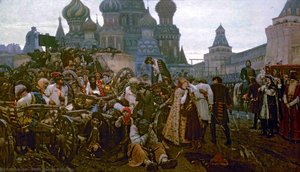
- The Morning of the Streltsy Execution: A hauntingly powerful depiction of political upheaval and human tragedy.
- Boyarynya Morozova: A monumental exploration of religious conviction and social conflict.
- Suvorov Crossing the Alps: A breathtaking scene of military leadership and epic endurance.
- Yermak’s Conquest of Siberia: A tribute to the expansion and rugged spirit of the Russian frontier.
Legacy and Historical Significance
As a prominent member of the Peredvizhniki (The Wanderers) movement and the Union of Russian Artists, Surikov played a vital role in shifting the focus of Russian art toward national identity and social truth. His work bridged the gap between academic tradition and a new, visceral realism that sought to document the struggles and triumphs of the common people alongside the grand narratives of the Tsars. Through his lens, history was not merely a collection of dates, but a living, breathing drama of human will.
Today, the masterpieces of Vasily Surikov are preserved in the world's most prestigious collections, including the State Tretyakov Gallery in Moscow and the State Russian Museum in Saint Petersburg. His influence persists as a testament to his ability to transform historical research into emotional truth, ensuring that his vision of the Russian spirit remains an indelible part of the global artistic heritage.
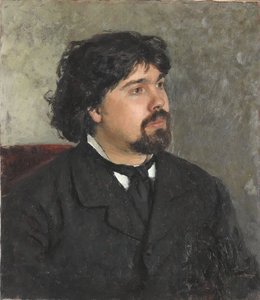
vasily ivanovich surikov
1848 - 1916 , Russia
Quick Facts
- Artistic Movement Or Style: Realism
- Date Of Birth: January 24, 1848
- Date Of Death: March 19, 1916
- Full Name: Vasily Ivanovich Surikov
- Nationality: Russian
- Notable Artworks:
- Third Ecumenical Council of Ephesus
- Old Man in a Kitchen Garden
- Place Of Birth: Krasnoyarsk, Russia
Related Articles
Vasily Surikov: Historical Epic & Psychological Realism in 19th-Century Russian Painting
Explore the powerful historical paintings of Vasily Surikov, a leading figure of Russian Realism. Discover his dramatic compositions, psychological depth & lasting influence on 19th-century art. Learn about collecting Surikov's masterpieces.
Vladimir Makovsky: Realism, Social Commentary & Russian Life in Late 19th-Century Painting
Explore the captivating world of Vladimir Makovsky, a leading Russian realist painter. Discover his insightful depictions of 19th-century life, social commentary & legacy with ArtsDot.
Vasily Vereshchagin: Realism, War & Subversion in 19th-Century Russian Painting
Explore the powerful realism of Vasily Vereshchagin's war paintings & Central Asian scenes. Discover how this Russian master challenged artistic conventions and offered a brutal, honest depiction of 19th-century conflict. Learn about his legacy for discerning collectors.
The Evocative Embrace of Reality: Exploring Romantic Realism in 19th-Century Painting
Explore the captivating world of Romantic Realism! Discover key artists like Courbet & Millet, masterpieces, and the social context behind this influential art movement. Expert insights for collectors at ArtsDot.
Romantic Realism's Finest: 10 Masterpieces for Your Home | ArtsDot
Explore 10 defining masterpieces of Romantic Realism! Discover Courbet, Millet & Daumier's powerful paintings—capturing emotion and social realities. Find museum-quality reproductions for your home at ArtsDot.com.