

 Preview
 Send
Send Share
Share
 Details

 Download
 Similars
 X-Ray
X-Ray Diaporama
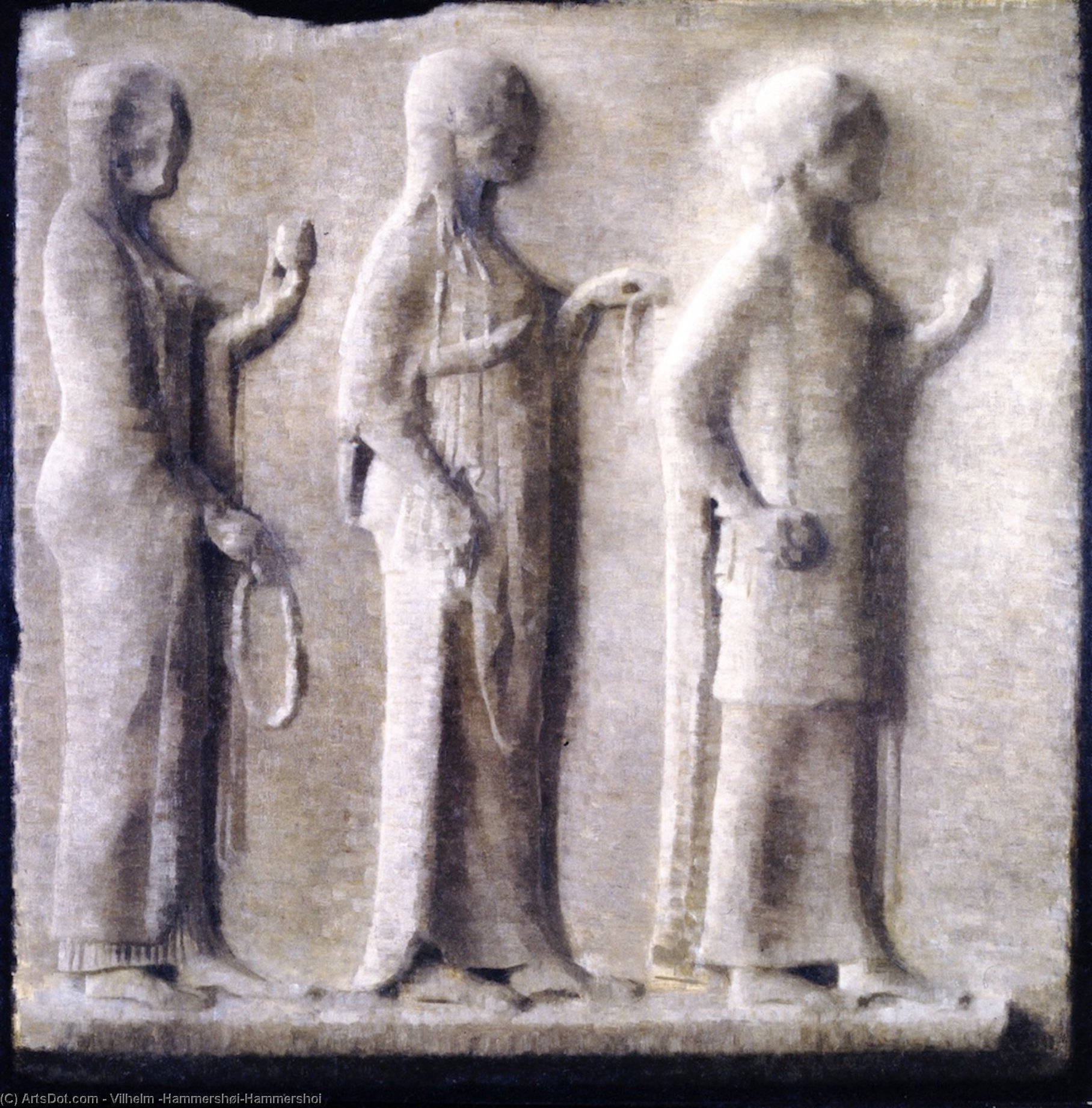
A Greek Relief in the Louvre
 Acrylic On Canvas
- WallArt
- Post-Impressionism
 1891
1891 96.0 x 95.0 cm
 Ny Carlsberg Glyptotek
 Read More
Purchase a high-resolution, enhanced digital image, far superior to the online preview.
Each file is meticulously prepared by our in-house specialists using advanced tools and expert manual retouching. We ensure every image has exceptional clarity, precise color accuracy, and fine detail.
The final file is delivered via email within 72 hours, optimized for immediate use in professional, editorial, and print environments. This is the same quality trusted by top-tier design studios, publishers, and galleries.
Digital Image
Download a high-resolution file for personal display, printing, and creative projects. ( Buy Print Buy Hand Made Painting)
Included in Every Digital Image Order
Expert Digital Delivery, Guaranteed
When you choose ArtsDot.com, you're not just getting an image - you're receiving a professionally enhanced digital artwork, crafted with precision and backed by a satisfaction guarantee. Here's everything that comes with your order, automatically:

Fast Email Delivery
Your high-resolution digital image file will be emailed to you within 72 hours of ordering - ready for immediate use.

AI-Enhanced Digital File
Your artwork is professionally optimized using advanced AI tools and manual editing, ensuring maximum detail, clarity, and color accuracy.

Free Lifetime Re-Delivery
Accidentally deleted or lost your file? No worries - we'll resend it to you anytime, free of charge.

No Import Fees - Ever
Enjoy your artwork instantly with zero customs, duties, or delivery fees - digital downloads are always tax-free.

Color Accuracy Guarantee
We ensure your digital image reflects the original colors as closely as possible using professional tools and color management.

60-Day Satisfaction Guarantee
If you're not satisfied with your digital image, we'll revise it or refund 100% within 60 days - no questions asked.

100% Money-Back Guarantee
Not satisfied? Get a full refund within 60 days of receiving your digital file - no questions asked.

Bulk Order Discounts
Buy 3 images, save 10% - Buy 5, save 15% - Buy 10+, save 20%. Great for creative projects, galleries, and agencies.
Collectible Description
A Meditation on Antiquity: Exploring Vilhelm Hammershøi’s “A Greek Relief in the Louvre”
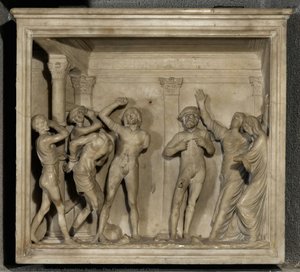
The painting "A Greek Relief in the Louvre" by Vilhelm Hammershøi stands as a testament to the enduring power of artistic contemplation and the subtle beauty found within minimalist compositions. Completed in 1891, this deceptively simple oil on canvas transcends mere representation; it invites viewers into a realm of quiet introspection, mirroring the spirit of the Post-Impressionist movement while simultaneously grounding itself firmly in classical ideals. The scene depicts three women positioned before a wall – an arrangement deliberately reminiscent of ancient Greek relief sculptures, specifically those adorning temples and tombs. Hammershøi’s masterful technique eschews dramatic gestures or vibrant hues, opting instead for a muted palette dominated by shades of beige, cream, and grey. These colors aren't merely decorative; they embody the stillness and solemnity characteristic of monastic spaces and contribute to an atmosphere that feels both timeless and profoundly contemplative. The subtle tonal variations achieved through thin washes of paint create an illusion of texture – hinting at weathered stone or plaster – furthering the impression of antiquity and reinforcing the artist’s fascination with architectural grandeur. Hammerøi's stylistic approach aligns closely with Post-Impressionism, prioritizing mood and atmosphere over precise detail. Influenced by artists like Cézanne and Gauguin, Hammershøi sought to capture not just what he saw but how it *felt*. The deliberate lack of sharp outlines and the soft curves defining the drapery of the women’s garments emphasize fluidity and grace, subtly elevating the figures beyond mere physicality. The inclusion of two handbags – a detail that adds a touch of realism – serves as an unexpected counterpoint to the overarching serenity, prompting reflection on the intersection between tradition and everyday life. The painting's symbolic resonance extends beyond its visual references to Greek sculpture. It speaks to themes of solitude, contemplation, and the veneration of beauty—values central to Hammershøi’s artistic philosophy. The Louvre itself – a repository of European art history – serves as an implicit frame for this scene, suggesting that Hammershøi wished to engage with the legacy of Western civilization while simultaneously distilling it into its purest form. Ultimately, “A Greek Relief in the Louvre” is more than just a depiction; it’s an invitation to pause and appreciate the profound beauty residing within simplicity—a timeless masterpiece deserving of careful observation and thoughtful consideration.- Artist: vilhelm (hammershøi)hammershoi
- Born Year: 1864
- Death Year: 1916
- Birth City: Copenhagen
- Birth Country: Denmark
Related Artworks


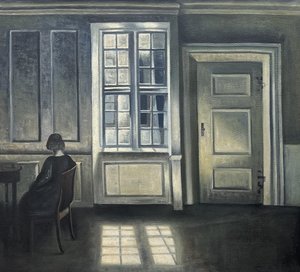
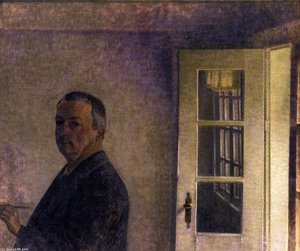
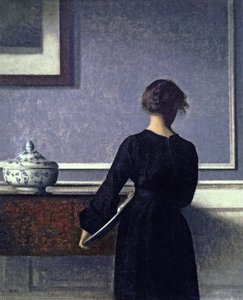
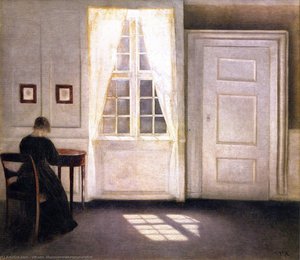
Artist Biography
The Enigmatic Stillness of Vilhelm Hammershøi
To stand before a painting by Vilhelm Hammershøi is to step across a threshold into a realm suspended between memory and dream. His work possesses an almost palpable silence, a quietude that seems to absorb the noise of the modern world. Born in Copenhagen in 1864, this Danish master developed a visual language so distinct, so profoundly atmospheric, that it continues to captivate collectors and critics alike today. Hammershøi’s canvases are not merely depictions of rooms or figures; they are meditations on absence, light, and the delicate passage of time.
His early life was rooted in the cultural milieu of late 19th-century Copenhagen, a period ripe with artistic ferment. While he navigated the currents of academic art, his true calling lay in capturing moments of profound introspection. His dedication to interior spaces became legendary, transforming domestic settings into grand stages for psychological drama. The muted tones—the soft grays, the pale creams, the whisper of dusty ochre—are hallmarks that define his unique visual signature.
Mastery of Light and Atmosphere
The technical brilliance underpinning Hammershøi’s seemingly simple scenes is nothing short of masterful. He possessed an unparalleled ability to render light not as a mere illumination, but as a tangible, atmospheric element itself. In his depictions of empty hallways or sparsely furnished drawing rooms, the quality of the light seems to emanate from within the paint, suggesting unseen sources and untold narratives. This preoccupation with atmosphere elevated his work beyond simple genre painting; it became an exploration of mood.
His compositions often feature receding perspectives, drawing the viewer deep into the painted space, only to have that depth ultimately dissolve into a soft, ambiguous haze. Whether portraying solitary figures—often veiled or seen from the back—or simply empty architectural volumes, the sense of enclosure and quiet contemplation is overwhelming. It is in this careful management of negative space that his genius resides; the emptiness itself becomes the most eloquent subject.
Symbolism and the Inner Landscape
Hammershøi’s art has always been deeply intertwined with Symbolist currents, even if he never strictly adhered to the movement's dogma. His paintings invite viewers into a space of ambiguity. The figures, when present, often seem detached from their surroundings or lost in thought, suggesting an internal life far richer than what the canvas portrays. There is a pervasive sense of melancholy beauty—a sublime yearning that speaks to universal human experiences: solitude, memory, and the passage of time.
Some scholars have interpreted his work as a visual diary of his own emotional landscape, a retreat into the controlled environment of art when the external world proved too loud or complex. The repetition of motifs—the curtain, the empty chair, the distant window view—lends his oeuvre a ritualistic quality, suggesting that these quiet moments were necessary anchors against the flux of existence.
Legacy and Enduring Influence
Though he passed away relatively young in 1916, Vilhelm Hammershøi’s influence proved remarkably enduring. His commitment to understatement and tonal subtlety provided a crucial counterpoint to the bolder palettes emerging from other contemporary movements. His work resonated deeply with modern sensibilities that valued introspection over overt narrative.
Today, his paintings are sought after for their ability to transform any space they inhabit. They do not shout; they whisper profound truths about beauty found in restraint. To appreciate Hammershøi is to accept the poetry of the unsaid, to find grandeur in the muted tones, and to allow oneself to become momentarily lost within the exquisite, enveloping silence of his painted worlds.
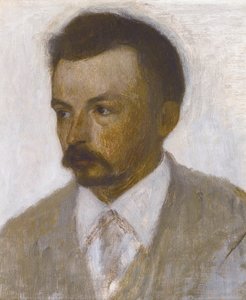
vilhelm (hammershøi)hammershoi
1864 - 1916 , Denmark
Quick Facts
- Artistic Movement Or Style: Symbolism art
- Date Of Birth: 1864
- Date Of Death: 1916
- Full Name: Vilhelm Hammershøi
- Nationality: Danish
- Place Of Birth: Copenhagen, Denmark

