 Preview
 Send
Send Share
Share
 Details

 Download
 Similars
 X-Ray
X-Ray Diaporama
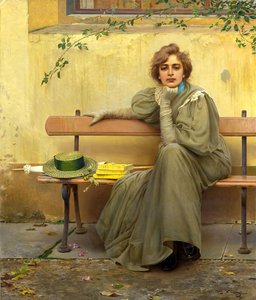
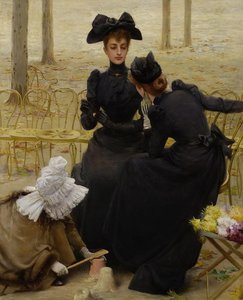
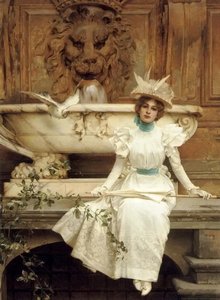
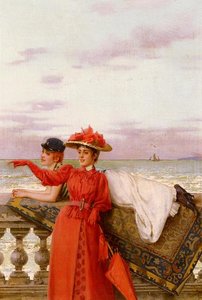
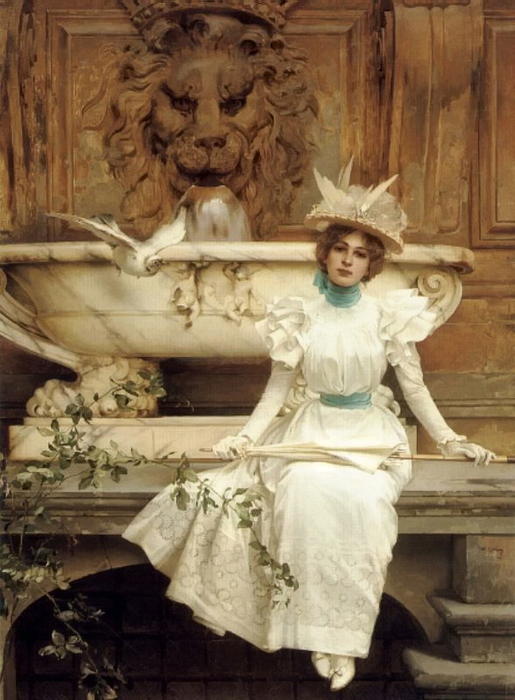
Waiting by the Fountain
 Read More
Hand Made Oil Reproduction
Hand-painted oil on canvas in your size and frame, made to order by our artists. ( Buy Print Buy Image)




































Pick from our preset sizes that match the artwork's original proportions.

You may enter your own dimensions to fit a specific frame or space. If your selected size does not match the original image's proportions, we will either crop the artwork or extend the painting with additional hand-painted elements. A digital mockup will be sent for your approval before production begins.
Please note that the on-screen preview does not reflect the actual cropping or extension. Only the mockup will accurately show the final composition.
While custom sizes are available, we recommend selecting a dimension from the predefined list to preserve the original proportions.
After order, ArtsDot.com team will email client for instructions and provide a mockup preview
Worldwide Delivery () in 3/4 weeks instead of standard 5 weeks. (17 August). No compromise on quality.

Free Worldwide Express Shipping

High-Quality Linen Canvas

Full Shipping Insurance

Customs Tax Refund Guarantee

True Color Matching Guarantee

60-Day Return Policy (Defects Only)

100% Money-Back Guarantee

Bulk Discount Offer
 Glass option is only available in size under 110 CM

Waiting by the Fountain
Reproduction Medium
Reproduction Size
-


Total Price
$ 263
Related Artworks
Artist Biography
Georges Seurat: A Pioneer of Light and Color
Georges Seurat, born in Paris on December 2nd, 1859, was a figure whose brief but brilliant career irrevocably altered the course of modern art. He wasn’t merely a painter; he was an investigator, meticulously dissecting the very nature of light and color to achieve a revolutionary visual language. His life, tragically cut short at the age of 31 in March 1891, remains shrouded in some mystery, yet his legacy as the founder of Neo-Impressionism – and indeed, Pointillism – endures as one of artistic innovation’s most significant achievements. His early influences were diverse, ranging from the classical ideals championed by Ingres to the vibrant scenes of Delacroix, a testament to his ambition to synthesize tradition with modern sensibilities. However, it was his encounter with scientific theories concerning color perception, particularly those articulated by Chevreul and Charles Blanc, that truly ignited his artistic vision. These ideas, combined with his own meticulous observations, led him to develop the groundbreaking technique of Pointillism – a method of applying tiny dots of pure color to create an image, allowing the viewer’s eye to blend them optically.Early Life and Artistic Training
Seurat's upbringing was relatively conventional for a Parisian bourgeois family. His father, Antoine-Chrisostôme Seurat, was a property owner with roots in Champagne, while his mother, Ernestine Faivre, hailed from Paris. Growing up amidst the bustle of the city, he developed an early fascination with drawing and sketching, initially under the tutelage of sculptor Justin Lequien. This foundational training provided him with essential skills but it was his discovery of Humbert de Superville’s *Essai sur les signes inconditionnels de l'art* – a treatise exploring the fundamental principles of art – that truly shaped his artistic philosophy. This book, advocating for an objective and scientific approach to painting, profoundly influenced Seurat’s belief that art should be based on observable phenomena rather than subjective emotion. He formally enrolled at the École des Beaux-Arts in 1878, studying under Henri Lehmann, a disciple of Ingres, further honing his skills in portraiture and classical composition. However, it was during this period that he began to experiment with conté crayon, developing a unique method for creating drawings on paper with a rough surface – a technique he would later adapt to his paintings.The Development of Pointillism
Seurat’s artistic journey wasn't simply about mimicking Impressionist techniques; it was a deliberate departure, driven by a desire to capture the *essence* of visual perception. He meticulously studied color theory, analyzing how colors interact and influence one another. Inspired by scientific research into optics and color mixing, he developed Pointillism – a revolutionary technique that involved applying small, distinct dots of pure color to a canvas, rather than blending them on the palette. This method aimed to create an optical mixture in the viewer’s eye, resulting in a shimmering, vibrant effect. His early works, such as *Bathers at Asnières* (1883-84), demonstrate this technique with remarkable precision and control. The painting depicts a group of bathers enjoying a summer afternoon by the Seine, rendered through an intricate network of tiny dots – each color carefully chosen to create a harmonious and luminous whole. This approach moved beyond mere representation; it was an attempt to capture the *impression* of light and color as perceived by the eye.Major Works and Artistic Style
Seurat’s most celebrated work, *A Sunday Afternoon on the Island of La Grande Jatte – 1884*, stands as a monumental achievement in Neo-Impressionism. Completed between 1884 and 1886, this vast canvas captures a scene of Parisian leisure on an island in the Seine, showcasing Seurat’s mastery of Pointillism and his ability to create a sense of depth and atmosphere through color and texture. The painting's meticulous detail and vibrant colors immediately captivated audiences and established Seurat as a leading figure in the avant-garde art world. Other significant works include *Un Chien Emarqué* (1886-88), a portrait of a dog, and *Port्रेट de Mademoiselle X* (1885). His later paintings, such as *Les Poseuses*, reflected a growing interest in stylization and influenced by sources like caricatures and popular posters. Despite his short career, Seurat’s influence on subsequent generations of artists is undeniable.Legacy and Historical Significance
Georges Seurat's untimely death at the age of 31 cut short a brilliant artistic career, but his innovative techniques and groundbreaking approach to painting left an indelible mark on the art world. His development of Pointillism challenged traditional notions of color mixing and representation, paving the way for new approaches to visual expression. His work profoundly influenced artists such as Vincent van Gogh, who adopted aspects of Seurat’s technique in his own paintings, and the Italian Futurists, who embraced the dynamism and fragmentation inherent in Pointillism. Today, *A Sunday Afternoon on the Island of La Grande Jatte* remains one of the most iconic images in modern art, a testament to Seurat's genius and a symbol of the transformative power of scientific inquiry applied to artistic creation. His legacy continues to inspire artists and scholars alike, solidifying his place as a pivotal figure in the history of Western art.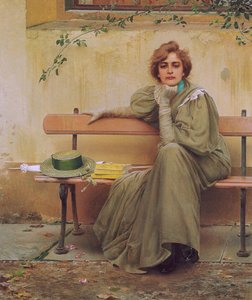
vittorio matteo corcos
1859 - 1933 , Italy
Quick Facts
- Artistic Movement Or Style:
- Neo-Impressionism
- Pointillism
- Artists Or Movements Influenced By This Artist:
- Van Gogh
- Futurists
- Artists Who Influenced This Artist:
- J.-A. D. Ingres
- Delacroix
- Date Of Birth: December 2, 1859
- Date Of Death: March 29, 1891
- Full Name: Georges Seurat
- Nationality: French
- Notable Artworks:
- A Sunday on La Grande Jatte
- Bathers at Asnières
- Place Of Birth: Paris, France