 Preview
 Send
Send Share
Share
 Details

 Download
 Similars
 X-Ray
X-Ray Diaporama
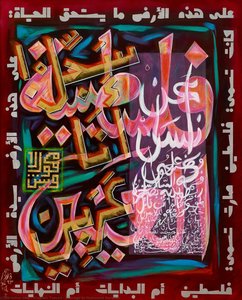
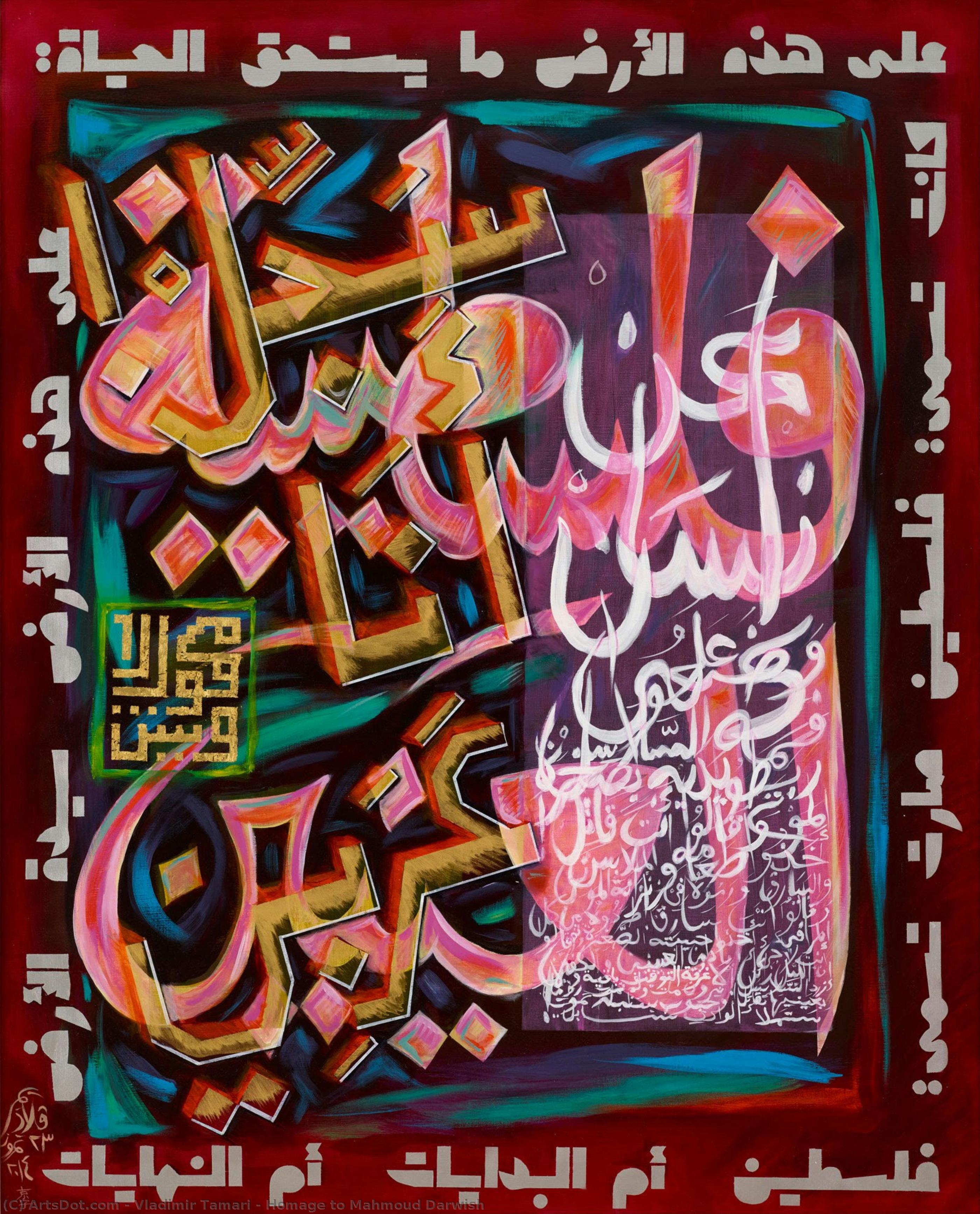
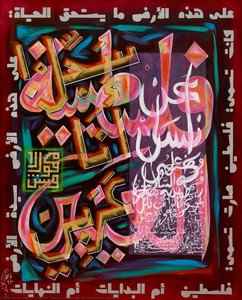
Homage to Mahmoud Darwish
 2014
2014 162.0 x 129.0 cm
 The Ramzi and Saeda Dalloul Art Foundation
 Read More
Giclée / Art Print
Museum-quality giclée or canvas print with fast production and flexible finish options. ( Buy Hand Made Painting Buy Image)




































Pick from our preset sizes that match the artwork's original proportions.

You may enter your own dimensions to fit a specific frame or space. If your selected size does not match the original image's proportions, we will either crop the artwork or extend the image with a mirrored or solid-fill edge. A digital mockup will be sent for your approval before production begins.
Please note that the on-screen preview does not reflect the actual cropping or extension. Only the mockup will accurately show the final composition.
While custom sizes are available, we recommend selecting a dimension from the predefined list to preserve the original proportions.
Worldwide Delivery () in 2 weeks instead of standard 4/5 weeks. (27 August)

Free Worldwide Express Shipping

High-Quality Linen Canvas

Full Shipping Insurance

Customs Tax Refund Guarantee

True Color Matching Guarantee

60-Day Return Policy (Defects Only)

100% Money-Back Guarantee

Bulk Discount Offer
 Glass option is only available in size under 110 CM

Homage to Mahmoud Darwish
Giclée / Art Print
Reproduction Size
-


Total Price
$ 63
Related Artworks





Artist Biography
A Renaissance Soul: The Luminous Journey of Vladimir Tamari
Born in the ancient, storied streets of Jerusalem in 1942, Vladimir Tamari was a man whose very existence seemed to bridge the gap between disparate worlds. A true modern-day Renaissance man, his life was a tapestry woven from the threads of Palestinian heritage, Middle Eastern displacement, and the disciplined precision of scientific inquiry. His early years, shaped by the spiritual echoes of the Eastern Orthodox Church and the vibrant cultural currents of Islam, provided a foundation of profound curiosity. This innate inquisitiveness led him from the American University of Brilliant to the prestigious St. Martin’s School of Art in London, creating a unique intellectual duality: he was at once a seeker of aesthetic beauty and a student of the fundamental laws governing our physical universe.
The trajectory of Tamari’s life was irrevocably altered by the historical upheavals of his homeland. The displacement of his family from Yafa during the 1948 catastrophe eventually brought him to Beirut, a city that served as both a refuge and an academic incubator. It was here, amidst the complexities of exile, that Tamari began to develop a visual language capable of expressing the profound tensions of identity and memory. His work during this period often carried the weight of the Palestinian struggle, yet it was never merely political; rather, it sought to capture the human essence within the broader movement of history.
The Convergence of Light and Physics
Perhaps the most captivating aspect of Tamari’s legacy is the seamless integration of his scientific mastery with his artistic expression. As a physicist specializing in optics and imaging, he did not merely paint light; he understood its very mechanics. This deep comprehension allowed him to pioneer works that are often described as resplendent, powerful landscapes of living light. His mastery of abstract watercolor became a vehicle for exploring the transformation of reality, most notably in his celebrated series, Metamorphoses. In these works, the boundaries between form and void dissolve, much like the particles he studied in his scientific research.
His inventive spirit was equally prolific, manifesting in patents for innovative lighting devices and systems that explored three-dimensional perspectives. To Tamari, there was no wall between the laboratory and the studio; a device designed to cancel optical diffraction was as much an act of creation as a brushstroke on canvas. This synergy reached its zenith in his ability to translate complex scientific principles into emotive, visual experiences, where color gradients and abstract smears served as symbolic indicators of connection and cosmic space.
A Life Transformed by the Orient
In 1970, a pivotal shift occurred when Tamari relocated to Japan, eventually settling in Tokyo. This move introduced a new layer of profound influence to his palette and perspective. The aesthetics of Japanese culture—its emphasis on minimalism, its reverence for nature, and its unique approach to space—deeply permeated his later works. His series The Gaze of the East stands as a testament to this period, capturing the vibrant, pulsing essence of Tokyo through a lens shaped by decades of coexistence with Japanese tradition.
Even in his most abstract moments, one can find traces of his diverse biography:
- The Palestinian Roots: The enduring memory of Jerusalem and the landscapes of his youth.
- The London Training: A sophisticated command of Western modernism and graphic design.
- The Japanese Influence: An appreciation for the subtle, the seasonal, and the atmospheric.
- The Scientific Lens: A structural understanding of light, color, and the geometry of the universe.
Beyond the canvas, Tamari’s contributions extended to typography, where he patented a unique printed Arabic letter named AlQuds in honor of his beloved Jerusalem. Whether through his musical paintings—created while listening exclusively to specific composers—or his research into the Beautiful Universe theory, Vladimir Tamari remained a lifelong explorer. He left behind a body of work that continues to inspire, reminding us that art and science are not separate disciplines, but two different ways of witnessing the same magnificent truth.
Vladimir Tamari
1942 - 2017 , Palestine
Quick Facts
- Artistic Movement Or Style: Abstract Watercolor
- Artists Or Movements Influenced By This Artist: ['Oriental Painting']
- Artists Who Influenced This Artist:
- Physics
- Saint Martin's School
- Date Of Birth: 1942
- Full Name: Vladimir Tamari
- Nationality: Palestinian
- Notable Artworks:
- Metamorphoses
- The Look of the Orient
- Place Of Birth: Jerusalem, Palestine