

 Preview
 Send
Send Share
Share
 Details

 Download
 Similars
 X-Ray
X-Ray Diaporama
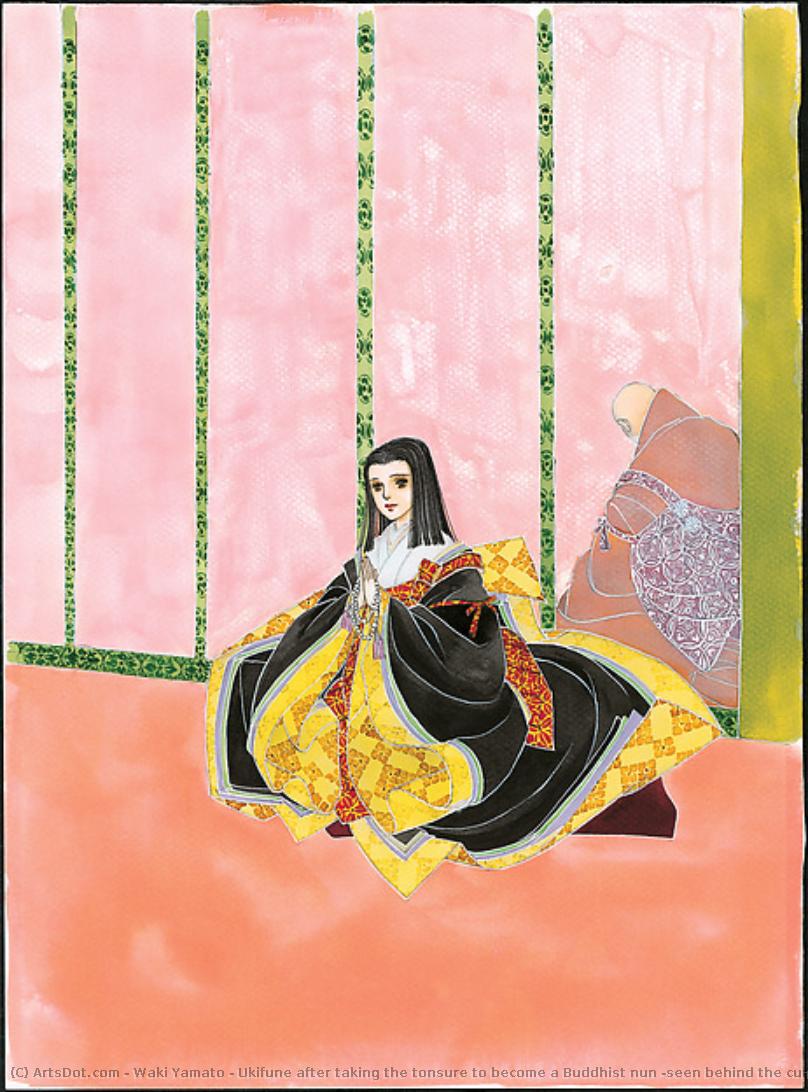
Ukifune after taking the tonsure to become a Buddhist nun (seen behind the curtain) and living in a convent outside the capital in Ono, from the manga series The Tale of Genji: Dreams at Dawn (Genji monogatari: Asaki yumemishi)
 1993
1993 37.0 x 27.0 cm
 Read More
Purchase a high-resolution, enhanced digital image, far superior to the online preview.
Each file is meticulously prepared by our in-house specialists using advanced tools and expert manual retouching. We ensure every image has exceptional clarity, precise color accuracy, and fine detail.
The final file is delivered via email within 72 hours, optimized for immediate use in professional, editorial, and print environments. This is the same quality trusted by top-tier design studios, publishers, and galleries.
Digital Image
Download a high-resolution file for personal display, printing, and creative projects. ( Buy Print Buy Hand Made Painting)
Included in Every Digital Image Order
Expert Digital Delivery, Guaranteed
When you choose ArtsDot.com, you're not just getting an image - you're receiving a professionally enhanced digital artwork, crafted with precision and backed by a satisfaction guarantee. Here's everything that comes with your order, automatically:

Fast Email Delivery
Your high-resolution digital image file will be emailed to you within 72 hours of ordering - ready for immediate use.

AI-Enhanced Digital File
Your artwork is professionally optimized using advanced AI tools and manual editing, ensuring maximum detail, clarity, and color accuracy.

Free Lifetime Re-Delivery
Accidentally deleted or lost your file? No worries - we'll resend it to you anytime, free of charge.

No Import Fees - Ever
Enjoy your artwork instantly with zero customs, duties, or delivery fees - digital downloads are always tax-free.

Color Accuracy Guarantee
We ensure your digital image reflects the original colors as closely as possible using professional tools and color management.

60-Day Satisfaction Guarantee
If you're not satisfied with your digital image, we'll revise it or refund 100% within 60 days - no questions asked.

100% Money-Back Guarantee
Not satisfied? Get a full refund within 60 days of receiving your digital file - no questions asked.

Bulk Order Discounts
Buy 3 images, save 10% - Buy 5, save 15% - Buy 10+, save 20%. Great for creative projects, galleries, and agencies.
Related Artworks
Artist Biography
A Pioneer of Shōjo Manga: The World of Waki Yamato
Waki Yamato, born in Sapporo, Japan, on March 13, 1948, stands as a monumental figure in the history of shōjo manga—comics geared towards young women. Her career, launched in 1966 with the short story *Dorobō Tenshi* (Thief Angel), blossomed into a prolific and influential body of work that redefined the genre. Yamato didn’t simply create comics; she crafted immersive worlds filled with romantic longing, strong female characters, and a keen eye for historical detail, establishing herself as one of Japan's most beloved manga artists. Her enduring legacy lies not only in her popular titles but also in her ability to adapt classic literature into accessible and emotionally resonant narratives.Early Career and the Rise to Prominence
Yamato’s early work demonstrated a steady commitment to the shōjo genre, exploring themes of love, friendship, and self-discovery. However, it was with *Mon Cherie CoCo* in 1971 that she first garnered widespread attention. This series, later adapted into an anime television program, showcased her burgeoning talent for fashion illustration and character design. The true breakthrough came with *Haikara-san ga Tōru* (Here Comes Miss Modern), serialized from 1975 to 1977. This captivating story of a fiercely independent young woman navigating early 20th-century Japan resonated deeply with audiences, becoming an instant sensation. The series’ success was multifaceted—it won the inaugural Kodansha Manga Award for shōjo in 1977 and spawned a musical production by the renowned Takarazuka Revue, further cementing Yamato's position as a leading artist. Notably, *Haikara-san ga Tōru* also achieved international recognition through television broadcasts in Italy and France, introducing her unique style to a global audience.Adapting History: Yokohama Monogatari and N.Y. Komachi
Following the triumph of *Haikara-san ga Tōru*, Yamato continued to explore historical settings with works like *Aramis '78* and *Yokohama Monogatari* (The Story of Yokohama). These series distinguished themselves through their portrayal of active, adventurous heroines traveling abroad during the Meiji period. Yamato’s interest in strong female protagonists extended beyond mere adventure; she used these narratives to examine themes of cultural exchange and women's roles in a rapidly changing world. *Yokohama Monogatari*, for example, featured characters who sought independence and fulfillment through travel and marriage, challenging conventional societal norms. Similarly, *N.Y. Komachi* followed a tomboyish photographer’s journey to New York City, further broadening the scope of her storytelling. These works weren't simply historical romances; they were explorations of identity and agency within specific cultural contexts.The Magnum Opus: Asaki Yume Mishi and The Tale of Genji
Yamato’s most ambitious undertaking was undoubtedly *Asaki Yume Mishi* (Brilliant Dream), a 13-volume adaptation of Murasaki Shikibu's timeless masterpiece, *The Tale of Genji*. Beginning in 1980 and concluding in 1993, this monumental project demonstrated Yamato’s dedication to historical accuracy and her profound understanding of the source material. She meticulously researched the Heian period, striving for authenticity in her depictions of court life, customs, and aesthetics. However, *Asaki Yume Mishi* wasn't a slavish reproduction; Yamato skillfully modernized the characters and plot to resonate with contemporary readers, making the complex world of Genji accessible without sacrificing its emotional depth. The series is often lauded as one of the finest visual interpretations of *The Tale of Genji*, earning her widespread critical acclaim and solidifying her reputation as a master storyteller.Legacy and Influence
Waki Yamato’s impact on shōjo manga is immeasurable. Her emphasis on strong female characters, evocative storytelling, and historical accuracy paved the way for countless artists who followed in her footsteps. The success of *Haikara-san ga Tōru* demonstrated the commercial viability of sophisticated shōjo narratives, while *Asaki Yume Mishi* proved that classic literature could be successfully adapted for a modern audience. Her works have been celebrated for their lush artwork and romantic tension, appealing to readers across generations. With total sales exceeding 10 million copies for *Haikara-san ga Tōru* and over 12 million for *Asaki Yume Mishi* as of 1997, Yamato’s influence continues to be felt throughout the manga industry and beyond. She remains a vital figure in understanding the evolution of shōjo manga and its enduring power to captivate and inspire.
waki yamato
1948 - , Japan
Quick Facts
- Artistic Movement Or Style: Shojo manga
- Date Of Birth: March 13, 1948
- Full Name: Waki Yamato
- Nationality: Japanese
- Notable Artworks:
- Dorobō Tenshi
- Mon Cherie CoCo
- Haikara-san ga Tōru
- Asaki Yume Mishi
- Place Of Birth: Sapporo, Japan

