 Preview
 Send
Send Share
Share
 Details

 Download
 Similars
 X-Ray
X-Ray Diaporama
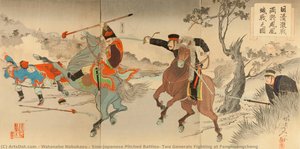
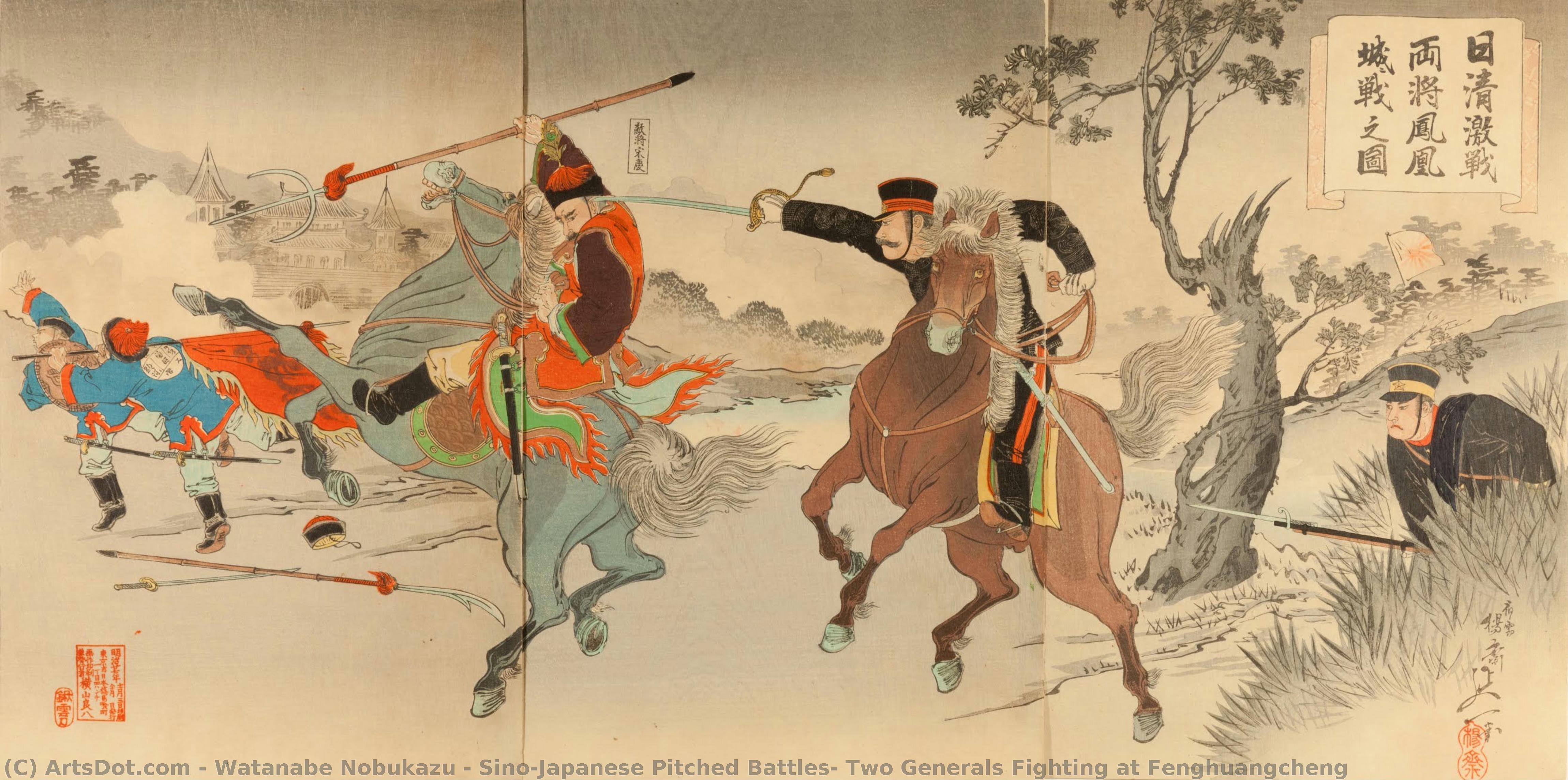
Sino-Japanese Pitched Battles: Two Generals Fighting at Fenghuangcheng


 Read More
Hand Made Oil Reproduction
Hand-painted oil on canvas in your size and frame, made to order by our artists. ( Buy Print Buy Image)




































Pick from our preset sizes that match the artwork's original proportions.

You may enter your own dimensions to fit a specific frame or space. If your selected size does not match the original image's proportions, we will either crop the artwork or extend the painting with additional hand-painted elements. A digital mockup will be sent for your approval before production begins.
Please note that the on-screen preview does not reflect the actual cropping or extension. Only the mockup will accurately show the final composition.
While custom sizes are available, we recommend selecting a dimension from the predefined list to preserve the original proportions.
After order, ArtsDot.com team will email client for instructions and provide a mockup preview
Worldwide Delivery () in 3/4 weeks instead of standard 5 weeks. (30 August). No compromise on quality.

Free Worldwide Express Shipping

High-Quality Linen Canvas

Full Shipping Insurance

Customs Tax Refund Guarantee

True Color Matching Guarantee

60-Day Return Policy (Defects Only)

100% Money-Back Guarantee

Bulk Discount Offer
 Glass option is only available in size under 110 CM

Sino-Japanese Pitched Battles: Two Generals Fighting at Fenghuangcheng
Reproduction Medium
Reproduction Size
-


Total Price
$ 263
Related Artworks




Artist Biography
The Visionary Chronicler of a Changing Japan
In the sweeping tapestry of Japanese art history, few figures capture the dramatic transition from tradition to modernity as poignantly as Watanabe Nobukazu. Born Shimada Jirō around 1872, this master printmaker emerged during an era defined by profound geopolitical shifts and internal transformation. His life and work serve as a visual bridge between the classical elegance of the Edo period's lingering aesthetics and the raw, cinematic intensity of Japan’s emergence as a global power. As a student of the legendary Yōshū Chikanobu, Nobukazu inherited a profound respect for the meticulous craftsmanship of the Ukiyo-e tradition, yet he possessed a unique, contemporary pulse that allowed him to document the turbulent winds of the Sino-Japanese and Russo-Japanese wars with unparalleled vigor.
The foundation of Nobukazu’s artistry was laid through rigorous training in calligraphy and painting, disciplines that instilled in him a reverence for the precision of line. Under Chikanobu’s mentorship, he learned to navigate the delicate balance between decorative beauty and narrative depth. This early education did more than just teach him technique; it provided him with the vocabulary to translate complex historical narratives into the medium of woodblock printing. His ability to weave together the fine, rhythmic lines characteristic of his master with a burgeoning sense of realism allowed him to create works that were not merely art, but essential historical documents.
The Drama of Conflict and the Mastery of Print
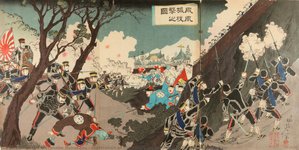
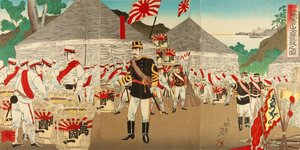
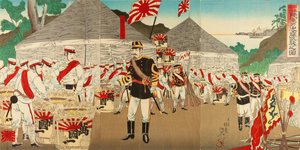
Nobukazu’s ascent to international prominence was inextricably linked to the martial fervor of his time. During the Sino-Japanese War (1894–1895), he became a prolific chronicler of the battlefield, producing elaborate triptychs that captured the heat of combat and the strategic grandeur of military maneuvers. His depictions of pivotal engagements, such as those at Liaodong harbor and Pyongyang, are celebrated for their theatrical composition and breathtaking realism. In these prints, the viewer is not a distant observer but an eyewitness to the smoke, the movement of troops, and the heavy atmosphere of conflict. He utilized the multi-panel format of the triptych to create expansive, panoramic vistas that mirrored the scale of the wars themselves.
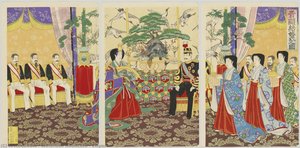
Beyond the battlefield, Nobukazu demonstrated a remarkable versatility in capturing the ceremonial and the serene. His masterpiece, "Emperor," stands as a testament to his ability to evoke the solemnity of the Meiji era. In this work, he moves away from the chaos of war to present an imperial procession characterized by profound historical gravity. Through a sophisticated palette of muted ochres, deep browns, and soft creams, he creates an atmosphere of dignified antiquity. The print is a masterclass in structural harmony, where:
- Intricate Line Work delineates the complex patterns of ceremonial robes and architectural grandeur.
- Layered Pigments provide a sense of texture and depth that avoids garishness in favor of refined elegance.
- Symbolic Elements, such as wandering birds and sentinel trees, act as silent witnesses to the unfolding imperial splendor.
A Lasting Legacy in Wood and Ink
The historical significance of Watanabe Nobukazu lies in his role as a visual historian. While many artists of his era remained tethered to purely decorative themes, Nobukazu embraced the dynamism of his age. His work captures the dual identity of Japan at the turn of the century: a nation deeply rooted in its ancestral traditions yet aggressively marching toward a modern, industrial future. His technique—a seamless blend of Chikanobu’s meticulous detail and an expressive, almost cinematic use of color—ensured that his prints possessed both a timeless aesthetic and a contemporary urgency.
Today, the legacy of Nobukazu continues to resonate with scholars and collectors who seek to understand the soul of Meiji-era Japan. His ability to translate the ephemeral moments of war and the enduring rituals of the state into the permanent medium of woodblock printing ensures his place in the pantheon of great Japanese printmakers. Through his eyes, we do not just see history; we feel the weight of its progression, the tension of its battles, and the quiet dignity of its most sacred traditions.
watanabe nobukazu
1872 - 1944 , Japan
Quick Facts
- Artistic Movement Or Style: Ukiyo-e
- Artists Or Movements Influenced By This Artist: ['Utagawa School']
- Artists Who Influenced This Artist: ['Yōshū Chikanobu']
- Date Of Death: 1944
- Full Name: Watanabe Nobukazu (渡辺延一)
- Nationality: Japanese
- Notable Artworks:
- Imperial Prosperity: Ceremony in the Eastern Capital
- Illustration of the Attack on the Hōōjyo (Hōōjyo kogeki no zu)
- Triumphal Return of Victorious Japanese Imperial Army from Asan
- Bronze Statue of Saigō in Ueno Park,
- Watanabe Nobukazu
- Place Of Birth: Tokyo, Japan