


 Preview
 Send
Send Share
Share
 Details

 Download
 Similars
 X-Ray
X-Ray Diaporama
 Stats
StatsAkalis at the Holy Tank, Umritsar

 Read More
Purchase a high-resolution, enhanced digital image, far superior to the online preview.
Each file is meticulously prepared by our in-house specialists using advanced tools and expert manual retouching. We ensure every image has exceptional clarity, precise color accuracy, and fine detail.
The final file is delivered via email within 72 hours, optimized for immediate use in professional, editorial, and print environments. This is the same quality trusted by top-tier design studios, publishers, and galleries.
Digital Image
Download a high-resolution file for personal display, printing, and creative projects. ( Switch to Print Buy Hand Made Painting)
Included in Every Digital Image Order
Expert Digital Delivery, Guaranteed
When you choose ArtsDot.com, you're not just getting an image - you're receiving a professionally enhanced digital artwork, crafted with precision and backed by a satisfaction guarantee. Here's everything that comes with your order, automatically:

Fast Email Delivery
Your high-resolution digital image file will be emailed to you within 72 hours of ordering - ready for immediate use.

AI-Enhanced Digital File
Your artwork is professionally optimized using advanced AI tools and manual editing, ensuring maximum detail, clarity, and color accuracy.

Free Lifetime Re-Delivery
Accidentally deleted or lost your file? No worries - we'll resend it to you anytime, free of charge.

No Import Fees - Ever
Enjoy your artwork instantly with zero customs, duties, or delivery fees - digital downloads are always tax-free.

Color Accuracy Guarantee
We ensure your digital image reflects the original colors as closely as possible using professional tools and color management.

100-Day Satisfaction Guarantee
If you're not satisfied with your digital image, we'll revise it or refund 100% within 100 days - no questions asked.

100% Money-Back Guarantee
Not satisfied? Get a full refund within 100 days of receiving your digital file - no questions asked.

Bulk Order Discounts
Buy 3 images, save 10% - Buy 5, save 15% - Buy 10+, save 20%. Great for creative projects, galleries, and agencies.
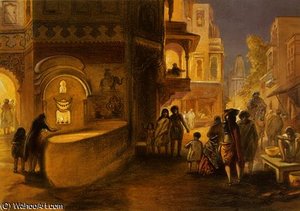
A Glimpse into Sikh Ceremony: "Akalis at the Holy Tank, Umritsar" by William Simpson
This captivating artwork by Scottish artist William Simpson offers a fascinating window into 19th-century India. Depicting “Akalis at the Holy Tank, Umritsar,” the painting transports viewers to an ornate Indian palace or courtyard, alive with activity and steeped in cultural significance. The scene portrays a seated figure adorned with a striking statue upon his head, surrounded by onlookers and individuals moving through the space. Simpson’s masterful composition creates a theatrical effect, reminiscent of a staged event or royal procession, capturing a moment rich in historical context and religious ceremony. The slightly flattened perspective enhances this sense of spectacle, drawing attention to the central figure and the intricate architectural details that define the setting.Style & Technique: A Blend of Realism and Decorative Detail
Simpson’s style is characterized by a compelling blend of realism and decorative elements, reflecting the artistic trends prevalent in 19th-century depictions of Indian culture within European art circles. The painting is primarily executed in oil on canvas, showcasing Simpson's skill in layering and blending colors to achieve depth and texture. Notice how he uses lines to precisely define architectural features – arches, windows, and intricate carvings – as well as the folds of clothing and subtle nuances of facial expressions. The color palette leans towards muted earth tones punctuated by vibrant highlights of red and gold, creating a visually rich and harmonious composition. The diffused lighting contributes to a soft, aged appearance, further enhancing the painting's historical charm.Historical Context & Cultural Significance
Created during a period of increased British engagement with India, this artwork provides valuable insight into Sikh religious practices and social structures. Umritsar, home to the Golden Temple (Harmandir Sahib), is one of the holiest places in Sikhism, and the "Holy Tank" refers to the Amrit Sarovar, a sacred pool surrounding the temple. The “Akalis” depicted were members of a devoted order within the Sikh community, known for their commitment to upholding religious principles. Simpson's work, likely commissioned for the *Illustrated London News*, served as a visual record for European audiences unfamiliar with Indian culture and traditions. It’s important to note that while offering a glimpse into this world, such depictions were often filtered through a Western lens, reflecting contemporary perspectives on colonial encounters.Symbolism & Emotional Impact
Beyond its documentary value, the painting is rich in symbolic meaning. The central figure with the statue atop his head likely represents authority or divinity within the Sikh faith. The attentive onlookers suggest an audience participating in a significant religious event. The overall atmosphere evokes a sense of reverence and solemnity, while also hinting at the grandeur and complexity of Indian courtly life. Simpson’s skillful rendering invites viewers to contemplate the cultural nuances and spiritual depth of this historical moment, making "Akalis at the Holy Tank, Umritsar" a compelling work that resonates with both artistic merit and historical significance.Related Artworks
Artist Biography
A Life Etched in Conflict and Culture
William Simpson, a name forever linked to the stark realities of the Crimean War—often whispered as “Crimean Simpson”—was far more than a mere war artist. He was a visual chronicler, an intrepid observer who documented a 19th-century world undergoing rapid transformation. Born into the grinding poverty of Glasgow in 1823, his journey from hardship to prominence stands as a testament to both innate talent and unwavering tenacity. His early life was shadowed by a difficult family situation; an abusive and alcoholic father led him to seek refuge with his grandmother in Perth at age ten—a move that, while offering stability, limited formal schooling but ignited within him a lifelong dedication to self-directed learning. This pursuit of knowledge continued through apprenticeships at the Glasgow lithographic firm of Macfarlane, which he later described as pivotal, and evening studies at the Andersonian University and Mechanics' Institute. These formative years laid the groundwork for a career that would seamlessly blend artistic skill with an insatiable curiosity about the world beyond Britain’s shores.Witness to War: The Crimean Revelation
The outbreak of the Crimean War (1853-1856) irrevocably altered Simpson's trajectory. Initially commissioned to create a lithograph based on secondhand accounts of the Battle of Alma, his talent quickly caught the attention of Colnaghi & Son, who dispatched him directly to Crimea in November 1854. This wasn’t simply about illustrating battles; it was about *experiencing* them and translating that experience onto paper with meticulous detail. Simpson didn't shy away from depicting the grim realities of war—the mud, the suffering, the sheer exhaustion etched on the faces of soldiers. His watercolors weren't romanticized visions but unflinching records of a brutal conflict. These images were then transformed into lithographs for publications like The Illustrated London News, bringing the horrors and heroism of the Crimean War directly into British homes. He became known as “Crimean Simpson” not just for his presence there, but for the authenticity and immediacy he brought to his depictions. His work provided a crucial visual narrative during a war that was otherwise distant and abstract for many back home. The Seat of War in the East, his seminal series of lithographs from these sketches, remains a landmark achievement in war reporting and visual storytelling—a testament to his courage and artistic skill under fire.Beyond Crimea: India, Exploration, and Artistic Ambition
Simpson’s success in Crimea opened doors to further assignments as a special artist and correspondent for The Illustrated London News. In the late 1850s, he embarked on an extensive journey to India, documenting the aftermath of the Sepoy Revolt of 1857. This expedition wasn't simply about recording military events; it was a deep dive into Indian landscapes, culture, and daily life. He captured bustling marketplaces, serene temples, majestic palaces, and portraits of local people with remarkable sensitivity. His watercolors from India reveal a nuanced understanding of the subcontinent—a far cry from the often-simplistic depictions prevalent at the time. Simpson envisioned a comprehensive illustrated volume on India, an ambitious project that unfortunately fell through due to financial difficulties faced by Day & Son, the intended publisher. Despite this setback, his Indian watercolors remain invaluable records of a pivotal moment in British colonial history, showcasing not only the grandeur of the subcontinent but also the complexities and tensions inherent in imperial rule. He continued to travel extensively, documenting scenes from Russia, China, and beyond, always bringing back detailed observations rendered with remarkable skill.Legacy and Lasting Influence
William Simpson’s legacy extends far beyond his stunning visual documentation of 19th-century events. He helped establish the role of the “special artist”—an embedded observer who provided firsthand visual reporting from conflict zones and distant lands. His work wasn't just art; it was journalism, history, and cultural observation all rolled into one. Simpson enjoyed the patronage of Queen Victoria herself, a testament to the esteem his artistry garnered. He was elected an associate of the Institute of Painters in Water Colours in 1874 and became a full member five years later. His detailed watercolors and lithographs continue to be studied by historians and art enthusiasts alike, offering invaluable insights into the past. He was, as some called him, a “Prince of Pictorial Correspondents,” whose work continues to resonate with audiences today.Notable Works
- The Seat of War in the East: A seminal series of lithographs based on his Crimean sketches, offering a detailed visual record of the conflict.
- Retreat of the Russians from Sebastopol: A powerful watercolor capturing a pivotal moment in the fall of Sevastopol, showcasing Simpson’s skill in depicting dramatic scenes.
- Mongolia. Group Near The Great Wall Of China.: Demonstrates his ability to capture cultural exchange and landscapes with realism and romanticism.
- Akalis at the Holy Tank, Umritsar: A vibrant depiction of Sikh devotion, rich in historical and cultural detail.
- Camp of the Fourth Division: An evocative painting depicting a 19th-century military encampment.
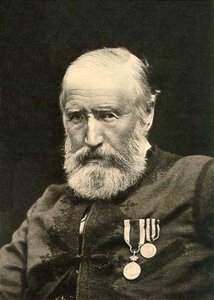
William Simpson
1823 - 1899 , United Kingdom
Quick Facts
- Artistic Movement Or Style: Victorian art
- Date Of Birth: 1823
- Date Of Death: 1899
- Full Name: William Simpson
- Nationality: British
- Notable Artworks:
- The Seat of War in the East
- Retreat from Sebastopol
- Mongolia near Great Wall
- Akalis at Holy Tank
- Camp of Fourth Division
- Place Of Birth: Glasgow, UK