 Preview
 Send
Send Share
Share
 Details

 Download
 Similars
 X-Ray
X-Ray Diaporama
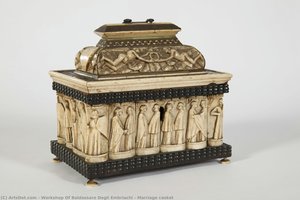
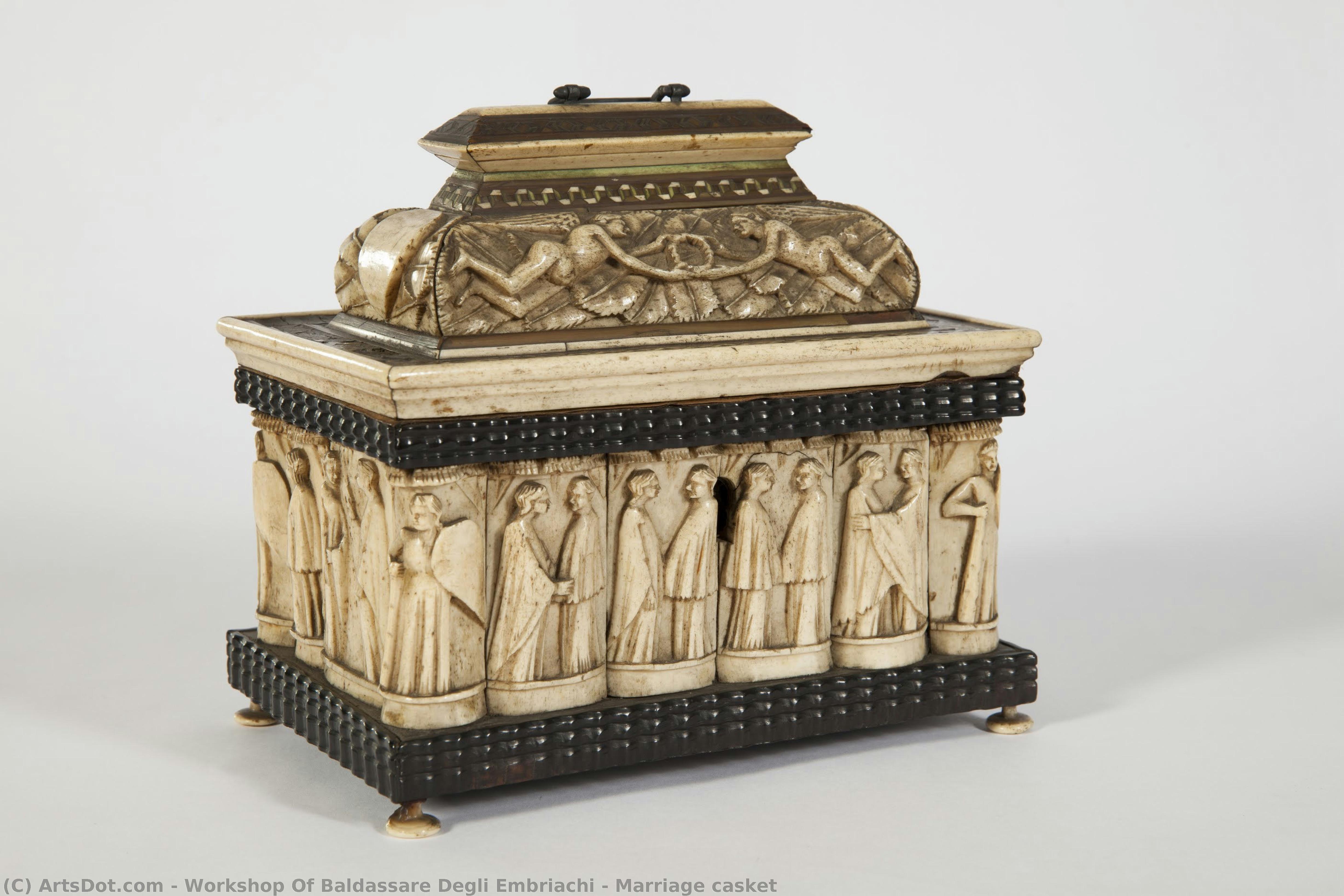
Marriage casket
 1425
1425 7.0 x 12.0 cm
 The Ema Klabin House Museum
 Read More
Hand Made Oil Reproduction
Hand-painted oil on canvas in your size and frame, made to order by our artists. ( Buy Print Buy Image)




































Pick from our preset sizes that match the artwork's original proportions.

You may enter your own dimensions to fit a specific frame or space. If your selected size does not match the original image's proportions, we will either crop the artwork or extend the painting with additional hand-painted elements. A digital mockup will be sent for your approval before production begins.
Please note that the on-screen preview does not reflect the actual cropping or extension. Only the mockup will accurately show the final composition.
While custom sizes are available, we recommend selecting a dimension from the predefined list to preserve the original proportions.
After order, ArtsDot.com team will email client for instructions and provide a mockup preview
Worldwide Delivery () in 3/4 weeks instead of standard 5 weeks. (24 August). No compromise on quality.

Free Worldwide Express Shipping

High-Quality Linen Canvas

Full Shipping Insurance

Customs Tax Refund Guarantee

True Color Matching Guarantee

60-Day Return Policy (Defects Only)

100% Money-Back Guarantee

Bulk Discount Offer
 Glass option is only available in size under 110 CM

Marriage casket
Reproduction Medium
Reproduction Size
-


Total Price
$ 263
Related Artworks





Artist Biography
The Enigmatic World of Baldassare degli Embriachi and His Workshop
Baldassare degli Embriachi, a name resonating through the annals of Florentine Renaissance art, represents more than just an artist; he embodies a fascinating intersection of commerce, diplomacy, and artistic patronage. Born sometime in the 1330s to the Obriachi family of Florence – though his formative years were spent in the papal city of Avignon – Baldassare emerged as a pivotal figure in the late Gothic and early Renaissance periods. He wasn’t merely a sculptor wielding chisels, but an astute “art entrepreneur,” orchestrating the creation of exquisite objects through a workshop that flourished across Italy, primarily in Florence and Venice.
Initially enrolling in the Arte del Cambio, the moneychangers’ guild in Florence around 1368, Baldassare quickly established himself as a man of business. His ventures extended beyond finance; he navigated courtly circles, even earning the title of Count Palatine after selling pearls to Empress Charles IV in 1369. This early success propelled him into a world of international trade and political maneuvering, skills that would prove invaluable in establishing and expanding his artistic enterprise. A shift towards Venice around 1395, prompted by both business opportunities and potential political entanglements with Gian Galeazzo Visconti, Duke of Milan, marked a new chapter for the workshop.
A Legacy Forged in Ivory and Bone
The Workshop of Baldassare degli Embriachi became renowned for its luxurious creations carved from bone, ivory, and horn, often meticulously inlaid within frameworks of stained wood using the *certosina* technique. This method involved assembling intricate geometric patterns and designs with precision and artistry. While Baldassare himself likely didn’t engage in the physical carving process, his role was crucial – he provided the capital, secured commissions, and negotiated sales to a discerning clientele that included emperors, kings, and noble courts across Northern Europe. The workshop's output wasn’t limited to individual commissions; it appears they maintained a stock of pieces, catering to the burgeoning market for gifts associated with betrothals and weddings.
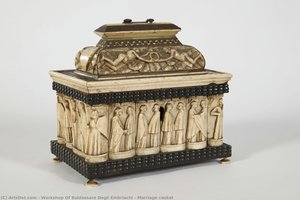
The most celebrated products of the Embriachi workshop are undoubtedly the “marriage caskets” or wedding caskets. These hexagonal or oblong boxes, approximately a foot across, featured hinged lids that rose to reveal intricately carved scenes. Often depicting classical mythology, allegorical virtues and vices, or biblical narratives, these caskets were not merely containers but symbols of love, prosperity, and hope for the future. Beyond caskets, the workshop produced portable altarpieces, reliquaries, furniture panels, and mirrors – each piece reflecting a dedication to detail and refined craftsmanship.
Technique, Style, and the Embriachi “Type”
The Embriachi workshop’s distinctive style is characterized by its elegant compositions, delicate carving, and skillful use of materials. The bone panels were typically narrow and tall, featuring one or two figures arranged in rows along a surface. A hallmark of their work is the *tarsia a toppo* technique, involving overlays of organic materials glued onto a poplar carcass. While influenced by Gothic aesthetics, the workshop also incorporated emerging Renaissance elements, such as classicizing motifs like fluted columns and scenes drawn from classical mythology. The use of paint and gilding further enhanced the vibrancy and visual appeal of their creations.
However, attributing works definitively to the Embriachi workshop remains a challenge. Due to the lack of signatures and documentation on most pieces, art historians often employ the term “Embriachi-type” or “workshop of Embriachi” to denote objects sharing stylistic similarities. It’s believed that other workshops also produced similar carvings, making precise identification difficult. Generally, the quality of carving tends to decline in works dated after 1410, with some scholars suggesting production ceased around 1416 based on changes in painted elements.
Historical Significance and Enduring Appeal
The Workshop of Baldassare degli Embriachi occupies a unique position in the history of decorative arts. Their innovative approach to mass-production – utilizing prefabricated, modular components – allowed for the creation of affordable yet elaborate objects that catered to a wide range of patrons. This efficiency, combined with their exquisite craftsmanship and refined style, contributed to the dissemination of late medieval artistic trends across Europe.
Today, examples of Embriachi workshop creations are treasured in major collections worldwide, including the Metropolitan Museum of Art, the Victoria and Albert Museum, and the British Museum. These objects offer a glimpse into the luxurious world of Renaissance patronage, the intricate artistry of Italian workshops, and the enduring legacy of Baldassare degli Embriachi – a man who masterfully blended commerce, diplomacy, and artistic vision to create a lasting impact on the art world.
Quick Facts
- Artistic Movement Or Style: Renaissance
- Date Of Death: Living
- Full Name: Baldassare degli Embriachi
- Nationality: Italian
- Notable Artworks:
- Marriage Casket
- Altarpiece
- Place Of Birth: Florence, Italy