 Preview
 Send
Send Share
Share
 Details

 Download
 Similars
 X-Ray
X-Ray Diaporama
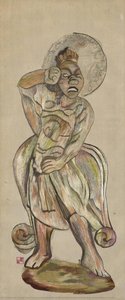
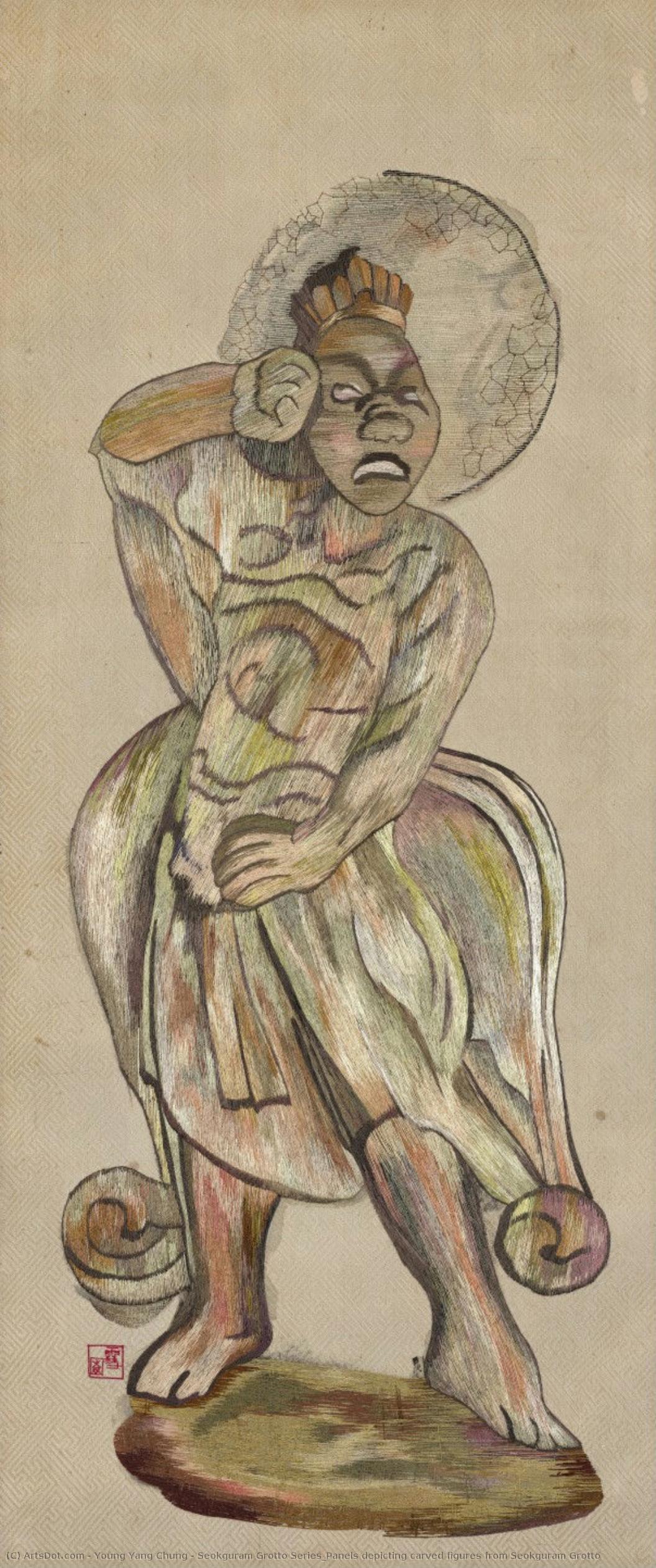
Seokguram Grotto Series_Panels depicting carved figures from Seokguram Grotto
 Contemporary Realism
 1960
1960 37.0 x 90.0 cm
 The Chung Young Yang Embroidery Museum
 Read More
Giclée / Art Print
Museum-quality giclée or canvas print with fast production and flexible finish options. ( Buy Hand Made Painting Buy Image)




































Pick from our preset sizes that match the artwork's original proportions.

You may enter your own dimensions to fit a specific frame or space. If your selected size does not match the original image's proportions, we will either crop the artwork or extend the image with a mirrored or solid-fill edge. A digital mockup will be sent for your approval before production begins.
Please note that the on-screen preview does not reflect the actual cropping or extension. Only the mockup will accurately show the final composition.
While custom sizes are available, we recommend selecting a dimension from the predefined list to preserve the original proportions.
Worldwide Delivery () in 2 weeks instead of standard 4/5 weeks. (24 August)

Free Worldwide Express Shipping

High-Quality Linen Canvas

Full Shipping Insurance

Customs Tax Refund Guarantee

True Color Matching Guarantee

60-Day Return Policy (Defects Only)

100% Money-Back Guarantee

Bulk Discount Offer
 Glass option is only available in size under 110 CM

Seokguram Grotto Series_Panels depicting carved figures from Seokguram Grotto
Giclée / Art Print
Reproduction Size
-


Total Price
$ 63
Collectible Description
Related Artworks
Artist Biography
A Weaver of Tradition and Innovation
Young Yang Chung stands as a singular figure in the realm of East Asian textile art, recognized globally for her masterful embroidery and profound understanding of its historical roots. Born in Seoul, South Korea, in 1936, Chung’s artistic journey began with an unwavering fascination for Korean folk textiles—patterns imbued with symbolic meaning reflecting agricultural cycles, familial bonds, and spiritual beliefs. This early passion would shape the trajectory of her lifelong dedication to preserving and reimagining a venerable craft that many once dismissed as mere domesticity.
Her formative years were marked by exposure to traditional Korean embroidery techniques passed down through generations within her family. These early experiences instilled in her a deep appreciation for meticulous craftsmanship and the importance of honoring artistic heritage. However, Chung was never content with tradition alone; she sought to elevate the medium through rigorous academic inquiry. In 1976, she pursued a doctorate at New York University, specializing in textile history. Her dissertation meticulously traced the origins of embroidery across China, Japan, and Korea, demonstrating its evolution from utilitarian adornment to complex expressions of cultural identity.
The Alchemy of Thread and Symbolism
Chung’s artistic philosophy centers on bridging the gap between tradition and innovation. She firmly believes that while honoring established techniques is crucial, it is equally vital to experiment with new materials and approaches to revitalize embroidery's relevance in contemporary art. Her work often functions as a silent language of silk, where every stitch carries the weight of history and myth. In her celebrated Seokguram Grotto Series, she faced the monumental challenge of translating the carved-stone bodhisattvas of Korea’s greatest architectural masterpiece into the soft textile medium. Inspired by the trompe l'oeil mural paintings of Giovanni Battista Tiepolo, she utilized innovative thread-twisting methods and gradations of color to create a breathtaking illusion of three-dimensionality on a two-dimensional plane.
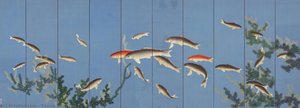
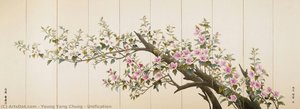
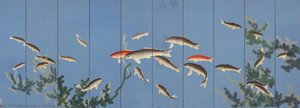
The symbolism within her pieces often reflects the socio-political landscape of her homeland. In works such as Unity, created in the 1960s following the Korean War, she utilized the motif of gracefully swimming fish to symbolize wealth, abundance, and a profound desire for the unification of the Korean people. Similarly, her piece Unification employs the Rose of Sharon—the national flower of Korea—to depict the division between North and South through a landscape of vibrant blossoms. Through these works, Chung transforms the needle and thread into tools of political and spiritual commentary, weaving the hopes of a nation into the very fabric of her art.
A Legacy Woven in Silk
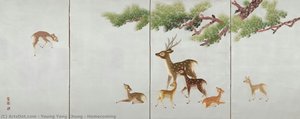
Beyond her individual creations, Dr. Chung has been a tireless advocate for the recognition of textile art as a fine art medium. She has worked to challenge the historical stigma that labeled embroidery as "women's work" or a "minor art." Her prolific output has led to solo exhibitions across continents, from Seoul’s National Museum of Korea to prestigious galleries in Europe and North America. Her ability to blend various stitch types—such as the radiated darning stitch used in her Homecoming screen—with textured, thickly twisted threads allows her to capture the organic essence of nature, from the delicate needles of pine branches to the rugged bark of ancient trees.
Perhaps her most enduring contribution to the art world is the establishment of The Chung Young Yang Embroidery Museum. Nestled within the serene campus of Sookmyung Women’s University in Seoul, this institution serves as a living dialogue between the past and the present. Founded in 2004, the museum is far more than a mere repository for textiles; it is a sanctuary for cultural storytelling that preserves the delicate endurance of human artistry. Through her lectures, writings, and this monumental institution, Young Yang Chung has ensured that the intricate beauty of East Asian embroidery continues to inspire future generations of artists and historians alike.
young yang chung
1936 - , South Korea
Quick Facts
- Artistic Movement Or Style: Embroidery Art
- Date Of Birth: 1936
- Full Name: Young Yang Chung
- Nationality: Korean
- Notable Artworks: ['Unity']
- Place Of Birth: South Korea
Related Articles
Yi Eungro: Bridging East & West in the Landscape of Korean Modernism
Explore the captivating world of Yi Eungro (Lee Ungno), a pivotal figure in Korean modernism. Discover his unique fusion of Eastern and Western artistic traditions, abstract masterpieces, and lasting legacy. A must-read for discerning art collectors.

Rococo's Radiant Legacy: 10 Masterpieces for Your Home |
Indulge in the elegance of Rococo! Explore 10 masterpieces by Fragonard, Boucher & Watteau. Discover the stories behind these iconic paintings and bring timeless art to your home with museum-quality reproductions from .
Albrecht Dürer's Masterpieces: 25 Iconic Artworks for Your Home | ArtsDot
Explore 25 iconic artworks by Albrecht Dürer, a master of the German Renaissance. Discover the stories behind Melencolia I, Knight Death and Devil & more. Find museum-quality art reproductions for your home at ArtsDot.com.