 Preview
 Send
Send Share
Share
 Details

 Download
 Similars
 X-Ray
X-Ray Diaporama
 Stats
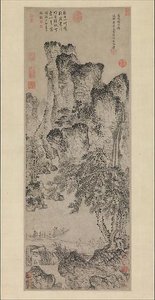
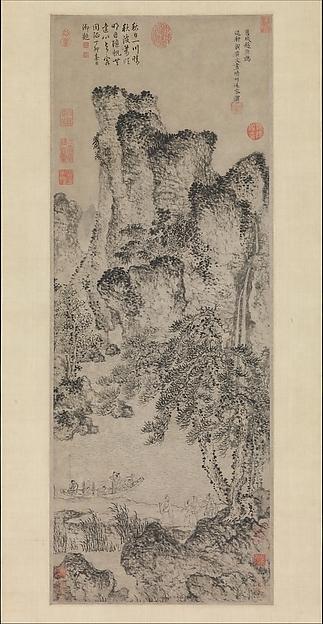
Stats元 趙原 (元) 晴川送客圖 軸 Farewell by a Stream on a Clear Day
 196.0 x 59.0 cm
 Read More
Giclée / Art Print
Museum-quality giclée or canvas print with fast production and flexible finish options. ( Buy Hand Made Painting Switch to Digital Image)




































Pick from our preset sizes that match the artwork's original proportions.

You may enter your own dimensions to fit a specific frame or space. If your selected size does not match the original image's proportions, we will either crop the artwork or extend the image with a mirrored or solid-fill edge. A digital mockup will be sent for your approval before production begins.
Please note that the on-screen preview does not reflect the actual cropping or extension. Only the mockup will accurately show the final composition.
While custom sizes are available, we recommend selecting a dimension from the predefined list to preserve the original proportions.
Worldwide Delivery () in 2 weeks instead of standard 4/5 weeks. (8 September)

Free Worldwide Express Shipping

High-Quality Linen Canvas

Full Shipping Insurance

Customs Tax Refund Guarantee

True Color Matching Guarantee

100-Day Return Policy (Defects Only)

100% Money-Back Guarantee

Bulk Discount Offer
 Glass option is only available in size under 110 CM

元 趙原 (元) 晴川送客圖 軸 Farewell by a Stream on a Clear Day
Giclée / Art Print
Reproduction Size
-


Total Price
$ 63
Related Artworks









Artist Biography
A Brushstroke Across Eras: The Enigmatic World of Zhao Yuan
Zhao Yuan, a name whispered among connoisseurs of Chinese painting, remains an elusive figure despite the enduring beauty of his landscapes. Born in Yingcheng (modern-day Yingxian County, Shandong Province) sometime during the late Yuan dynasty (1368-1407), he lived through a period of immense upheaval and transition – the fall of the Mongol-led Yuan and the establishment of the Ming. Little is definitively known about his life; dates of birth and death are lost to time, adding an air of mystique to his artistic legacy. He was known by the courtesy name Shanzhang (善长) and adopted the sobriquet Danlin (丹林), names that offer glimpses into a personality perhaps valuing skill and a cultivated spirit. His life unfolded primarily in Suzhou, a burgeoning center for art and culture, where he found himself amidst a vibrant community of scholars and painters grappling with new aesthetic ideals. This context profoundly shaped his artistic development, positioning him as a crucial link between the traditions of the Yuan masters and the evolving styles of the early Ming.Echoes of Tradition: Influences and Artistic Development
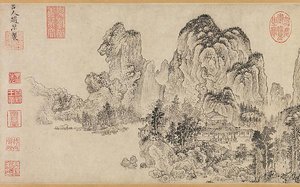
Zhao Yuan’s art is deeply rooted in the literati painting tradition, but it wasn't born in isolation. He stands as a compelling example of an artist synthesizing diverse influences into a uniquely personal style. His most significant debt is undoubtedly to Wang Meng (1308-1383), one of the last great masters of the Yuan dynasty. Like Wang Meng, Zhao Yuan embraced a dense, complex compositional structure characterized by layered mountains, gnarled trees, and meticulously rendered details. However, while Wang Meng often imbued his landscapes with a sense of dramatic power and spiritual intensity, Zhao Yuan’s work tends towards a more refined elegance and lyrical quality. Qingchuan Songbie (Farewell at Qingchuan) exemplifies this – the scene is not overwhelming but invites quiet contemplation. Beyond Wang Meng, echoes of earlier masters like Fan Kuan (c. 937-1020), renowned for his monumental landscapes and powerful brushwork, can also be detected in Zhao Yuan’s treatment of rock formations and atmospheric effects. He also drew inspiration from Yan Wengui (active late 14th century) whose influence is visible in the delicate rendering of architectural elements within his paintings. This careful blending of styles demonstrates a sophisticated understanding of art history and a deliberate effort to forge his own path.The Landscapes of Contemplation: Major Works and Techniques
Although Zhao Yuan’s surviving oeuvre is relatively small, it showcases a remarkable consistency in style and quality. His most celebrated works include Qingchuan Songbie (Farewell at Qingchuan) and Hexi Caotang (Grassland Cottage at Hexi). These paintings are not merely depictions of scenery; they are imbued with poetic meaning, reflecting the literati ideal of expressing inner feelings through nature. Qingchuan Songbie, for instance, depicts a farewell scene by a riverbank, rendered with exquisite detail and subtle emotional nuance. The composition is carefully balanced, drawing the viewer’s eye through layers of mountains, trees, and figures. Zhao Yuan's technique is characterized by precise brushwork, delicate washes, and a masterful use of ink tonality. He employed a variety of brushstrokes – dry strokes for texture, wet strokes for atmosphere, and fine lines for detail – to create a sense of depth and realism. His color palette is typically restrained, favoring muted tones that enhance the overall mood of tranquility and contemplation. The meticulous attention to detail in his architectural renderings—pavilions, bridges, and dwellings—reveals a keen observational skill and an appreciation for the beauty of human craftsmanship integrated within the natural world.Historical Significance: A Bridge Between Dynasties
Zhao Yuan’s significance lies not so much in groundbreaking innovation but rather in his ability to synthesize and refine existing traditions during a pivotal moment in Chinese art history. He served as a crucial bridge between the expressive, often dramatic styles of the late Yuan masters like Wang Meng and the more restrained, elegant aesthetics that characterized the early Ming dynasty. As the Yuan collapsed, many artists sought new ways to express their feelings about the changing political landscape. Zhao Yuan’s paintings, while not overtly political, reflect a sense of quiet resilience and a longing for harmony in a turbulent world. He embodies the literati ideal of finding solace and meaning in nature, even amidst chaos. His work helped pave the way for later Ming artists who would further develop the tradition of landscape painting, emphasizing individual expression and poetic sensibility. While his personal life remains shrouded in mystery, Zhao Yuan’s artistic legacy continues to inspire awe and admiration, reminding us of the enduring power of art to transcend time and circumstance.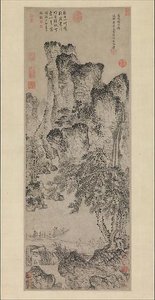
zhao yuan
1350 -
Quick Facts
- Artistic Movement Or Style: Landscape painting
- Artists Who Influenced This Artist:
- Wang Meng
- Yan Wengui
- Fan Kuan
- Date Of Birth: 1350
- Date Of Death: Living
- Full Name: Zhao Yuan
- Nationality: Chinese
- Notable Artworks:
- Qingchuan Songbie
- Hexi Caotang
- Place Of Birth: Yingcheng, China