 Preview
 Send
Send Share
Share
 Details

 Download
 Similars
 X-Ray
X-Ray Diaporama
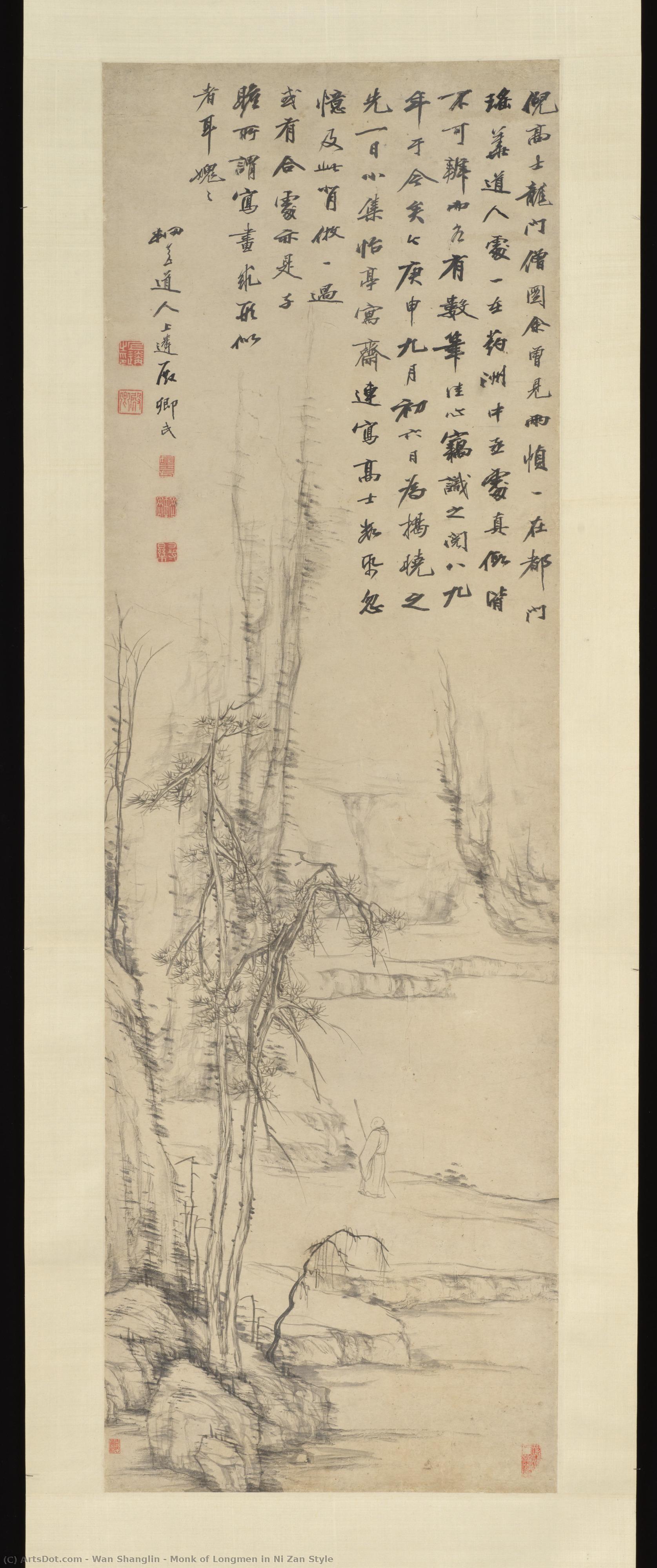
Monk of Longmen in Ni Zan Style
 1800
1800 119.0 x 38.0 cm
 Read More
Hand Made Oil Reproduction
Hand-painted oil on canvas in your size and frame, made to order by our artists. ( Buy Print Buy Image)




































Pick from our preset sizes that match the artwork's original proportions.

You may enter your own dimensions to fit a specific frame or space. If your selected size does not match the original image's proportions, we will either crop the artwork or extend the painting with additional hand-painted elements. A digital mockup will be sent for your approval before production begins.
Please note that the on-screen preview does not reflect the actual cropping or extension. Only the mockup will accurately show the final composition.
While custom sizes are available, we recommend selecting a dimension from the predefined list to preserve the original proportions.
After order, ArtsDot.com team will email client for instructions and provide a mockup preview
Worldwide Delivery () in 3/4 weeks instead of standard 5 weeks. (30 August). No compromise on quality.

Free Worldwide Express Shipping

High-Quality Linen Canvas

Full Shipping Insurance

Customs Tax Refund Guarantee

True Color Matching Guarantee

60-Day Return Policy (Defects Only)

100% Money-Back Guarantee

Bulk Discount Offer
 Glass option is only available in size under 110 CM

Monk of Longmen in Ni Zan Style
Reproduction Medium
Reproduction Size
-


Total Price
$ 263
Related Artworks









Artist Biography
Robert Barker: The Pioneer of the Panorama
Born in Kells, County Meath, Ireland, in 1739, Robert Barker’s name is inextricably linked to one of the most remarkable innovations in visual art – the panorama. While often overshadowed by later developments and other artists, Barker deserves recognition as the true progenitor of this immersive experience, a man who not only painted breathtaking scenes but also conceived of a method for presenting them that fundamentally altered how audiences perceived space and time. His life was one of constant movement, driven by a desire to share his artistic vision with a rapidly expanding world, and his legacy continues to resonate in museums and art institutions globally.
Barker’s early career began as a portrait painter in London, honing his skills under the tutelage of established masters. However, it was his fascination with capturing expansive views – particularly those offered by the burgeoning cityscapes of Edinburgh – that ultimately led him to develop the panorama. He recognized the limitations of traditional perspective and sought a way to convey the overwhelming scale and detail of a scene. This quest culminated in the coinage of the word “panorama” itself, derived from Greek roots signifying ‘all’ and ‘view,’ perfectly encapsulating his ambition to offer a complete survey of a location.
The Birth of an Immersive Experience
Barker's breakthrough came in 1792 with the construction of a dedicated panorama building in Leicester Square, London. This wasn’t merely a large painting; it was a meticulously engineered cylindrical canvas, painted to depict Edinburgh as seen from Calton Hill. The innovative aspect lay not just in the sheer scale – over 300 square feet – but also in Barker's masterful manipulation of perspective. He employed techniques previously unseen in panoramic art, creating an illusion of depth and distance that was remarkably convincing for its time. Visitors, standing on a central platform beneath a skylight, could wander around the circular canvas, taking in a 360-degree view of the city.
The success of this venture was immediate and astounding. Barker quickly established a lucrative business, constructing similar panoramas of other major cities – including London itself, presented from the rooftop of Albion Mills on the South Bank – and even venturing abroad to capture scenes in Rome and Naples. His panoramas weren’t simply static images; they were carefully staged theatrical experiences, designed to transport viewers to another place and time. The Barker Panorama wasn't just a painting; it was an entire world contained within a single room.
Influences and Artistic Techniques
Barker’s work demonstrates a fascinating interplay of influences. While he drew inspiration from earlier “prospect” paintings – wide-angle views that had been popular since the 16th century – he pushed these techniques to an unprecedented level of realism and detail. His use of trompe l'oeil, particularly in depicting textiles and decorations, was remarkably sophisticated for its time, a testament to his artistic skill and meticulous attention to detail. He also incorporated elements of the “picturesque,” a burgeoning aesthetic that valued scenes of natural beauty and romanticism. The influence of Francis Towne is evident in Barker’s approach to landscape painting, particularly his use of atmospheric perspective and loose brushwork.
Furthermore, Barker's work reflects the broader intellectual currents of the late 18th century. The rise of scientific inquiry and a fascination with the natural world fueled his desire to capture expansive views accurately and convincingly. His panoramas were not merely artistic creations; they were also demonstrations of engineering ingenuity and a testament to the power of visual representation.
Legacy and Lasting Impact
Despite facing competition from later panorama developments, such as the cyclorama – moving panoramas that offered even greater dynamism – Barker’s pioneering work laid the foundation for this enduring art form. His innovations in perspective, scale, and presentation had a profound impact on subsequent artists and institutions. The University of Edinburgh still houses one of his original panoramic paintings, a tangible reminder of his groundbreaking contribution to visual culture.
Robert Barker's legacy extends beyond the panoramas themselves. He was a true innovator, a visionary who dared to challenge conventional artistic practices and create an entirely new way of experiencing art. His name remains synonymous with the panorama, a testament to his enduring influence on the world of visual arts.
zi dianqing, hao liangang
1739 - 1813 , China
Quick Facts
- Artistic Movement Or Style: Panoramic painting
- Artists Or Movements Influenced By This Artist:
- Francis Towne
- Cyclorama
- Artists Who Influenced This Artist: ['Charles Jervas']
- Date Of Birth: 1739
- Date Of Death: 1806
- Full Name: Robert Barker
- Nationality: Irish
- Notable Artworks:
- The Panorama (Edinburgh)
- Barker Panorama London
- Place Of Birth: Kells, County Meath, Ireland