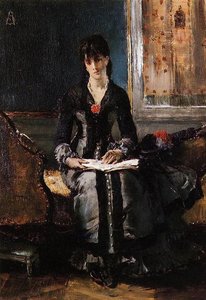
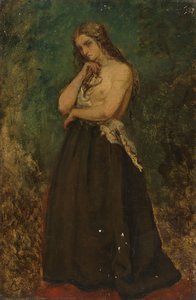
Early Life & Artistic Foundations: From Social Realism to Dutch Influences
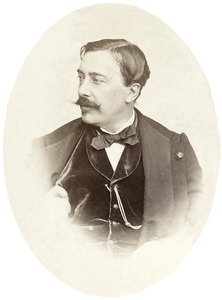 alfred émile léopold stevens
Alfred Stevens (1823-1906): Belgian Realist painter of elegant Parisian women & 'la vie moderne'. Influenced by Dutch Masters, his art captures 19thC society with refined detail.
Alfred Émile Léopold Stevens, born in Brussels in 1823, emerged from a family deeply entwined with the artistic currents of his time. His father, an avid collector with a penchant for Eugène Delacroix’s watercolors, instilled an early appreciation for color and composition. However, it was not initially the allure of romanticism that captivated the young Stevens, but rather a profound concern for social realities. His earliest works reflected this sensibility, notably a painting depicting the plight of vagrants – a bold statement for its time and indicative of a burgeoning realist impulse. This initial foray into social commentary would prove pivotal, establishing a foundation of meticulous observation and empathetic portrayal that characterized his entire career. Yet, Stevens’s artistic trajectory wasn't solely defined by this early commitment to realism; a parallel fascination with the Dutch Masters—artists like Gabriel Metsu and Gerard ter Borch—began to exert a powerful influence. He admired their ability to capture the quiet dignity of everyday life, the subtle interplay of light and shadow within domestic interiors, and the exquisite rendering of textures. This blend of social awareness and Dutch precision would become the hallmark of his unique style.
The Parisian Salon Years: Achieving Recognition and Defining 'La Vie Moderne'
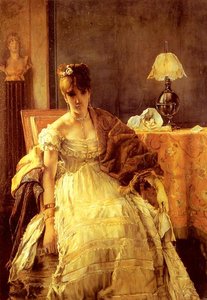
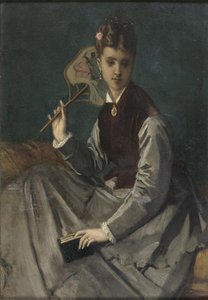 La dame à l'éventail
Admire 'La Dame à l’Éventail' by Alfred Stevens – a stunning 19th-century portrait of a refined woman. Explore its realism, muted palette & symbolic details in this exquisite oil painting.
In 1843, Stevens relocated to Paris, a city rapidly transforming into the epicenter of artistic innovation. He enrolled at the École des Beaux-Arts, immersing himself in the academic traditions while simultaneously absorbing the vibrant energy of the Parisian art scene. His breakthrough came with *The Hunters of Vincennes* (1857), a work that garnered significant attention and signaled his departure from overtly social themes towards more nuanced depictions of contemporary life. The 1860s witnessed Stevens’s ascent to prominence within the Parisian Salon system. He became celebrated for his paintings of elegant women, often portrayed in refined interiors, embodying what would become known as ‘la vie moderne.’ These weren't merely portraits; they were carefully constructed narratives that offered glimpses into the lives of the upper-middle class—their leisure, their aspirations, and their quiet moments of contemplation. Stevens’s success wasn’t accidental. He possessed an uncanny ability to capture not just likeness but also a sense of personality, imbuing his subjects with a captivating air of mystery and sophistication.
A Master of Detail: Examining Stevens's Realistic Technique and Composition
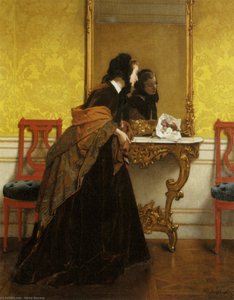
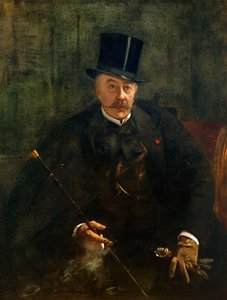 Alfred Stevens
Explore the elegant realism of Alfred Stevens! Belgian painter known for Parisian life & women portraits. Discover his Dutch-inspired style & legacy.
Stevens’s mastery lay in the meticulous execution of detail. He wasn’t interested in broad brushstrokes or dramatic gestures; instead, he favored a smooth, almost enamel-like finish that lent his paintings an extraordinary sense of realism. This technique, directly inspired by the Dutch Masters, allowed him to render fabrics with breathtaking accuracy—the sheen of silk, the delicate folds of lace, the subtle textures of velvet. But his skill extended beyond mere technical proficiency. Stevens was a keen observer of light and shadow, using them to sculpt form and create atmosphere. His compositions were carefully balanced, often employing mirrors or strategically placed objects to draw the viewer’s eye and enhance the sense of depth. Consider *La Dame à l'Éventail* – the muted palette, the refined pose of the sitter, and the subtle interplay of light on her face all contribute to a feeling of quiet elegance and restrained emotion. He wasn’t simply painting what he saw; he was constructing an idealized vision of Parisian beauty.
Symbolism and Psychological Depth in Stevens’s Portraits of Women
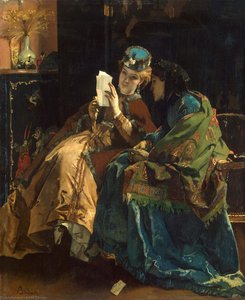
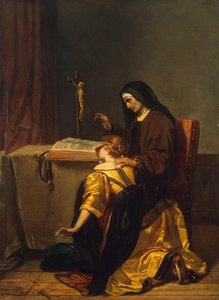 Absolution
Explore 'Absolution' by Alfred Stevens – a poignant 19th-century oil painting of faith & compassion. Admire its realism, dramatic lighting & symbolic details. Discover this masterpiece!
While celebrated for his realism, Stevens's work is far from devoid of symbolism. Beneath the surface of elegant portraits lay layers of meaning, often alluding to themes of longing, introspection, and societal constraints. *Portrait of a Young Woman* (often referred to as “The Parisian Sphinx”) exemplifies this duality. The dreamy expression of the sitter, coupled with the enigmatic setting, invites speculation about her inner life. Objects within his paintings—fans, flowers, books—were rarely arbitrary; they served as visual metaphors, hinting at hidden desires or unspoken emotions. *Absolution*, for example, is a poignant exploration of faith and compassion, conveyed through dramatic lighting and symbolic details that elevate the scene beyond a simple depiction of religious devotion. Stevens understood that true beauty wasn’t merely aesthetic; it was intertwined with psychological depth and emotional resonance.
Stevens’s Circle: Artistic Connections with Manet, Degas & the Belle Époque
Alfred Stevens was not an isolated figure; he thrived within a vibrant network of artists, writers, and intellectuals. His studio became a hub for Parisian society, attracting luminaries such as Édouard Manet, Théophile Gautier, and the Goncourt brothers. He forged a particularly close relationship with Manet, whose work shared a similar focus on contemporary life and elegant portraiture. Manet even left paintings in Stevens’s studio hoping to benefit from its bustling atmosphere and potential clientele—a testament to Stevens's reputation as a discerning tastemaker. Degas also frequented his salon, further solidifying Stevens’s position within the avant-garde circles of the Belle Époque. These connections weren’t merely social; they were intellectual exchanges that shaped Stevens’s artistic vision and contributed to the broader cultural landscape of 19th-century Paris. His wife, Marie, hosted weekly gatherings which became legendary for their lively discussions and eclectic mix of guests.
Legacy and Rediscovery: Alfred Stevens’s Enduring Appeal
Despite his considerable success during his lifetime, Alfred Stevens's work experienced a period of relative obscurity in the 20th century. However, recent scholarship has begun to re-evaluate his contribution to art history, recognizing him as a pivotal figure who bridged the gap between realism and symbolism. His paintings offer a fascinating glimpse into the lives of Parisian women during the Belle Époque—a world of elegance, refinement, and unspoken desires. Today, Stevens’s works are increasingly sought after by collectors and museums alike, testament to his enduring appeal. His ability to capture both the beauty and complexity of human experience continues to resonate with audiences, solidifying his place as a master of intimate realism and a captivating chronicler of ‘la vie moderne.’