The Genesis of a Style: Mucha's Early Life and Influences
 Wikipedia: Alphonse Mucha
Alfons Maria Mucha (Czech: [ˈalfons ˈmuxa] ; 24 July 1860 – 14 July 1939), known internationally as Alphonse Mucha, was a Czech painter, illustrator, and graphic artist. Living in Paris during the Art Nouveau period, he was widely known for his disti...
Alphonse Maria Mucha, a name synonymous with the sinuous elegance of Art Nouveau, wasn’t born into a world primed for artistic revolution. His beginnings in 1860, in the small Moravian town of Ivančice – then part of the Austrian Empire – were humble, steeped in the traditions of a region far removed from the burgeoning art scene of Paris. This very distance, however, proved formative. Young Alphonse’s early life was characterized by a deep connection to his homeland's folklore and a fervent Czech nationalism, sentiments that would later permeate his most ambitious works. While initially drawn to music – possessing a remarkable voice and skill with the violin – a thwarted academic pursuit led him towards visual artistry, fueled by an innate talent for drawing and a fascination with the ornate details of local churches.
His journey wasn’t immediate or straightforward. Rejection from Prague’s Academy of Fine Arts didn't extinguish his passion but rather propelled him into Vienna, where he worked as a scenery painter. This period, though financially precarious, exposed him to the grand theatrical productions and the academic style championed by artists like Hans Makart. Makart’s influence is discernible in Mucha’s early works – a penchant for historical subjects and opulent detail. However, it was a series of fortunate commissions from Count Karl Khuen Belasi that provided both financial stability and crucial artistic development, allowing him to hone his skills in mural painting and decorative art. These experiences laid the groundwork for the distinctive style he would soon cultivate, a style born not solely from Parisian innovation but also from the rich cultural tapestry of his Czech roots.
Sarah Bernhardt and the Birth of 'Le Style Mucha': Pioneering Theatrical Posters
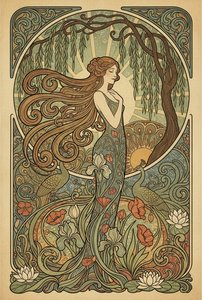
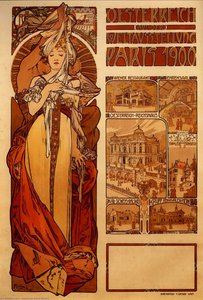
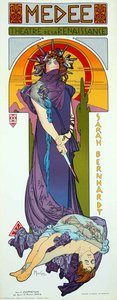 Untitled (8927)
Discover Alphonse Mucha’s "Untitled (8927)", a stunning Art Nouveau poster featuring Medée & Jason. Explore its intricate details, symbolism & timeless beauty – a masterpiece of Czech art.
The pivotal moment in Mucha’s career arrived unexpectedly in late 1894. A chance encounter led to a commission for a theatrical poster advertising Sarah Bernhardt's performance of *Gismonda*. Bernhardt, the most celebrated actress of her time – a true diva and icon – became his muse and patron. The resulting poster was a revelation. Departing from the prevailing graphic styles of the day—often bold and brash—Mucha’s design embraced a delicate aesthetic: flowing lines, intricate floral motifs, and a serene depiction of Bernhardt herself, framed by Byzantine-inspired ornamentation.
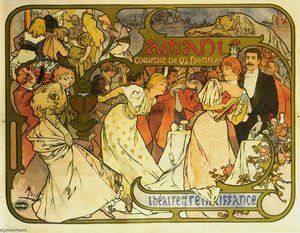
The success was immediate and overwhelming. Bernhardt, captivated by the poster's unique charm, secured an exclusive six-month contract with Mucha for all her theatrical advertising. This period saw the birth of what became known as “Le Style Mucha,” a term coined to describe his instantly recognizable aesthetic. He didn’t merely create posters; he crafted immersive visual experiences that extended beyond simple promotion. His designs weren't just about selling tickets; they were about evoking mood, conveying character, and celebrating the artistry of Bernhardt herself. The posters became collector’s items, transforming the humble advertising medium into a respected art form and establishing Mucha as a leading figure in the burgeoning Art Nouveau movement.
Decoding the Aesthetic: Key Characteristics of Mucha’s Art Nouveau
Art Nouveau ( AR(T) noo-VOH; French: [aʁ nuvo] ; lit. 'New Art'), Jugendstil in German, is an international style of art, architecture, and applied art, especially the decorative arts. It was often inspired by natural forms such as the sinuous curves...
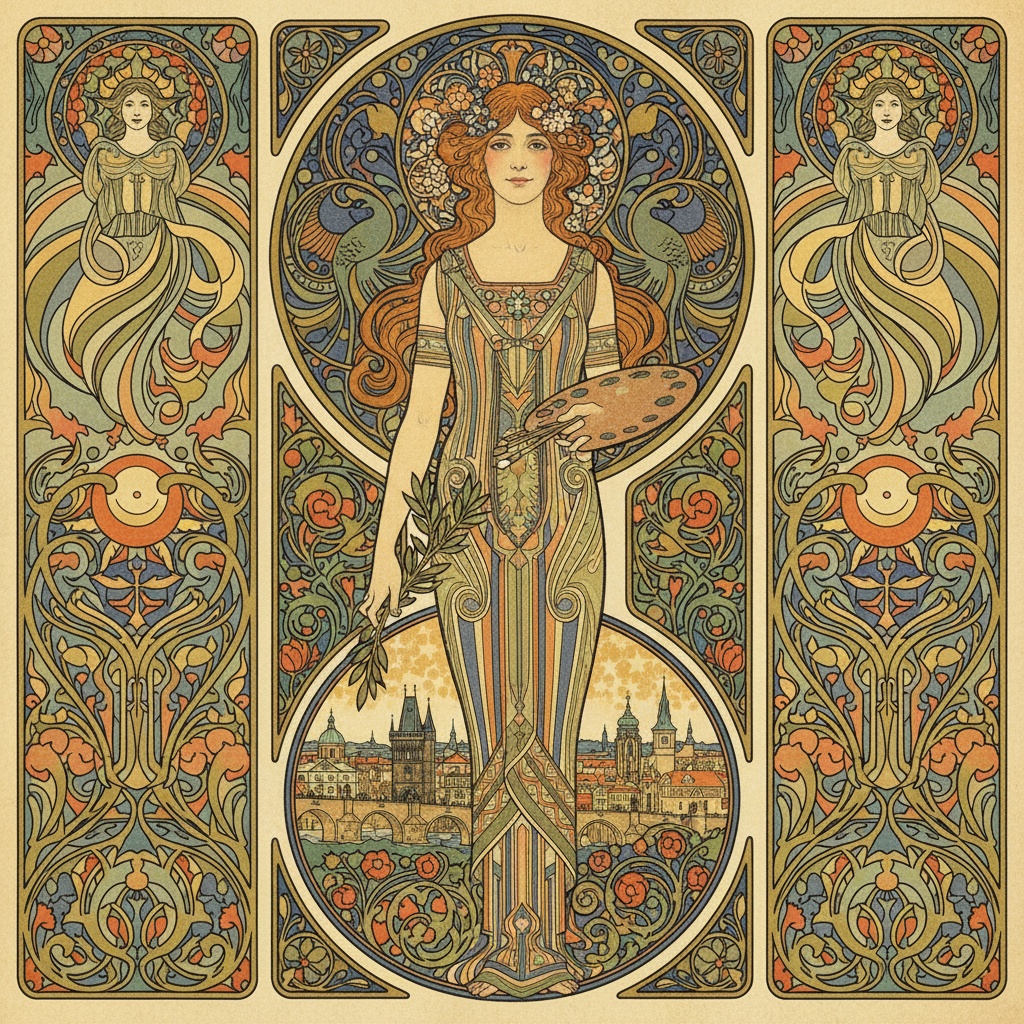
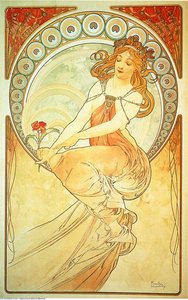
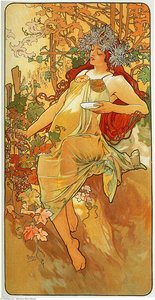
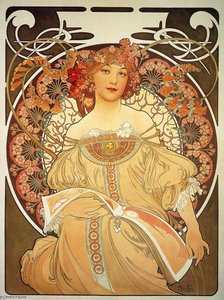
Mucha's Art Nouveau style is instantly recognizable, defined by a harmonious blend of natural forms, decorative ornamentation, and idealized femininity. Central to his aesthetic are flowing, curvilinear lines – often described as “whiplash” curves – that evoke organic growth and movement. These lines aren’t merely stylistic flourishes; they represent a deliberate rejection of the rigid geometry favored in earlier artistic traditions.
Floral motifs abound in Mucha's work, particularly poppies, lilies, and irises, symbolizing beauty, sensuality, and the ephemeral nature of life. He masterfully integrated these natural elements with stylized depictions of women – often adorned with elaborate hairstyles and flowing draperies – creating a sense of ethereal grace and elegance. The use of muted color palettes—soft pastels, golds, and earth tones—further enhances this delicate atmosphere. Beyond aesthetics, symbolism plays a crucial role. His compositions frequently incorporate allegorical figures and references to classical mythology, adding layers of meaning and intellectual depth. The halo-like ornamentation surrounding his female subjects hints at religious iconography, reflecting Mucha’s own spiritual inclinations.
Beyond the Poster: Decorative Panels, Illustrations, and a Broader Artistic Vision
While celebrated for his theatrical posters, Mucha's artistic output extended far beyond this realm. He seamlessly transitioned into designing decorative panels, book illustrations, and even jewelry, applying his signature style to a diverse range of mediums. His decorative panels – often featuring idealized women surrounded by floral motifs – were immensely popular, adorning homes and public spaces across Europe.
Job, for example, exemplifies this period, showcasing the elegance and intricate detail that defined his work. His illustrations, particularly those for *Les Fleurs* (Flowers) and various Czech literary works, demonstrate a remarkable ability to capture both beauty and narrative depth. He wasn’t simply illustrating text; he was creating visual poems that complemented and enhanced the written word. This versatility underscored Mucha's artistic breadth – he wasn’t confined by genre but rather sought to elevate the aesthetic quality of everyday objects and experiences.
The Slav Epic: A Monumental Testament to Czech Nationalism
At the age of 57, after decades of international acclaim, Mucha embarked on his most ambitious project yet: *The Slav Epic*. This series of twenty monumental canvases – depicting key moments in the history of Slavic peoples – was a deeply personal undertaking, fueled by his unwavering commitment to Czech nationalism and a desire to celebrate the cultural heritage of his homeland. He dedicated over thirty years to this endeavor, working tirelessly on each canvas with meticulous detail.
The *Slav Epic* is not merely a historical chronicle; it’s a powerful visual narrative that seeks to inspire national pride and unity. The scale of the paintings is breathtaking – each one a vast panorama filled with intricate figures and symbolic imagery. Mucha returned to his roots, drawing inspiration from Czech folklore, religious traditions, and historical accounts. He presented the completed series to the Czech nation in 1928, ten years after achieving independence, viewing it as his most important contribution to his country’s cultural identity.
Mucha's Enduring Legacy and Influence on Modern Design
Alphonse Mucha’s influence extends far beyond the Belle Époque. His distinctive style continues to resonate with artists and designers today, inspiring countless interpretations and adaptations. His emphasis on flowing lines, natural forms, and idealized femininity has left an indelible mark on graphic design, illustration, and fashion.
Untitled (8927), for example, remains a potent symbol of Art Nouveau’s enduring appeal. His work paved the way for new approaches to advertising and visual communication, transforming the poster from a simple promotional tool into a respected art form. Moreover, his commitment to celebrating cultural heritage – exemplified by *The Slav Epic* – continues to inspire artists seeking to express their own national identities through their work. ArtsDot.com offers a stunning collection of Mucha’s masterpieces, allowing you to experience the beauty and elegance of Art Nouveau firsthand. Explore our range of handmade oil paintings and museum-quality prints, and discover the enduring legacy of this remarkable artist.