
Defining American Regionalism: The Aesthetic of Authenticity for Modern Interiors
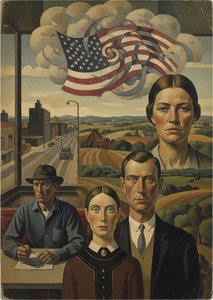 Echoes of Place: Regionalism & American Identity in Interwar Art
The Rise of Regionalism: A Response to Modernity & Crisis Wikipedia: Regionalism (art) American Regionalism is an American realist modern art movement that included paintings, murals, lithographs, and illustrations depicting realistic scenes of rural...
In the rapidly evolving landscape of global hospitality, where sterile minimalism often dominates, there exists a profound opportunity to anchor a space with narrative depth and historical weight. American Regionalism offers precisely this—a movement that emerged in the 1930s not merely as an aesthetic choice, but as a soulful response to the turbulence of the Great Depression and the perceived detachment of European avant-garde movements like Cubism and Surrealism. For the discerning hotel designer, integrating Regionalist art is an exercise in introducing authenticity into a transient environment. Unlike the fragmented realities of modern abstraction, Regionalism seeks to reaffirm the beauty of the familiar, focusing on the rhythmic cycles of rural life and the quiet dignity of small-town existence.
This movement was a deliberate countercurrent to cosmopolitan detachment, looking inward toward the American heartland to find stability and identity. By incorporating these works, a designer does more than decorate a wall; they curate an atmosphere of groundedness and permanence. The movement’s commitment to portraying life as it was—unvarnished, honest, and deeply connected to the soil—provides a perfect tonal foundation for boutique hotels or luxury lodges seeking to evoke a sense of place and heritage. It is an art of the tangible, making it an ideal choice for interiors that aim to resonate with the human need for connection and stability.
Thematic Elements: Utilizing Rural Landscapes and Small-Town Narratives in Hotel Decor
American realism was a movement in art, music and literature that depicted contemporary social realities and the lives and everyday activities of ordinary people. The movement began in literature in the mid-19th century, and became an important tende...
The power of Regionalist art lies in its ability to transform a corridor or a lobby into a window onto a storied landscape. The thematic core of this movement revolves around the landscape as identity. When selecting pieces for a hospitality project, one must consider how the imagery of rolling hills, weathered farmhouses, and sun-drenched plains can influence the psychological comfort of a guest. There is an inherent tranquility in the depiction of the American Midwest—a sense of vastness tempered by the intimacy of local life. These works often utilize a restrained palette of warm earth tones, such as ochres, browns, and deep yellows, which naturally complement organic interior materials like reclaimed wood, leather, and stone.
Beyond mere scenery, the movement captures the dignity of labor and the quiet moments of solitude. A painting that depicts a solitary farmhouse or a bustling small-town street serves as a conversation piece, inviting guests to reflect on the enduring power of place. For designers working on large-scale projects, these themes can be layered into the architectural fabric. Imagine a suite where the artwork mirrors the ruggedness of the exterior environment, or a restaurant lounge where the light-drenched landscapes provide a soft, atmospheric backdrop to a sophisticated dining experience. The goal is to use these narratives to bridge the gap between the built environment and the natural world.
Curating the Collection: Selecting Masterpieces from Grant Wood to Edward Hopper
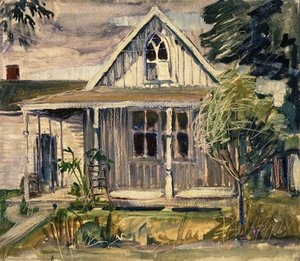
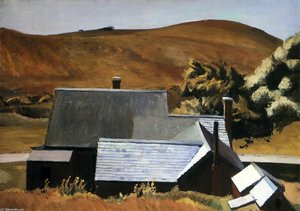 Burly Cobb's House, South Truro
A Quiet Moment: Exploring Edward Hopper’s *Burly Cobb's House, South Truro* (1933) Burly Cobb's House, South Truro*, painted in 1933, offers a compelling glimpse into the American landscape through the discerning eye of Edward Hopper. This work isn’t...
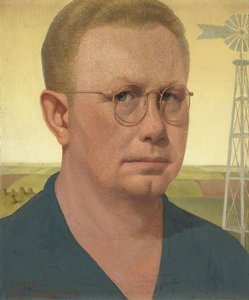
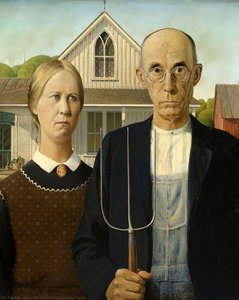
Curating a collection of Regionalist works requires an eye for both iconographic strength and stylistic nuance. At the heart of this movement stands Grant Wood, whose mastery of the Midwestern aesthetic—most famously captured in American Gothic—brought a sense of structured, almost Flemish-inspired precision to American subjects. His work offers a rhythmic, highly composed elegance that fits perfectly within formal or classically inspired hotel lobbies. For designers seeking a more evocative and atmospheric approach, the works of Edward Hopper provide an unparalleled study in light and solitude. While often associated with urban alienation, Hopper’s depictions of rural settings, such as his studies of New England farmhouses, offer a compelling sense of stillness and contemplative depth.
A successful curation might also look toward the subtle realism of artists like Levi Wells Prentice, whose sensitivity to light and detail captures the essence of the American landscape with an almost uncanny precision. When selecting pieces for a large-scale installation, consider the interplay between different masters. You might pair the structured, iconic imagery of Wood with the more impressionistic, light-focused works of others to create a dynamic visual journey. The key is to ensure that each selected piece contributes to a cohesive narrative of place, ensuring that the collection feels like a curated gallery rather than a random assortment of prints.
Strategic Implementation: Multi-Panel Layouts and Large-Scale Murals for Grand Atriums
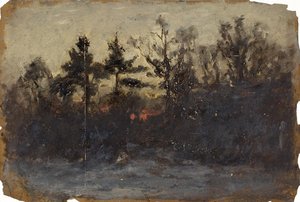 Untitled landscape 2
Admire "Untitled Landscape 2" by Theodore Clement Steele – a luminous American Impressionist masterpiece. Explore serene beauty & evocative landscapes. Hand-painted reproduction available.
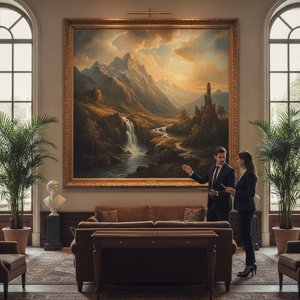
For architects and designers managing grand atriums or expansive corridors, a single canvas often fails to command the necessary scale. This is where the multi-panel trend becomes an essential tool in the designer's repertoire. By splitting a singular Regionalist landscape across three, four, or even five panels, you can create a sweeping, cinematic experience that guides the guest through a space. These multi-panel configurations allow for a modern, architectural look that breaks up the visual weight of a large wall while maintaining the continuity of the brushstrokes and color transitions across every panel.
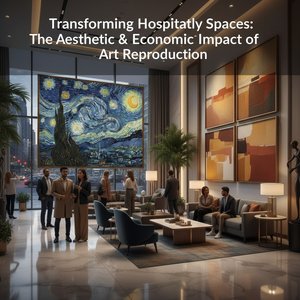
Furthermore, for truly monumental spaces, the application of large-format murals and frescoes can redefine the entire volume of a room. Recreating historical landscapes or even ceiling frescoes on massive canvas rolls allows a designer to transform a standard hotel ceiling into a breathtaking sky or a lush, pastoral canopy. This level of customization enables the recreation of historical grandeur in any contemporary setting, much like the way high-end wallpaper functions but with the added prestige and texture of hand-painted oil. Such large-scale implementations turn architectural elements into immersive art installations, leaving a lasting impression on every visitor.
Sourcing with Efficiency: Procurement Solutions for High-Volume Hospitality Projects
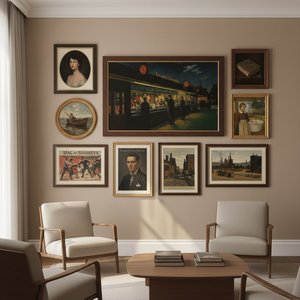 American Realism's Defining Works: 10 Masterpieces for Your Home
Introduction Imagine stepping back in time to a nation grappling with rapid industrialization, urbanization, and social change. This was America in the late 19th and early 20th centuries – a period of immense upheaval and profound questioning. The pr...
In the professional realm of hospitality procurement, the challenges are often logistical: managing budgets, meeting tight deadlines, and ensuring consistent quality across multiple properties. For the procurement manager or interior designer, sourcing fine art must be as efficient as it is aesthetic. The ability to access a deep catalog of hand-painted oil reproductions allows for the realization of high-concept designs without the prohibitive costs of original masterpieces. This approach provides the tactile depth of real paint—visible brushstrokes and a rich tonal range—that digital prints simply cannot replicate, ensuring that even large-scale installations maintain a premium, museum-grade feel.
Efficiency in sourcing is further enhanced by modern service capabilities, such as Professional Digital Mockup Services, which allow designers to visualize the composition and color matching on their specific walls before production begins. This eliminates uncertainty during the design phase of large-scale projects. Additionally, the ability to customize orders—requesting specific sizes, framing options like MirrorWrap or ExtendedWrap, or even "remixing" styles—ensures that the artwork is perfectly integrated into the project's technical specifications. When sourcing for volume, the focus remains on operational reliability: clear pricing, VAT-compliant documentation, and dependable global shipping via partners like DHL or FedEx, ensuring that the art arrives on schedule to meet the demands of a grand opening.