

Introduction
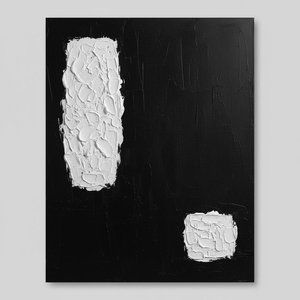
Forget everything you think you know about a "blank canvas." When we talk about white in the world of fine art, we aren't talking about emptiness or a lack of color; we are talking about light, texture, and pure, unadulterated impact. There is a profound, electric energy that happens when an artist masters the spectrum of ivory, pearl, alabaster, and bone. It is a high-stakes game of shadows and highlights where the slightest brushstroke can shift the entire mood of a room.
Historically, the use of white has been a technical flex for the world's most daring creators. From the heavy, sculptural impasto layers that make a canvas feel three-dimensional to the ethereal, light-drenched atmospheres that seem to glow from within, these works have pushed the boundaries of what paint can actually do. While some movements used white to evoke classical purity, others—especially the bold, graphic rebels of the modern era—have used it to create high-contrast, punchy compositions that demand your attention the second you walk into a space.
In today's design-conscious world, these pieces remain incredibly relevant. They act as the ultimate "anchor" for any contemporary interior, providing a clean, sophisticated aesthetic that feels both timeless and cutting-edge. A painting dominated by white tones doesn't just sit on your wall; it breathes light into your environment, offering a sense of space and clarity that darker, heavier works simply cannot match.
Get ready to dive into a curated selection of visual powerhouses. We are stripping away the noise to focus on the brilliance of the bright side. From legendary masterpieces that redefined light to contemporary icons of minimalism, here are the Top 10 Famous Paintings Dominated by White Tones that prove sometimes, the most powerful statement is the one made with the brightest palette.
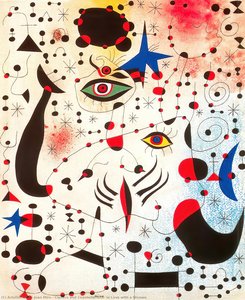
Ciphers and Constellations, in Love with a Woman - Joan Miró
 Ciphers and Constellations, in Love with a Woman - Joan Miró
Owning Ciphers and Constellations, in Love with a Woman by Joan Miró isn’t just a purchase; it is an inheritance of the Surrealist soul. As part of our exploration into the top 10 famous paintings dominated by white tones , this 1941 masterpiece stands out not through heavy pigment, but through its expansive, creamy off-white void that breathes life into a cosmic dance. Miró uses this luminous negative space as a stage for a high-impact visual rhythm, where sharp black lines, sudden bursts of primary red, and watchful, wandering eyes collide.
The piece feels like a fever dream captured on paper—a constellation of symbols representing fate and desire floating in an ethereal, light-drenched vacuum. There is a profound, rhythmic energy in how the stark white background allows the biomorphic shapes to vibrate with intensity. Bringing this lineage of taste into your own space means more than decorating a wall; it is about inviting a piece of art history’s most hypnotic visual language to live alongside you, turning your home into a curated gallery of modern legend.
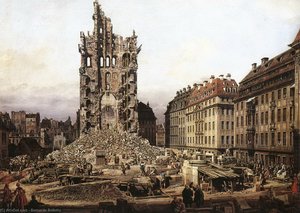
The Ruins of the Old Kreuzkirche in Dresden - Bernardo Bellotto
 The Ruins of the Old Kreuzkirche in Dresden - Bernardo Bellotto
Unveiling The Ruins of the Old Kreuzkirche in Dresden by Bernardo Bellotto is like stepping into a high-definition window to the 18th century, where the heavy atmosphere of history meets a striking, pale architectural palette. As one of our Top 10 Famous Paintings Dominated by 'White' Tones , this masterpiece uses desaturated, light-drenched textures to command attention. Bellotto masterfully employs bone-whites, ash grays, and sun-bleached stone to highlight the skeletal remains of the church, creating a luminous yet somber contrast against the debris.
This isn't just a cityscape; it is an emotional powerhouse. The way the light hits the crumbling masonry provides a sophisticated, neutral anchor for modern luxury interiors, offering a sense of timelessness and architectural depth. For the design-conscious collector, the painting’s ability to blend the stark, bright tones of destruction with the gritty reality of reconstruction offers a profound narrative of resilience. It is a high-impact statement piece that brings a refined, historical soul to any contemporary space.
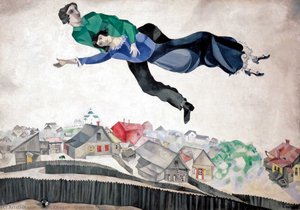
Over the town - Marc Chagall
 Over the town - Marc Chagall
In Over the town , Marc Chagall captures that breathless, weightless moment of pure euphoria, where the gaze of the floating figures reflects a profound sense of liberation and romantic transcendence. As one of the most striking entries in our list of top 10 famous paintings dominated by white tones , this 1918 masterpiece uses a luminous, airy palette to bridge the gap between reality and a dreamscape. The way the pale, ethereal light washes over the stylized cityscape creates a psychological depth that feels both intimate and infinite, acting as a universal mirror for our own deepest yearnings for escape.
The composition relies on a delicate balance of soft whites and muted earth tones, punctuated by sudden bursts of color that prevent the scene from feeling static. Integrating this piece into your home does more than just decorate a wall; it transforms a personal sanctuary into a space for profound reflection and calm. By bringing this surrealist vision of flight and connection into your interior, you invite a sense of poetic stillness and light-drenched wonder into your everyday life.
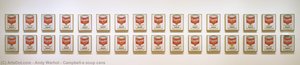
Campbell's soup cans - Andy Warhol
 Campbell's soup cans - Andy Warhol
There’s a gaze in Campbell's soup cans by Andy Warhol that follows you—not with judgment, but with understanding . This isn’t just a collection of grocery icons; it is a mirror reflecting our shared obsession with mass culture and the beauty found in the mundane. As one of the most striking entries in our list of famous paintings dominated by white tones , Warhol uses that crisp, clinical white background to make the vibrant reds and sharp commercial branding pop with an electric, high-impact energy.
The grid layout creates a rhythmic, hypnotic pulse, where the stark negative space acts as a breathing room for the repetitive, mechanical beauty of the cans. When you bring this piece into your space, it doesn't just decorate a wall; it reminds you that even the most everyday objects can be elevated to legendary status. It is a bold, graphic statement that turns your interior into a curated urban gallery, proving that true style lives in the intersection of pop culture and pure, luminous light.
Broadway Boogie Woogie - Piet Mondrian
 Broadway Boogie Woogie - Piet Mondrian
Forget everything you know about static canvas; in Broadway Boogie Woogie , Piet Mondrian doesn't just use white—he uses it as a rhythmic stage. Imagine the high-voltage pulse of Manhattan in 1943, where the stark, clean white background isn't just empty space, but the very air vibrating with jazz. It is the essential silence between the notes of a boogie-woogie beat.
Mondrian composed this masterpiece like a sonic architect. The brilliant white expanse acts as a high-contrast canvas for those electric yellow, red, and blue grids to dance across. Every intersecting line feels like a neon streak against a bright city morning. This isn't just an abstract painting; it is the invention of light through geometry. When you look at this piece, the white tones don't just reflect your room's lighting—they amplify it, creating a sense of infinite, structured energy. It’s a masterclass in how a dominant light palette can turn a flat surface into a portal of pure, urban movement, making it an absolute icon for any modern, design-conscious space.
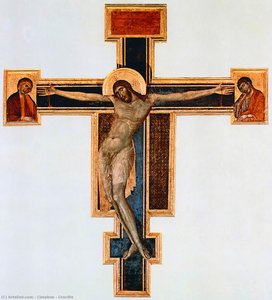
Crucifix - Cimabue
 Crucifix - Cimabue
Before the Renaissance fully broke free from the rigid, flat icons of the Byzantine era, there was a moment of profound transition where light began to breathe life into divinity. In this pivotal era, Crucifix by Cimabue emerges as a masterclass in using high-contrast tones to anchor the viewer's soul. While much of the panel is steeped in the solemnity of deep blues and rich golds, it is the striking use of pale whites and creams against the dark, heavy wood of the cross that commands the eye.
The figure of Christ is rendered with a startling, luminous pallor, his body draped in a flowing white cloth that cuts through the surrounding shadows like a sudden burst of clarity. This intentional use of bright, desaturated tones creates a focal point of pure, sacrificial light amidst the grief of the flanking figures. Cimabue’s ability to manipulate these lighter pigments brings a nascent anatomical depth and a haunting, visceral emotion to the wood panel. It is this dramatic interplay of brightness and shadow that secures its place among the top 10 famous paintings dominated by white tones , proving that even in the darkest themes, light remains the ultimate storyteller.
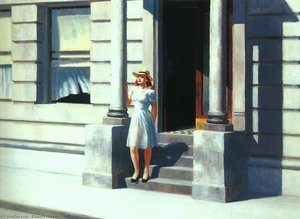
Summertime - Edward Hopper
 Summertime - Edward Hopper
Edward Hopper’s 1943 masterpiece, Summertime , is a masterclass in the power of high-contrast minimalism. While many look for heavy pigments, this piece commands attention through its brilliant use of light and expansive, bleached architectural tones. The painting captures a profound moment of urban solitude, where the stark, sun-drenched whites of the classical building meet deep, dramatic shadows, creating a visual tension that feels incredibly modern.
In this work, the white tones aren't just background; they are the stage for a psychological drama. The way the light hits the stone steps and the woman’s straw hat evokes a sense of heat and heavy stillness. For today’s design-conscious collector, this aesthetic resonates deeply with the contemporary obsession with clean lines and "quiet luxury." It’s a piece that brings a sophisticated, cinematic atmosphere to any space, proving that the most impactful stories are often told through the brightest highlights and the most intentional use of negative space.
All Saints day I - Wassily Wassilyevich Kandinsky
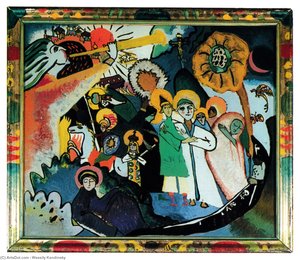 All Saints day I - Wassily Wassilyevich Kandinsky
In All Saints Day I , Wassily Kandinsky orchestrates a celestial explosion where light does not merely illuminate the canvas—it defines the very soul of the composition. The work is anchored by a brilliant, sun-like central orb that radiates a pure, high-impact glow, acting as the primary engine for this top painting dominated by white tones and luminous highlights. This masterful command of illumination creates a dramatic interplay between radiant brightness and saturated, non-naturalistic colors, pushing the boundaries of early Expressionism.
Kandinsky’s ability to use light as a spiritual force secured this piece's legendary status; the way the white brilliance pierces through swirling, geometric shapes creates a sense of divine movement. When brought into a modern interior, a high-quality oil reproduction of this masterpiece offers more than just color—it provides a focal point of pure energy. The visible impasto textures and the stark, bright highlights add an incredible layer of depth and luxury, transforming a contemporary wall into a window of spiritual dynamism and sophisticated design.
Still life no. 20 - Tom Wesselmann
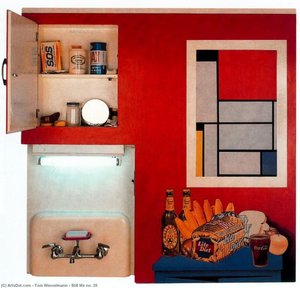 Still life no. 20 - Tom Wesselmann
In Still Life no. 20 by Tom Wesselmann, the mundane becomes a high-voltage explosion of graphic energy, freezing a fragment of post-war consumerism in a state of eternal, vibrant tension. This masterpiece earns its place among the top paintings dominated by white tones not through emptiness, but through the strategic use of bright, clinical whites to anchor its chaotic brilliance. The stark, porcelain whites of the toilet and refrigerator act as essential visual breathers, cutting through the aggressive saturation of the red background and primary-colored packaging.
Wesselmann masterfully balances the heavy, graphic weight of commercial objects—cereal boxes and glass bottles—with a clean, almost architectural precision. The interplay of light on smooth, white surfaces creates a sense of hyper-real clarity that feels both nostalgic and incredibly modern. For the contemporary collector, this piece brings an unmistakable punch of urban sophistication; its bold lines and crisp highlights offer a high-impact focal point that transforms any minimalist interior into a curated design statement, celebrating the beauty found in the everyday.
Allegory of 'Sculpture' - Gustav Klimt
 Allegory of 'Sculpture' - Gustav Klimt
Before he became the icon of the Golden Phase, Gustav Klimt delivered a masterclass in ethereal light with Allegory of 'Sculpture' . This isn't just a painting; it is a dreamscape where white tones and marble-like textures collide to create something truly transcendent. The composition breathes through a palette of soft whites, warm golds, and muted earth tones, casting a serene, almost melancholic glow over the scene.
Klimt masterfully blends classical realism with a haunting Symbolist edge. As you gaze upon the central figure, the way light dances across the smooth, pale skin against the intricate, carved reliefs creates a profound sense of three-dimensionality. The interplay of light and shadow brings a surreal vitality to the architectural ruins, making the space feel both ancient and alive. To own a piece like this is to invite transformation into your home; it’s about surrounding yourself with the genius of Klimt’s early mastery. This work doesn't just decorate a wall—it turns your space into a gallery of the soul , where every bright, luminous stroke tells a story of beauty and mystery.
Conclusion
As the light fades on our journey through these luminous canvases, we are reminded that white is never merely an absence of color, but a profound presence of light, breath, and infinite possibility. These masterpieces do more than occupy space within a frame; they act as windows into the human spirit, capturing moments of stillness, purity, and quiet strength that resonate far beyond the museum walls. To live with such works is to invite a daily dialogue with history—to feel the textured weight of a brushstroke and the ethereal glow of a carefully rendered highlight every time you glance across a room.
We invite you to move beyond mere observation and bring this enduring grace into your own sanctuary. Whether it is the crisp, modern energy of a graphic contemporary piece or the soft, atmospheric depth of a hand-painted classic, these works possess the power to transform a house into a curated reflection of your soul. Let these tones of light and ivory shape your surroundings, serving as constant, beautiful reminders of the creativity that connects us all across time. Explore the transformative power of brightness within our full collection and find the piece that speaks to your unique light.