The Genesis of Precisionism: Sheeler’s Early Influences & Artistic Foundations
Charles Rettew Sheeler Jr., a name synonymous with the stark beauty of American industrialization, didn't emerge from a vacuum. His artistic trajectory was a carefully considered evolution, born from a unique confluence of training and exposure. Born in Philadelphia in 1883, Sheeler’s initial education at the School of Industrial Art instilled a foundational respect for draftsmanship and applied design – skills that would later prove crucial to his meticulous depictions of machinery and architecture. This practical grounding distinguished him from many of his contemporaries who pursued more purely aesthetic concerns. Following this, studies at the Pennsylvania Academy of Fine Arts under William Merritt Chase broadened his palette and introduced him to Impressionistic techniques, yet even then, a nascent desire for structure and clarity hinted at the path he would ultimately forge. A pivotal journey to Europe in 1904-5 exposed Sheeler to the Italian masters – Giotto, Masaccio, and Piero della Francesca – whose emphasis on simplified forms and monumental compositions resonated deeply. However, it was his subsequent trip with Morton Livingston Schamberg in 1908-9, and a visit to Michael and Sarah Stein’s Parisian salon, where he encountered the burgeoning Cubist movement, that truly ignited a transformative spark. While not adopting Cubism wholesale, Sheeler absorbed its analytical approach to space and form, recognizing its potential for representing the complexities of the modern world. This early period wasn't about imitation; it was about synthesizing diverse influences into something uniquely his own – a vision poised to capture the spirit of an evolving America.
Photography as Revelation: Capturing Industrial America with Unprecedented Clarity
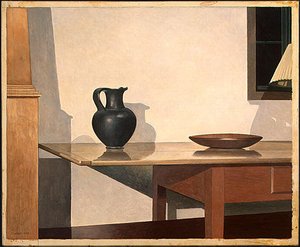 Interior 1
Explore Charles Sheeler’s ‘Interior 1’: a striking Precisionist still life featuring geometric forms & dramatic lighting. Discover this unique oil painting's balanced composition and earthy tones.
The turn of the 20th century witnessed a burgeoning fascination with photography, and for Sheeler, it wasn’t merely a supplementary skill but a fundamental mode of artistic inquiry. Initially employed as a commercial photographer documenting architectural subjects, he quickly transcended the limitations of his assignments, recognizing the medium's capacity to reveal hidden beauty in industrial landscapes. Self-taught, armed with a simple Brownie camera, Sheeler began exploring the spaces around him – particularly his beloved farmhouse in Doylestown, Pennsylvania – transforming ordinary interiors into studies of light and shadow, geometric composition, and tactile texture. This period was crucial; it wasn’t simply about *what* he photographed but *how*. He manipulated lighting, embraced unexpected viewpoints, and cropped compositions with a precision that foreshadowed his later paintings. The influence of Alfred Stieglitz cannot be overstated here. Stieglitz championed photography as a legitimate art form, encouraging Sheeler to view the camera not as a tool for mere documentation but as an instrument for artistic expression. This conviction culminated in 1920 with *Manhatta*, a groundbreaking avant-garde film created in collaboration with Paul Strand. *Manhatta* wasn’t a narrative; it was a poetic meditation on the dynamism and scale of New York City, utilizing rapid editing and striking imagery to convey the energy of modern life – a testament to Sheeler's evolving vision.
Sheeler's Masterpieces of Industry: 'River Rouge Plant' and the Celebration of Modernity
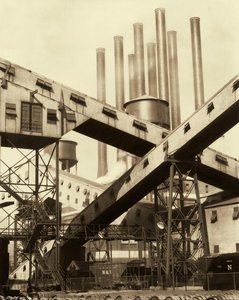
The commission from Ford Motor Company in 1927 to photograph their sprawling River Rouge plant proved to be a watershed moment. Unlike earlier depictions of factories focused on human labor, Sheeler’s images were devoid of workers; instead, he concentrated on the monolithic machinery, gleaming architecture, and intricate network of conveyors – celebrating the power and efficiency of industrial production. The resulting thirty-two photographs weren't simply documentation; they were carefully constructed compositions that elevated the factory to a cathedral of modernity. Criss-Crossed Conveyors, River Rouge Plant, for example, exemplifies this approach: interlocking geometric forms create a mesmerizing pattern, emphasizing the plant’s scale and complexity. These images weren't merely aesthetically pleasing; they reflected a broader cultural fascination with technology and progress. Sheeler wasn’t necessarily endorsing or critiquing industrialization; he was observing it – distilling its essence into a visual language of clean lines, sharp angles, and unwavering clarity. The paintings that followed, directly inspired by these photographs, further refined this aesthetic, solidifying his reputation as a leading exponent of Precisionism.
Beyond Representation: Geometric Abstraction and the Pursuit of Essential Form
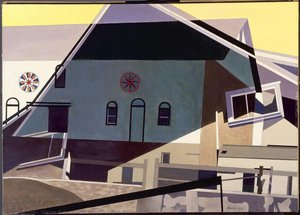 Barn Decorations
Charles Sheeler’s ‘Barn Decorations’ (1959) is a striking geometric abstraction in bold colors. Explore this Precisionist masterpiece – oil, linear design & architectural detail.
While often categorized as a Precisionist, Sheeler’s artistic ambitions extended beyond mere representation. He wasn't content to simply depict industrial subjects; he sought to reduce them to their essential forms – stripping away extraneous detail in pursuit of a more universal visual language. This is evident in works like Barn Decorations (1959), where the subject matter, though rooted in rural America, is transformed into a striking geometric abstraction characterized by bold colors and linear design. He consistently reduced compositions to simple shapes and underlying geometrical structures, with clear outlines and smooth handling of surfaces – a hallmark of his style. This pursuit of essential form wasn’t arbitrary; it was informed by his earlier studies of Cubism and the Italian masters, as well as a deep-seated belief in the inherent beauty of structure and order. Sheeler often worked in series, revisiting the same motifs through different mediums – photography, painting, drawing – each iteration revealing new facets of his vision. This iterative process allowed him to explore the interplay between representation and abstraction, ultimately creating works that transcended their subject matter.
Sheeler’s Legacy & Influence: A Cornerstone of American Modernist Painting
Charles Sheeler's impact on American modernist painting is undeniable. He wasn’t simply a chronicler of his time; he was a visionary who redefined the way we perceive industrial landscapes and architectural forms. His influence can be seen in the work of numerous subsequent artists, particularly those associated with the second generation of Precisionists. He bridged the gap between European avant-garde movements and American subject matter, creating a uniquely American aesthetic that celebrated both technology and tradition. Sheeler’s ability to seamlessly integrate photography and painting further broadened his influence, challenging conventional boundaries and paving the way for new artistic approaches. His work continues to resonate today, not only for its aesthetic beauty but also for its insightful commentary on the complexities of modern life. He demonstrated that even in the most utilitarian environments – factories, power plants, barns – there exists a profound sense of order, harmony, and visual poetry.
Collecting Sheeler: Identifying Key Works and Navigating the Market
For collectors seeking to acquire works by Charles Sheeler Jr., understanding his diverse output is crucial. While his paintings command significant prices, earlier photographs and prints offer more accessible entry points into his oeuvre. Key paintings to look for include those from the *River Rouge Plant* series, as well as his iconic depictions of New York City architecture – Upper Deck (1928-29) is a particularly sought-after example. His early photographs of Doylestown House are also highly prized for their intimate portrayal of domestic life and masterful use of light and shadow. The market for Sheeler’s work remains strong, with prices ranging from €25,000 to over €2,500,000 depending on size, medium, and provenance. Authenticity is paramount; consulting with reputable art dealers and appraisers is essential. ArtsDot.com offers a curated selection of high-quality reproductions of Sheeler’s masterpieces, allowing collectors to experience his vision firsthand. Whether you are an established collector or just beginning your journey, Charles Sheeler Jr.’s work represents a significant investment in American modernist history – a testament to the enduring power of art to capture the spirit of an age.