Early Life & Apprenticeship: From Sailor to Scene Painter
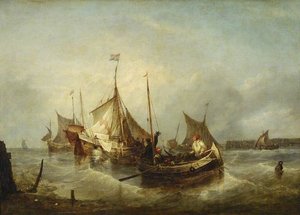
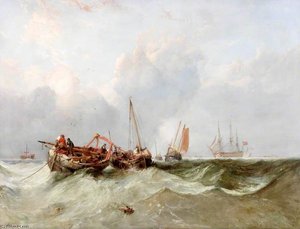
English painter, best known for his marine subjects. From 1808 to 1816 he was a sailor, mainly in the merchant service, although he was in the Royal Navy for a ...
Clarkson Frederick Stanfield’s journey to becoming one of Britain’s most celebrated marine painters was anything but conventional. Born in Sunderland in 1793, his early life was steeped in the realities of seafaring and artistic inclination – a potent combination that would define his oeuvre. His father, James Field Stanfield, a man of varied talents as an author, actor, and former seaman, named him after Thomas Clarkson, the prominent abolitionist, hinting at a family ethos of social awareness. However, it was perhaps from his mother, Mary Hoad, an accomplished artist in her own right, that young Clarkson inherited his initial artistic spark. The loss of his mother early in life prompted a somewhat itinerant upbringing, and by 1806, he found himself briefly apprenticed to a coach decorator – an experience cut short by the master’s intemperance. This led him, at just thirteen years old, to the rigorous world of the British Merchant Marine.
The years spent aboard ship were formative. They weren't merely about acquiring nautical knowledge; they were about absorbing the very essence of the sea – its moods, its colors, its unpredictable power. This firsthand experience would later distinguish his work from that of artists who relied solely on second-hand accounts or studio interpretations. Discharged from naval service in 1814 due to health concerns following a voyage to China, Stanfield’s path took an unexpected turn towards the theatrical world. In 1816, he secured a position as a decorator and scene painter at the Royalty Theatre in Wellclose Square, London. This marked the beginning of a decade-long immersion in creating illusions – vast landscapes and dramatic seascapes designed to transport audiences through spectacle.
His collaboration with David Roberts, another rising talent, further honed his skills. Together they worked on increasingly ambitious projects, culminating in the creation of “moving dioramas” – large-scale panoramic paintings that unfolded before captivated viewers, complete with sound and lighting effects. This period wasn’t simply a detour; it was crucial training in composition, perspective, and the art of creating atmosphere—skills he would later masterfully apply to his easel paintings.
The Rise of Panoramic Spectacle: Stanfield's Moving Dioramas
 Wikipedia: Clarkson Frederick Stanfield
Clarkson Frederick Stanfield (3 December 1793 – 18 May 1867) was an English painter best known for his large-scale paintings of marine art and landscapes. He was the father of the painter George Clarkson Stanfield and the composer Francis Stanfield....
The early 19th century witnessed an insatiable appetite for spectacle, and Clarkson Frederick Stanfield quickly became a leading figure in satisfying that demand. His partnership with David Roberts proved remarkably fruitful, resulting in a series of “moving dioramas” and panoramas that captivated London audiences. These weren’t static displays; they were immersive experiences designed to evoke wonder and transport viewers to distant lands and dramatic events. The technique involved painting enormous canvases that unrolled like scrolls, revealing ever-changing scenes accompanied by carefully orchestrated sound effects and lighting.
Among their most popular creations were depictions of naval battles – the Bombardment of Algiers and the Battle of Navarino – which resonated with a public fascinated by maritime history and national pride. Stanfield’s ability to capture the scale and intensity of these events, even within the confines of a theatrical setting, established his reputation as a painter capable of handling large-scale compositions and dramatic narratives. The panoramas weren't limited to military subjects; they also included scenic tours through Germany and Italy, such as “The Military Pass of the Simplon” and “Venice and Its Adjacent Islands.” These works demonstrated Stanfield’s versatility and his keen eye for capturing the unique character of different landscapes.
These ambitious projects demanded not only artistic skill but also logistical ingenuity. The sheer size of the canvases, the complexity of the mechanisms required to move them, and the coordination of sound and lighting effects were considerable undertakings. While commercially successful, these endeavors also provided Stanfield with invaluable experience in creating atmospheric effects and capturing a sense of depth and realism – qualities that would become hallmarks of his later easel paintings.
Mastering Marine Painting: Capturing the Drama of the Sea
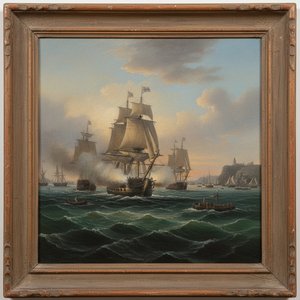
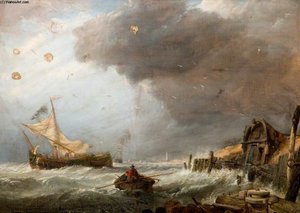
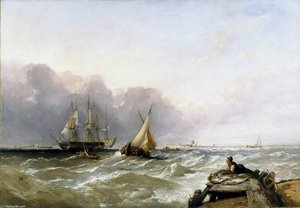 Shipping Off The Dutch Coast
Experience Clarkson Frederick Stanfield’s "Shipping Off The Dutch Coast." A captivating 19th-century marine painting showcasing dramatic seascapes & British coastal life. Acquire a stunning hand-painted reproduction.
By the 1820s, Stanfield began to focus increasingly on easel painting, particularly marine subjects. This transition wasn’t abrupt; it was a natural evolution building upon the skills honed during his years as a sailor and scene painter. He first exhibited at the Royal Academy in 1820, marking his formal entry into the established art world. However, it was through works like “Wreckers off Fort Rouge” (1827), which earned him a premium from the British Institution, that he began to gain serious recognition.
Stanfield’s marine paintings weren't simply depictions of ships and water; they were imbued with a sense of drama and atmosphere. He possessed an exceptional ability to capture the ever-changing moods of the sea – from tranquil calm to tempestuous fury. His compositions often featured dramatic lighting, powerful waves, and meticulously rendered vessels, conveying both the beauty and the danger of maritime life. Works like “Shipping Off The Dutch Coast” exemplify this mastery, showcasing a captivating 19th-century seascape that draws the viewer into the heart of the scene.
His paintings weren’t merely technically proficient; they were emotionally resonant. Stanfield understood the psychological impact of the sea – its ability to inspire awe, fear, and respect. He often depicted human figures as small and vulnerable in comparison to the vastness of the ocean, emphasizing the power of nature and the fragility of human existence. This sensitivity to emotional nuance set his work apart from other marine painters of the time.
Stanfield’s Landscapes: Evoking Atmosphere and Emotion
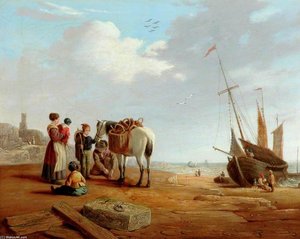
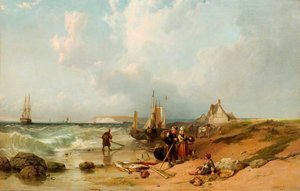 Sands Near Boulogne
Experience 'Sands Near Boulogne' by Clarkson Frederick Stanfield – a dramatic 19th-century marine painting of a coastal scene. Explore this captivating artwork today!
While best known for his seascapes, Stanfield was also a gifted landscape painter. His travels throughout Europe – Germany, Italy, Spain, and the Netherlands – provided him with a wealth of inspiration, which he translated into evocative paintings that captured the unique character of each region. He wasn’t interested in simply replicating topographical details; rather, he sought to convey the atmosphere and emotional essence of a place.
Paintings like “Sands Near Boulogne” demonstrate his ability to capture the subtle nuances of light and shadow, creating a sense of depth and realism. His landscapes often featured dramatic skies, rugged coastlines, and meticulously rendered vegetation, conveying both the beauty and the wildness of nature. He frequently employed a technique of layering colors and textures to create atmospheric effects, drawing the viewer into the scene.
Stanfield’s landscapes weren't devoid of human presence; however, his figures were often secondary to the overall composition, serving as accents that emphasized the scale and grandeur of nature. He was particularly adept at capturing the interplay between light and water, creating a sense of movement and dynamism in his paintings. This ability to evoke atmosphere and emotion made his landscapes highly sought after by collectors.
Legacy and Influence: A Romantic Vision Endures
Clarkson Frederick Stanfield’s impact on British art was profound. Elected Associate Member of the Royal Academy in 1832 and a full Academician in 1835, he became a leading figure in the artistic establishment. His elevation was partly due to commissions from William IV, who admired his work and recognized his talent. Throughout his career, Stanfield consistently produced powerful and popular works that resonated with a wide audience.
His influence extended beyond his own paintings. He inspired a generation of marine painters, including his son, George Clarkson Stanfield, who followed in his footsteps. His dramatic compositions, atmospheric effects, and emotional sensitivity set a new standard for seascape painting. Furthermore, his close friendship with Charles Dickens – he illustrated several of Dickens’ novels and was dedicated “Little Dorrit” to him – cemented his place in Victorian literary circles.
Today, Stanfield’s paintings are held in major museums around the world, including the National Gallery in London and the Victoria & Albert Museum. His works continue to captivate audiences with their beauty, drama, and emotional depth. At ArtsDot, we offer stunning hand-painted reproductions of his masterpieces, allowing you to experience the power and majesty of Stanfield’s vision firsthand. Whether it's the turbulent seas of “A Dutch Dogger Carrying Away Her Sprit” or the tranquil beauty of “Sands Near Boulogne”, Stanfield’s legacy endures as a testament to the enduring appeal of Romantic art. Explore our collection and bring a piece of this captivating world into your home.