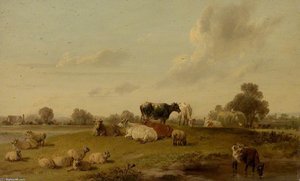
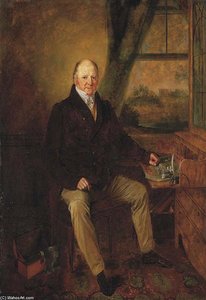
Early Life and Patronage: The Foundations of Bristow’s Career
Edmund Bristow (1 Apr 1787 – 12 Feb 1876) was an English animal, still life and subject painter. == Life and work == Bristow was born in Eton, Berkshire, the son of an heraldic painter. At an early age he was patronised by the Princess Elizabeth, ...
Edmund Bristow, born in Eton in 1787, emerged into a world already steeped in artistic tradition – his father was an heraldic painter, providing a foundational exposure to meticulous detail and the demands of discerning clientele. However, Bristow's path wasn’t merely one of inherited skill; it was quickly propelled forward by early patronage from prominent figures like Princess Elizabeth and the Duke of Clarence, later William IV. This royal endorsement wasn’t simply about financial support; it signaled an appreciation for Bristow’s burgeoning talent – a sensitivity to character and a nascent ability to capture the nuances of both animal life and the social world around him. These early commissions encouraged a focus on sketching local personalities in Eton and Windsor, honing his observational skills and establishing a network that would prove crucial throughout his career. It was a fortunate beginning for an artist who would later carve out a unique niche portraying scenes of rural England with remarkable realism.
A Master of Animal Portraiture: Detail, Expression, and Sporting Subjects
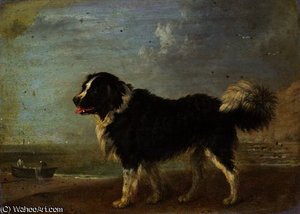 A Newfoundland dog on a seashore
Admire Edmund Bristow’s ‘A Newfoundland Dog on a Seashore’! This oil painting captures a Border Collie in stunning detail, showcasing 18th-century realism & atmospheric perspective.
Bristow’s reputation quickly solidified through his captivating animal portraiture, particularly dogs. He wasn't merely recording their physical likeness; he was delving into their personalities, capturing a sense of movement, intelligence, and even affection in each brushstroke. A Newfoundland Dog on a Seashore, for example, exemplifies this skill – the Border Collie’s coat rendered with stunning detail, its gaze conveying both alertness and gentle composure. This wasn't simply technical proficiency; it was an empathetic understanding of his subjects. Beyond individual portraits, Bristow excelled in depicting sporting scenes, capturing the energy and excitement of hunts and rural pursuits. These paintings weren’t just about the sport itself but also offered glimpses into the social fabric of the time – the camaraderie, the landscapes, and the inherent connection between humans and animals. His ability to portray these dynamic moments with such precision made him a favorite among landowners and sporting enthusiasts.
Landscapes in the Tradition of Windsor: Atmospheric Perspective and Romantic Ideals
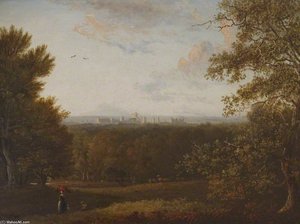 A Distant View Of Windsor From A Wood
Admire Edmund Bristow’s serene landscape of Windsor Castle! This Romantic oil painting captures a distant view with atmospheric perspective & classical detail. #art #landscape #windsorcastle
While celebrated for his animal studies, Bristow’s landscapes reveal a deeper engagement with the artistic currents of his time. A Distant View Of Windsor From A Wood beautifully illustrates this facet of his work. The painting isn't a dramatic, sweeping vista in the manner of Turner; instead, it offers a serene and contemplative view, imbued with a sense of Romantic idealism. Bristow masterfully employs atmospheric perspective, softening details and muting colors to create a convincing illusion of depth. This technique – where distant objects appear paler and less defined due to atmospheric haze – wasn’t merely a technical exercise; it evoked a feeling of tranquility and distance, inviting the viewer into the scene. His landscapes often served as backdrops for smaller narrative scenes, but even in isolation, they demonstrate a keen eye for composition and an appreciation for the subtle beauty of the English countryside.
Still Life and Domestic Scenes: Intimacy and Observation in Bristow's Work
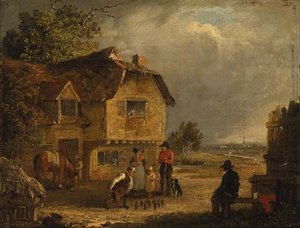 A Game Of Skittles
Discover Edmund Bristow’s ‘A Game of Skittles,’ a charming 18th/19th-century oil painting depicting rural life. Explore its realism, impasto texture & atmospheric perspective.
Bristow’s versatility extended to still life and domestic scenes, offering intimate glimpses into everyday life. Paintings like A Game Of Skittles are charming depictions of rural leisure, capturing the warmth of human interaction and the simple pleasures of community. These works aren't grand historical narratives; they are quiet moments frozen in time, rendered with meticulous detail and a gentle sense of humor. The impasto texture – the thick application of paint – adds a tactile quality to these scenes, bringing them to life and emphasizing the physicality of the objects depicted. He excelled at capturing the play of light on surfaces, from polished wood to woven fabrics, creating a sense of realism that draws the viewer into the scene. These domestic interiors reveal a keen observational skill and an ability to find beauty in the ordinary.
Bristow’s Technique: Impasto, Realism, and a Unique Artistic Voice
Throughout his diverse body of work, several key technical characteristics define Bristow's unique artistic voice. His commitment to realism is evident in every brushstroke – a dedication to accurately portraying textures, light, and form. The use of impasto, particularly noticeable in his still lifes and domestic scenes, adds depth and dimension to his paintings, creating a tactile quality that distinguishes them from more polished works. He wasn’t afraid to experiment with color palettes, often employing warm earth tones and subtle gradations to create a sense of atmosphere. However, perhaps the most defining aspect of Bristow's technique was his ability to imbue each subject – whether animal, landscape, or still life – with personality and emotion. This wasn’t simply about technical skill; it was about capturing the essence of his subjects and conveying their unique character.
Legacy and Rediscovery: Appreciating Bristow’s Contribution to 19th-Century British Art
Despite exhibiting regularly at the Royal Academy and other prominent galleries throughout his career, Edmund Bristow remained a somewhat eccentric figure – often refusing commissions and working only when inspired. This independent spirit may explain why his work wasn't as widely disseminated during his lifetime. However, in recent years, there has been a growing appreciation for his contribution to 19th-century British art. His exquisite animal portraits, serene landscapes, and intimate domestic scenes offer a fascinating glimpse into the social and cultural life of the period. Bristow’s dedication to realism, combined with his unique artistic voice, makes him a compelling figure worthy of further study and admiration. Today, collectors are increasingly recognizing the value of his work, drawn to its quiet beauty, meticulous detail, and enduring charm. At ArtsDot.com, we’re proud to offer high-quality reproductions of Bristow's masterpieces, allowing art enthusiasts to experience the captivating world he created.