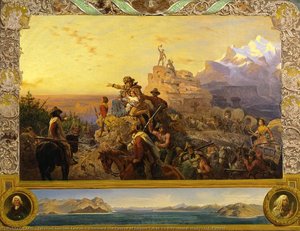
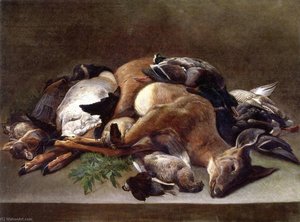
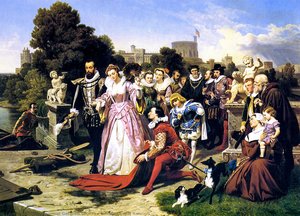
Leutze's Early Life & Artistic Formation: A Transatlantic Beginning
 Wikipedia: Emanuel Leutze
Emanuel Gottlieb Leutze (May 24, 1816 – July 18, 1868) was a German-born American history painter, best known for his 1851 painting Washington Crossing the Delaware. He is associated with the Düsseldorf school of painting. == Biography == Leutze wa...
Emanuel Gottlieb Leutze’s story is, at its core, a transatlantic one—a narrative woven from the threads of European heritage and the burgeoning spirit of American identity. Born in 1816 in Schwäbisch Gmünd, Württemberg, his childhood was marked by a relatively conventional upbringing until the family emigrated to the United States in 1825, settling first in Fredericksburg, Virginia, then Philadelphia. This relocation wasn’t merely geographical; it represented a conscious embrace of a new world, one brimming with democratic ideals and untamed potential. However, the path was not without hardship. The early death of his father in 1831 forced young Emanuel to shoulder responsibilities beyond his years, supporting his mother through portraiture—a practical necessity that nonetheless provided crucial foundational training. These early portraits, though modest in scale, reveal a nascent talent for capturing likeness and an emerging sensitivity to the human form. It was during this period of self-reliance and artistic exploration that the seeds of Leutze’s later grand historical visions were sown, fueled by a deep fascination with American history and a growing sense of national pride.
The Düsseldorf Years: Shaping a Romantic Historical Vision
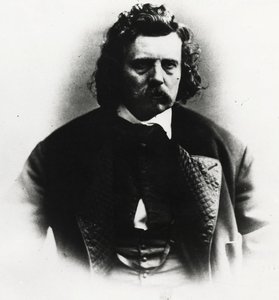 Emanuel Gottlieb Leutze
Discover Emanuel Gottlieb Leutze (1816-1868), the German-American painter famed for 'Washington Crossing the Delaware.' Explore his Romantic historical narratives & Düsseldorf School influence!
Recognizing the need for formal training, Leutze embarked on a journey back to Europe in 1840, specifically to the Kunstakademie Düsseldorf—the preeminent art school of the time. While his stay was relatively brief, lasting only a year due to disagreements with the academy’s rigid academic approach, it proved pivotal. He found himself drawn more to the influence of Karl Friedrich Lessing, whose Romantic sensibilities resonated deeply with Leutze's own inclinations. Düsseldorf, in the 1840s, was a hotbed of historical painting, and Leutze immersed himself in the works of Cornelius and Kaulbach, absorbing their techniques for dramatic composition and narrative storytelling. His travels through Italy further refined his artistic eye, exposing him to the masters—Titian and Michelangelo—and solidifying his commitment to large-scale canvases imbued with emotional power. Works like *Columbus before the Queen* demonstrate this burgeoning style, foreshadowing the ambitious historical scenes that would define his career. It was in Düsseldorf that Leutze began to formulate a distinct artistic voice, one characterized by a blend of meticulous realism and Romantic idealism.
Washington Crossing the Delaware: Beyond Patriotic Iconography
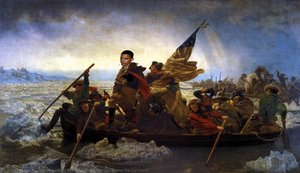
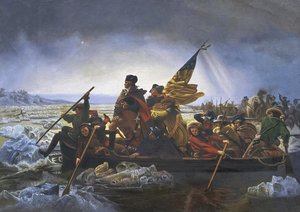
Perhaps no single painting is as inextricably linked with American identity as *Washington Crossing the Delaware*. Completed in 1850 (and tragically damaged shortly thereafter), this monumental work transcends mere historical depiction; it’s a carefully constructed myth, an embodiment of courage, determination, and the very spirit of revolution. Leutze didn't aim for strict accuracy—the boat is too small, the flag hadn’t yet been designed, and the river conditions are idealized—but rather sought to create a powerful symbol that would inspire hope in the wake of Europe’s failed Revolutions of 1848. The composition itself is masterful: Washington, stoic and resolute, stands as a beacon of leadership amidst the swirling chaos of ice and water. The diverse group of figures crammed into the boat—representing various social classes and ethnicities—underscores the unifying power of the American cause. Leutze employed American tourists and art students as models, imbuing the scene with a sense of authenticity even as it departed from strict historical fact. The painting’s enduring appeal lies not in its accuracy but in its ability to evoke a profound emotional response, transforming a specific moment in history into a timeless allegory of struggle and triumph.
Beyond 'Crossing': Leutze’s Broader Exploration of American Themes
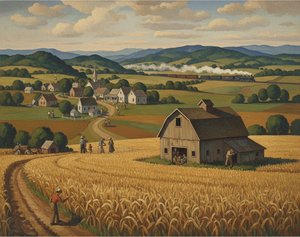
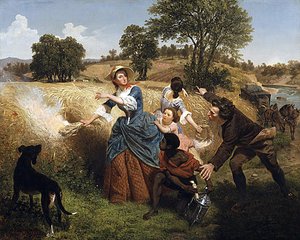 Mrs. Schuyler Burning Her Wheat Fields On The Approach Of The British
Explore Emanuel Leutze’s "Mrs. Schuyler Burning Wheat." A Romantic masterpiece depicting rural life & the British approach. Oil painting, historical narrative, & nostalgic beauty.
While *Washington Crossing the Delaware* cemented his reputation, Leutze's artistic output extended far beyond this iconic image. Paintings like *Mrs. Schuyler Burning Her Wheat Fields on the Approach of the British* and portraits such as *Thomas Mifflin (1744-1800)* reveal a broader engagement with American history and character. *Mrs. Schuyler*, for example, is a powerful depiction of rural sacrifice during the Revolutionary War, showcasing a woman’s unwavering commitment to the cause of liberty. The dramatic lighting and emotive composition are hallmarks of Leutze's Romantic style, elevating a personal act of defiance into a symbol of national resistance. Similarly, his portrait of Thomas Mifflin, though executed in black and white, demonstrates his skill in capturing formal dignity and psychological depth. Even works like *Indians and Captive*, a monochrome painting embodying loss and resilience, speak to the complexities of American expansion and the often-tragic consequences for indigenous populations. These lesser-known pieces reveal Leutze’s nuanced understanding of American history, moving beyond simplistic patriotic narratives to explore themes of conflict, sacrifice, and the enduring human spirit.
Transatlantic Resonance: The Reception and Legacy of Leutze's Work
Leutze’s paintings were not merely products *of* a transatlantic experience; they actively participated in shaping it. His works found enthusiastic audiences on both sides of the Atlantic, serving as potent symbols for Americans seeking to define their national identity and for Europeans yearning for democratic ideals. The multiple versions of *Washington Crossing the Delaware*, exhibited in New York and Washington D.C., drew massive crowds and fueled patriotic fervor during a period of increasing sectional tension. The painting’s impact extended beyond the art world, influencing popular culture and becoming deeply embedded in the American collective consciousness. However, his work wasn't without its critics. Some questioned his historical accuracy or perceived his style as overly dramatic. Despite these criticisms, Leutze remained a prominent figure in the American art scene, actively promoting artistic exchange between Europe and the United States. His legacy continues to resonate today, reminding us of the power of art to shape national narratives and inspire collective action.
Leutze as a Mirror to 19th-Century Identity & Progress
Emanuel Leutze, ultimately, was more than just a painter; he was a cultural ambassador, a passionate advocate for American ideals, and a keen observer of the shifting political landscape. His art reflects the anxieties and aspirations of the 19th century—the burgeoning sense of national identity, the complexities of westward expansion, and the ongoing struggle for democracy. His embrace of Romanticism, with its emphasis on emotion, individualism, and the power of nature, allowed him to create works that resonated deeply with audiences on both sides of the Atlantic. While his paintings may not always adhere to strict historical accuracy, they capture something far more profound: the spirit of an era—a time of revolution, progress, and a relentless pursuit of freedom. At ArtsDot.com, we are proud to offer high-quality reproductions of Leutze’s masterpieces, allowing you to experience the power and beauty of his art firsthand and connect with the enduring legacy of this remarkable transatlantic artist.