The Origins of Etching: From Armor Decoration to Printmaking
Before it graced the walls of galleries and captivated art collectors, etching emerged from a decidedly more utilitarian world – that of the armorer’s workshop. During the Middle Ages, skilled craftsmen employed acid-resistant varnishes to decorate metal surfaces, creating intricate designs on weaponry and ceremonial objects. This practice, born of necessity and aesthetic desire, laid the groundwork for what would become a revolutionary printmaking technique. While examples exist of decorative etching predating its use in artistic reproduction, it was in 15th-century Germany that the process truly began to blossom as a means of creating images on paper. Daniel Hopfer is widely credited with pioneering this shift, applying his skills honed from armor decoration to produce etched prints, often depicting religious scenes and heraldic motifs. These early etchings, though rudimentary by later standards, represent a pivotal moment – the birth of an art form capable of disseminating imagery far beyond the confines of individual patronage.
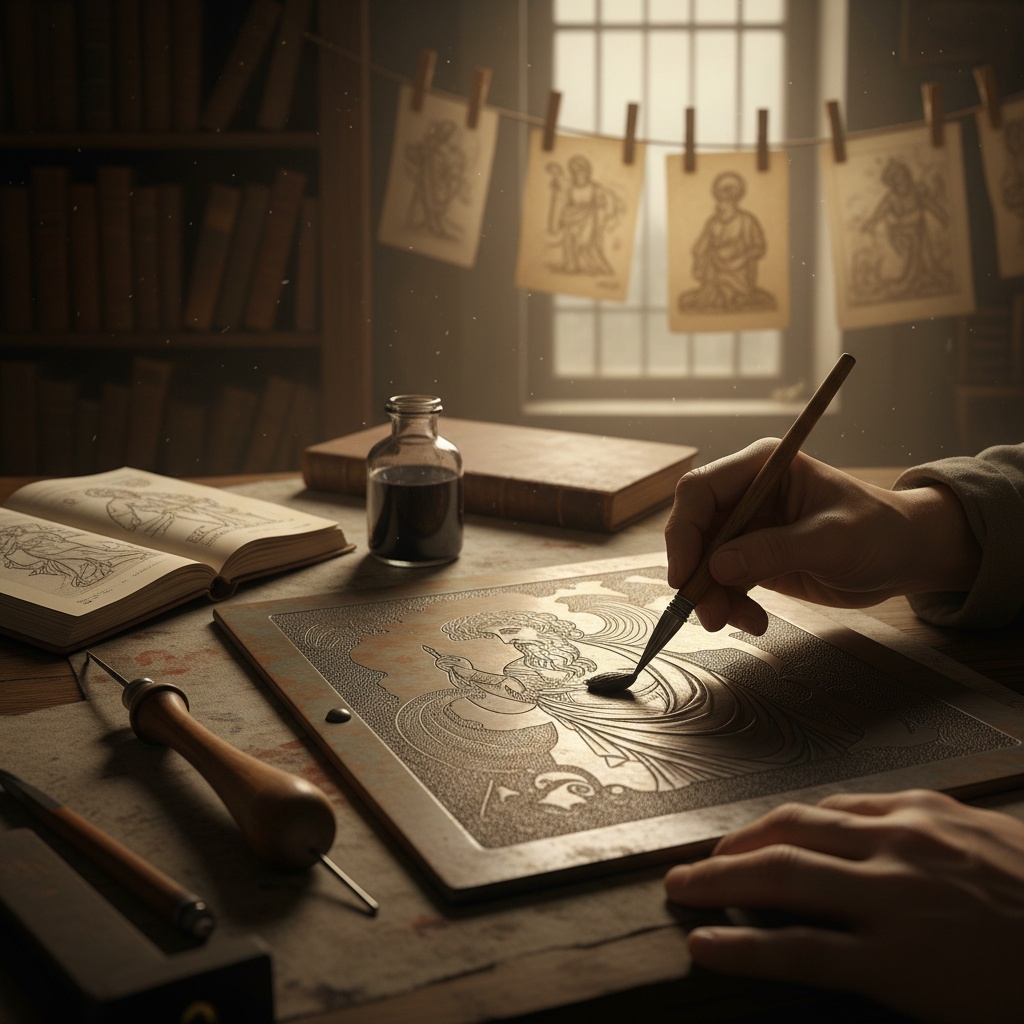
The appeal of etching lay in its relative accessibility compared to other printmaking methods like woodcut or engraving. While woodcut demanded considerable physical strength and precision carving skills, and engraving required years of apprenticeship to master the burin, etching offered a more fluid, drawing-based approach. Artists could essentially ‘draw’ their images onto a metal plate, using an etching needle to expose lines that would be bitten away by acid. This inherent connection between drawing and printmaking proved particularly attractive to artists accustomed to working with pen and ink.
Mastering the Medium: The Technical Process of Etching Explained
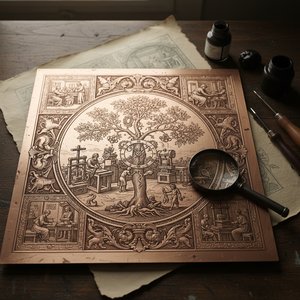
The core principle of etching revolves around controlled corrosion. A metal plate – typically copper, zinc, or steel – is meticulously polished to a mirror-like sheen, removing any imperfections that could interfere with the clarity of the final print. This smooth surface is then coated with an acid-resistant ground, a thin layer composed of wax, resin, and asphalt. The artist employs an etching needle, a sharp pointed tool, to carefully scratch away portions of the ground, revealing the bare metal beneath. This exposed metal will become the receptive area for the acid.
The plate is then immersed in an acid bath – hydrochloric acid being a favored choice – or has acid gently washed over its surface. The acid ‘bites’ into the exposed metal, creating recessed lines and areas that will ultimately hold the ink. Crucially, the duration of exposure to the acid dictates the depth and width of these recesses; longer bites result in deeper, wider lines that yield darker tones when printed. Artists often employ a technique called “stop-out,” selectively covering already bitten areas with additional ground to protect them from further corrosion, allowing for nuanced tonal variations. Once satisfied with the level of detail, the ground is removed using a solvent, leaving behind an intricate network of incised lines.
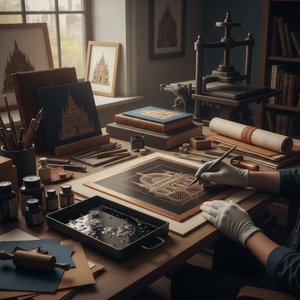
The inking process itself is a delicate art. Ink is applied across the entire plate surface and then meticulously wiped away, leaving ink only within the etched recesses. Dampened paper is then pressed firmly against the plate – traditionally using a rolling printing press – transferring the ink from the grooves to create the final image. The pressure of the press not only forces the ink onto the paper but also creates a characteristic ‘plate mark,’ an embossed line around the edges of the print, serving as a subtle signature of the intaglio process.
Rembrandt’s Revolutionary Use of Etching: Light, Shadow & Narrative Depth
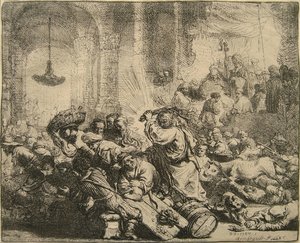
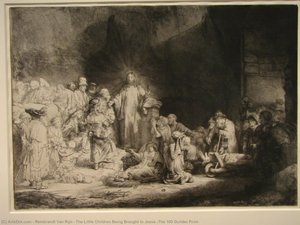 The Little Children Being Brought to Jesus (The 100 Guilder Print)
Explore Rembrandt’s ‘The Little Children,’ a masterpiece of Baroque art! Witness its dramatic light, emotional depth & innovative composition. A timeless classic by the Dutch master.
While etching quickly gained traction among Dutch artists in the 17th century, it was Rembrandt van Rijn who truly elevated the technique to unprecedented heights. He didn't merely utilize etching as a means of reproduction; he embraced it as a fully fledged artistic medium, capable of expressing profound emotional depth and dramatic narrative power. Rembrandt’s mastery lay in his innovative manipulation of acid bite, creating an extraordinary range of tonal values – from the deepest blacks to the most delicate highlights.
Consider *The Little Children Being Brought to Jesus* (often referred to as “The 100 Guilder Print”), a masterpiece showcasing Rembrandt’s unparalleled skill. The dramatic chiaroscuro—the interplay of light and shadow—is breathtaking, drawing the viewer's eye directly to the central figures. He achieved this effect through meticulous control of the acid bite, selectively protecting areas with ground to create varying levels of darkness. Similarly, *The Resurrection of Lazarus* demonstrates his ability to convey complex emotions – awe, grief, hope – through subtle gradations of tone and masterful composition. Rembrandt frequently reworked his plates, adding new details or altering existing ones over time, resulting in multiple ‘states’ of the print, each possessing its own unique character.
Rembrandt also pioneered the use of drypoint alongside etching, a technique that involved scratching directly into the metal plate with a sharp needle. Drypoint created a softer, more velvety line than etching, adding another layer of textural richness to his prints. His willingness to experiment and push the boundaries of the medium cemented his legacy as one of the greatest etchers in history.
Aesthetic Qualities and Distinctive Characteristics of Etched Prints
Intaglio ( in-TAL-ee-oh, -TAH-lee-; Italian: [inˈtaʎʎo]) is the group of printing and printmaking techniques in which an image is incised into a surface and the incised line or sunken area holds the ink. It is the direct opposite of a relief print w...
Etched prints possess a unique aesthetic character that distinguishes them from other printmaking techniques. The lines tend to be fluid and organic, reflecting the direct connection between the artist’s hand and the metal plate. Unlike the crisp, precise lines of engraving, etching often exhibits a slight burriness or softness, particularly in areas where the acid bite was less controlled.
Intaglio is a defining characteristic – the incised lines hold the ink below the surface of the plate, creating a tactile quality that can be felt as well as seen. This also results in the aforementioned plate mark, a subtle embossed line around the edges of the print, which serves as an authentication feature and testament to the printing process. The tonal range achievable through etching is remarkably broad, allowing for nuanced gradations of light and shadow that rival those found in painting.
The inherent imperfections of the process – slight variations in ink distribution, subtle burrs on the lines – often contribute to the charm and character of etched prints. These are not flaws but rather evidence of the artist’s hand and the unique nature of each impression. The ability to create multiple states of a plate also adds another layer of aesthetic complexity, allowing collectors to appreciate the evolution of an artwork over time.
Etching Beyond Rembrandt: Key Artists and Diverse Styles
While Rembrandt undoubtedly stands as the most celebrated master of etching, numerous other artists have made significant contributions to the technique. Hercules Segers, a Dutch artist contemporary with Rembrandt, experimented with unconventional methods, printing on colored paper and adding brushwork after the print was created, resulting in highly unique and painterly effects.
Francisco Goya, centuries later, employed etching – often combined with aquatint – to create his *Los Caprichos* series, a scathing social commentary filled with grotesque imagery and biting satire. James Abbott McNeill Whistler, an American artist working in the late 19th century, utilized etching to capture the atmospheric beauty of London’s canals and docks. Each artist brought their own distinct style and vision to the medium, demonstrating its versatility and enduring appeal.
The technique also found application beyond fine art, being used for topographical maps, scientific illustrations, and even decorative purposes. This broad range of applications underscores etching's adaptability and its ability to serve diverse artistic and practical needs.
The Enduring Legacy of Etching in Contemporary Art
Despite the rise of new printmaking technologies, etching continues to thrive as a vital art form today. Contemporary artists are pushing the boundaries of the medium, experimenting with unconventional materials, techniques, and subject matter. While traditional copper plate etching remains popular, artists are also exploring alternative methods such as photogravure – combining photographic imagery with etching processes – and microfabrication etching for creating intricate designs on miniature scales.
The enduring appeal of etching lies in its unique combination of technical skill, artistic expression, and tactile quality. It is a process that demands patience, precision, and a deep understanding of materials. At ArtsDot.com, we celebrate the rich history of etching by offering high-quality reproductions of masterpieces from Rembrandt and other renowned artists, allowing you to experience the beauty and artistry of this captivating medium firsthand. Explore our collection today and discover the timeless allure of etched prints.