Delacroix's Early Life & Formation: From Academic Roots to Romantic Rebellion
Ferdinand Victor Eugène Delacroix, born in 1798 amidst the waning years of the Neoclassical era, was destined to become a pivotal figure in the burgeoning Romantic movement. His upbringing, however, wasn’t one immediately steeped in artistic fervor. Though possessing aristocratic lineage – a fact subtly acknowledged throughout his life and career – Delacroix experienced a somewhat turbulent childhood marked by familial instability. While not entirely devoid of early encouragement, his formal training under Pierre-Narcisse Guérin at the Lycée Louis-le-Grand initially adhered to the established academic principles championed by Jacques-Louis David. This foundation in precise draftsmanship and classical subject matter proved crucial, ironically providing Delacroix with the technical mastery he would later so boldly subvert.
Early works like The Virgin of the Harvest (1819) reveal a nascent talent grappling with traditional forms, exhibiting a Raphael-esque grace. Yet, even in these initial attempts, a distinct emotional undercurrent began to surface – a yearning for expressiveness that set him apart from his contemporaries. The rejection of strict academic constraints wasn’t immediate; rather, it was a gradual evolution fueled by exposure to the works of Théodore Géricault, particularly the harrowing realism of The Raft of the Medusa (1819-1820). This painting served as a watershed moment for Delacroix, igniting within him a passion for dramatic narratives and a willingness to confront uncomfortable truths. The subsequent acceptance of his The Barque of Dante at the Salon of 1822 signaled not merely an artistic debut but a declaration of independence – a bold step towards forging a new path in French painting.
The Colorist’s Palette: Delacroix’s Revolutionary Use of Hue and Light
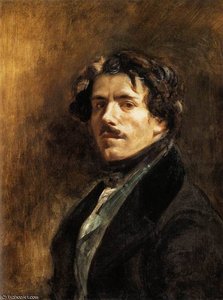 eugene self portrait
Examine Eugène Delacroix’s ‘Eugene Self Portrait,’ a Romantic masterpiece! Explore its textured oil painting, introspective mood & subtle symbolism. Discover this iconic artwork.
Delacroix is perhaps most celebrated as a master colorist, a painter who liberated hue from the constraints of line and form. Unlike his rival Ingres, who prioritized precise drawing and sculptural modeling, Delacroix embraced vibrant, often unconventional palettes and visible brushwork. He didn’t merely *apply* color; he orchestrated it – creating dynamic compositions where light itself became a palpable force. His fascination with Rubens, whose works he studied intently, was paramount. Rubens's rich textures, dramatic chiaroscuro, and emotive use of color profoundly influenced Delacroix’s approach.
He meticulously documented his observations in journals, experimenting with the interplay of complementary colors and the optical effects achieved through layering and glazing. This wasn’t simply about aesthetic preference; it was a deliberate attempt to capture emotional intensity. Delacroix believed that color possessed an inherent expressive power, capable of conveying mood, atmosphere, and even psychological states. He famously wrote against “cold exactitude,” advocating for a more intuitive and passionate approach to painting. The visible brushstrokes in his mature works weren’t signs of carelessness but rather intentional marks – evidence of the artist's hand and the energy infused into each canvas.
History, Politics, and the Canvas: Exploring Delacroix’s Engagement with His Time
Romanticism (also known as the Romantic movement or Romantic era) was an artistic and intellectual movement that originated in Europe towards the end of the 18th century. The purpose of the movement was to advocate for the importance of subjectivity...
Delacroix wasn’t an artist operating in a vacuum. The tumultuous political landscape of 19th-century France – marked by revolutions, restorations, and shifting ideologies – profoundly shaped his artistic vision. While not overtly a political activist, his work frequently engaged with themes of liberty, oppression, and national identity. The Massacre at Chios (1830), for example, depicted the brutal suppression of Greek rebels during their struggle for independence from Ottoman rule, serving as a powerful indictment of tyranny.
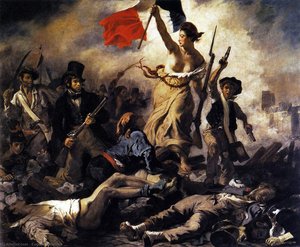
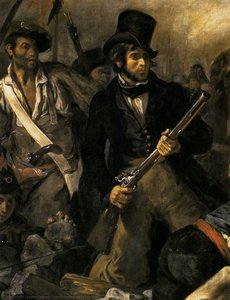
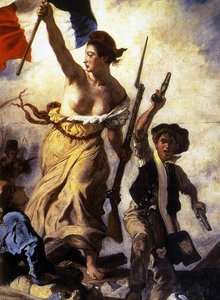
However, Delacroix’s engagement with history wasn't simply about documenting events; it was about imbuing them with emotional resonance. His most iconic work, Liberty Leading the People (1830), transcends mere historical representation to become a potent symbol of revolution and national fervor. The allegorical figure of Liberty, brandishing the French tricolor, embodies the spirit of defiance and hope. It’s important to note that Delacroix wasn't necessarily advocating for any specific political faction; rather, he was captivated by the raw energy and emotional power of revolutionary moments. His paintings often explored the complexities of human experience – the interplay between heroism and brutality, idealism and disillusionment.
Orientalism and Exotic Landscapes: A Journey Beyond European Conventions
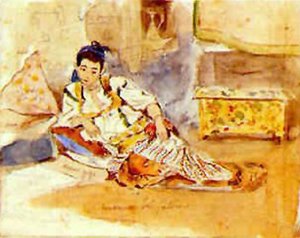 Mujer Arabe sentada
Discover 'Mujer Arabe sentada' by Delacroix – a serene watercolor capturing Romanticism’s beauty. Explore this evocative piece & its connection to Orientalist art.
In 1832, Delacroix embarked on a transformative journey to North Africa – Morocco and Algeria. This trip proved pivotal in shaping his artistic style and expanding his thematic repertoire. He wasn’t merely seeking exotic subject matter; he was driven by a desire to experience different cultures firsthand and challenge the prevailing European conventions of representation.
The resulting paintings, such as Women of Algiers (1834), are not simply depictions of “the Orient” but rather intimate portraits of individuals within their cultural context. Delacroix’s sketches reveal a keen eye for detail – the textures of fabrics, the play of light on skin, the nuances of everyday life. His work, however, also reflects the complexities and contradictions inherent in Orientalist art. While he sought to capture the beauty and dignity of his subjects, his representations were inevitably filtered through a European lens. Nevertheless, his North African paintings demonstrate a willingness to move beyond stereotypical depictions and engage with different cultures on a more nuanced level.
Legacy and Influence: How Delacroix Shaped Modern Art Movements
Delacroix’s impact on the development of modern art is undeniable. He stands as a crucial link between Neoclassicism and Impressionism, paving the way for artists who prioritized emotion, color, and individual expression. His emphasis on visible brushwork and dynamic compositions directly influenced the Impressionists, who sought to capture fleeting moments and subjective perceptions of light and atmosphere.
His rejection of academic constraints inspired generations of artists to challenge established norms and explore new forms of representation. Furthermore, his passion for exotic subject matter and vibrant palettes resonated with the Symbolist movement, which embraced dreamlike imagery and emotional intensity. Delacroix’s legacy extends beyond painting; his writings on color theory continue to be studied by artists today. He remains a towering figure in art history – a revolutionary voice who transformed how we understand the power of paint and the expressive potential of the human imagination.
- Explore Delacroix’s masterpieces at ArtsDot.com, where you can find high-quality reproductions of his iconic works.
- Discover custom painting options to bring your favorite artworks to life in the style of Delacroix.