Early Life & Artistic Formation: From Parisian Workshop to Italian Inspiration
 Wikipedia: François Boucher
François Boucher (UK: BOO-shay, US: boo-SHAY; French: [fʁɑ̃swa buʃe]; 29 September 1703 – 30 May 1770) was a French painter, draughtsman and etcher, who worked in the Rococo style. Boucher is known for his idyllic and voluptuous paintings on classi...
François Boucher, born in Paris in 1703, emerged from humble beginnings as the son of a lace designer, Nicolas Boucher, who provided his first artistic tutelage. However, it was under the guidance of François Lemoyne, a leading decorative artist of the era, that young Boucher’s talent truly began to blossom. Lemoyne recognized an exceptional potential and encouraged him to compete for the prestigious Prix de Rome in 1723 – a pivotal moment that would shape his artistic trajectory. Winning this coveted prize secured Boucher a period of study at the French Academy in Rome, though his arrival was delayed until 1728. Unlike many contemporaries who gravitated towards the imposing grandeur of Raphael and Michelangelo, Boucher found himself captivated by the baroque masters like Castiglione. This fascination with rustic subject matter and a painterly approach – prioritizing expressive brushwork over meticulous detail – would become a defining characteristic of his style, subtly diverging from the more rigid academic traditions.
The Quintessence of Rococo: Defining Boucher’s Style and Aesthetic
Rococo, less commonly Roccoco ( rə-KOH-koh, US also ROH-kə-KOH; French: [ʁɔkɔko] or [ʁokoko] ), also known as Late Baroque, is an exceptionally ornamental and dramatic style of architecture, art, and decoration which combines asymmetry, scrolling cu...
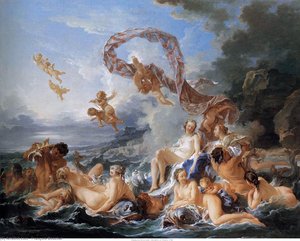
Boucher's name became synonymous with the mature Rococo style, an artistic movement that swept through France in the 18th century as a reaction against the formality of the Baroque. More than any other artist, he perfectly captured its spirit – one defined by lightness, elegance, and playful sensuality. His canvases overflowed with soft pastel colors, creamy surfaces, and a deliberate avoidance of harsh lines. Boucher’s compositions weren't intended to convey weighty moral lessons or historical narratives; instead, they offered an escape into idyllic worlds populated by flirtatious goddesses, graceful nymphs, and idealized shepherdesses. Allegorical scenes, often imbued with a subtle eroticism, were highly sought after by the French aristocracy, who found in them a reflection of their own refined tastes and leisurely pursuits. The hallmark of his work lies not just in *what* he painted – mythological tales or portraits – but *how* he painted it: with an exquisite attention to detail, a mastery of color, and a deliberate pursuit of visual pleasure.
Patronage, Courtly Life, and the Rise to Prominence under Louis XV
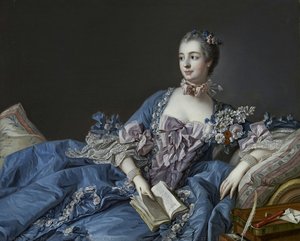
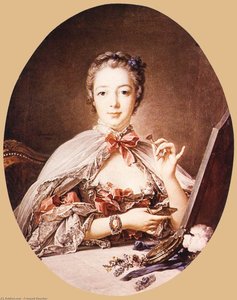 Marquise de Pompadour at the Toilet-Table
Discover François Boucher’s ‘Marquise de Pompadour at the Toilet-Table,’ a stunning Rococo portrait of aristocratic leisure & artistry. Explore its elegant details & 18th-century charm.
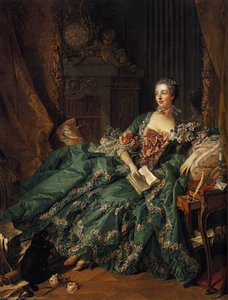
Boucher’s career flourished thanks to the unwavering support of King Louis XV and, most significantly, his celebrated mistress, Madame de Pompadour. She became his most devoted patron, commissioning numerous works for the royal residences – Versailles, Marly, Bellevue – transforming these spaces into showcases of Rococo splendor. This patronage wasn't merely about acquiring beautiful objects; it was a strategic investment in French artistic prestige and a reflection of Pompadour’s own discerning taste. In 1765, Boucher reached the pinnacle of his career when he was appointed director of the Royal Academy of Painting and Sculpture and bestowed with the title of “Premier peintre du roi” (First Painter to the King). This solidified his position as the leading artist of France, influencing not only painting but also decorative arts – tapestry design at the Gobelins workshop and porcelain production for the royal factories.
Mythological Visions & Pastoral Idylls: Exploring Key Masterpieces
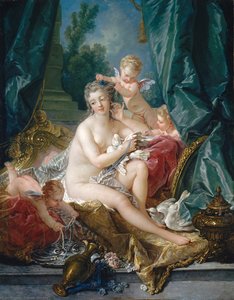
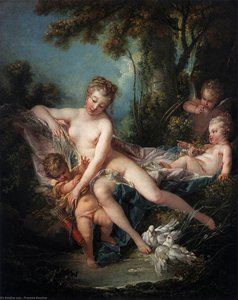
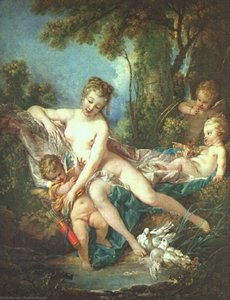 Venus Consoling Love
Discover François Boucher’s ‘Venus Consoling Love,’ a stunning Rococo masterpiece! Explore this iconic 18th-century painting of love & beauty – oil on canvas.
Among Boucher’s most celebrated paintings are works like “The Rising of the Sun” and “The Setting of the Sun,” which exemplify his ability to evoke atmosphere and emotion through color and light. However, it is perhaps his portraits of Madame de Pompadour that best reveal his artistic genius. He didn't simply depict her likeness; he transformed her into allegorical figures – a goddess of love, a shepherdess in an idyllic landscape – elevating her status and celebrating her beauty. “Venus Consoling Love” (1751) is another iconic example, showcasing Boucher’s masterful rendering of flesh tones and his ability to create a scene that is both visually stunning and emotionally resonant. The painting's delicate composition and subtle symbolism capture the complexities of love and desire with remarkable grace. Similarly, “Marquise de Pompadour at the Toilet-Table” (1759) offers an intimate glimpse into aristocratic leisure, highlighting the elegance and refinement of 18th-century French society.
Boucher's Legacy & Influence: From Accolade to Re-evaluation
Despite his immense popularity during his lifetime, Boucher’s reputation suffered a decline in the late 18th century as tastes shifted towards Neoclassicism. Critics like Denis Diderot condemned his work as frivolous and superficial, accusing him of pandering to the excesses of the aristocracy. However, his influence on subsequent generations of artists remained undeniable. Painters such as Jean-Honoré Fragonard continued to embrace the Rococo aesthetic, albeit with a more playful and often subversive edge. In recent decades, there has been a renewed appreciation for Boucher’s artistry, recognizing him not simply as a purveyor of aristocratic fantasies but as a master craftsman who redefined the pastoral genre and captured the spirit of an era. His reinvention of classical themes, his exquisite technique, and his ability to evoke emotion through color and composition continue to captivate audiences today.
Collecting Boucher Today: A Guide for Enthusiasts
For those seeking to acquire works by or in the style of François Boucher, a range of options exists. Original paintings are rare and command significant prices, often found in major museums and private collections. However, high-quality reproductions offer an accessible way to experience his artistry. Look for pieces that capture the characteristic pastel colors, delicate brushwork, and allegorical themes. Prints and tapestries based on his designs also provide a glimpse into his broader artistic influence. When considering a purchase, pay attention to the provenance of the work – its history of ownership can add significant value. ArtsDot offers a curated selection of reproductions that faithfully capture the beauty and elegance of Boucher’s masterpieces, allowing art enthusiasts to bring the spirit of Rococo France into their own homes.