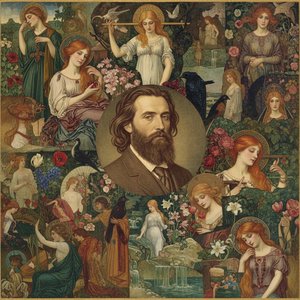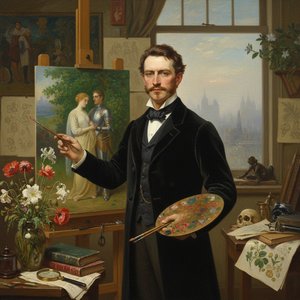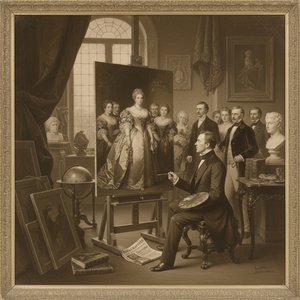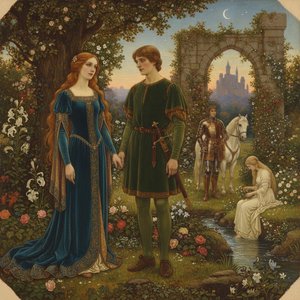
The Enigmatic Life of George Frederic Watts: Beyond Portraiture
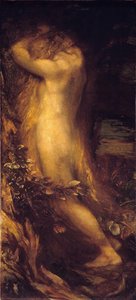
George Frederic Watts (1817-1904) occupies a unique position within the Victorian art landscape, often standing slightly apart from defined movements yet profoundly influencing them all. While he achieved considerable renown as a portraitist – capturing the likenesses of prominent figures like Cardinal Manning and Tennyson – to define him solely by this aspect is to overlook the core of his artistic ambition: a relentless pursuit of universal truths expressed through allegory and symbolism. Born on the anniversary of Handel, a coincidence Watts embraced, his early life was marked by delicate health and a somewhat unconventional education focused on classical literature rather than formal religious doctrine. This foundation instilled in him a lifelong fascination with ancient Greek ideals and a skepticism towards rigid dogma, shaping an artistic vision that sought to transcend the specific and embrace the eternal.
Watts’s early studies at the Royal Academy were brief, finding more resonance in independent exploration of sculpture – particularly the Elgin Marbles. He believed true artistry lay not merely in skillful representation but in conveying profound ideas, a conviction that would drive his entire career. His initial foray into public recognition came with the Westminster mural competition, an endeavor that, while ultimately unrealized in its original scope, sparked within him the concept of a grand artistic cycle – the “House of Life” – intended to encapsulate the full spectrum of human emotion and experience.
Allegory & Symbolism: Decoding Watts’ Universal Language
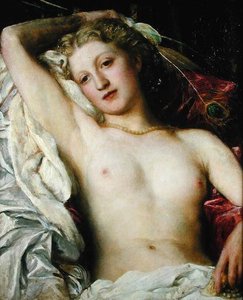 Girl with Peacock fan
Discover George Frederic Watts’ ‘Girl with Peacock Fan,’ a stunning Baroque-inspired oil painting of classical beauty. Explore its rich textures & symbolic details – a Victorian masterpiece!
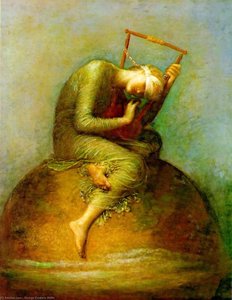
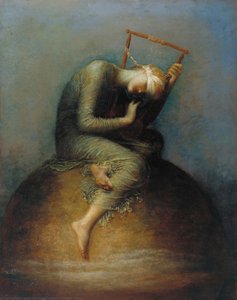
The heart of Watts's oeuvre lies in his allegorical paintings. Unlike straightforward narrative works, these pieces demand interpretation, inviting viewers into a realm of nuanced meaning. Works like “Hope” (1886) are famously ambiguous; the blindfolded figure, often interpreted as representing humanity groping towards an uncertain future, is open to multiple readings – resilience in the face of adversity, or perhaps the limitations of human perception itself. Watts deliberately avoided explicit explanations, believing that art should provoke thought and personal reflection rather than dictate a singular message. This approach aligns him with the Symbolist movement, though his style often retained a classical formality absent in more overtly radical Symbolist works.
His use of color is equally significant. Subtle gradations, hazy blues, and muted tones create an ethereal atmosphere, lending a sense of timelessness to his subjects. He wasn’t interested in capturing fleeting moments of realism but rather in evoking the underlying emotional currents that shape human existence. The figures themselves are often idealized, possessing a sculptural quality reminiscent of ancient Greek forms, further emphasizing their symbolic weight.
Classical Influences & the 'House of Life' Project
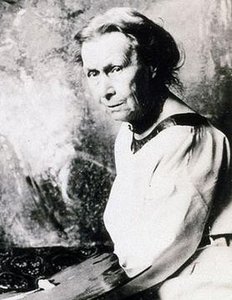 Annie Louise Swynnerton
Discover Annie Louise Swynnerton (1844-1933), a pioneering British painter celebrated for her allegorical scenes, portraits & symbolist works. First woman elected to the Royal Academy!
Watts’s Italian travels proved pivotal, exposing him to the Renaissance masters and solidifying his commitment to classical ideals. The frescoes of Michelangelo in the Sistine Chapel and Giotto in the Scrovegni Chapel profoundly impacted his vision for a large-scale artistic cycle – the “House of Life.” This ambitious project aimed to represent the entirety of human experience through a series of interconnected paintings, each embodying a specific emotion or philosophical concept. While never fully completed as Watts envisioned it, numerous works were conceived as part of this grand scheme, including “Love and Life” (1890), which depicts two figures – Love, youthful and vibrant, and Life, aged and burdened – symbolizing the inherent duality of existence.
The influence of Phidias is also palpable in Watts’s work. He sought to emulate the ancient Greek sculptor's ability to convey profound meaning through idealized forms and carefully considered compositions. This dedication to classical principles wasn’t merely stylistic; it reflected his belief that art should aspire to universal truths, transcending cultural boundaries and speaking to the fundamental human condition.
Watts and the Pre-Raphaelite Circle: Shared Aesthetics, Distinct Visions
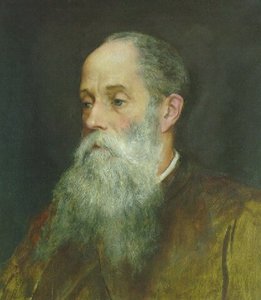 John Roddam Spencer Stanhope
Discover John Roddam Spencer Stanhope (1829-1908), a Pre-Raphaelite painter celebrated for his mythological and symbolic masterpieces. Explore the beauty of Aestheticism & British Symbolism!
Although not formally a member of the Pre-Raphaelite Brotherhood, Watts maintained close connections with many of its leading figures. He shared their rejection of academic conventions and their emphasis on detailed observation and emotional intensity. He was particularly friendly with Henry Thoby Prinsep and his circle, which included Julia Margaret Cameron, fostering an environment of artistic experimentation and intellectual exchange. However, Watts diverged from the Pre-Raphaelites in several key respects.
While the Pre-Raphaelites often focused on specific literary or historical narratives, Watts’s allegorical works were more abstract and philosophical. He also eschewed their meticulous realism in favor of a broader, more generalized style that prioritized emotional impact over precise detail. His portraits, while skillfully executed, often served as studies for his larger symbolic compositions, rather than being ends in themselves.
The Spiritual Dimension: Morality, Philosophy, and Artistic Purpose
Underlying Watts’s entire artistic output is a profound spiritual dimension. He believed that art had a moral purpose – to uplift humanity and inspire noble ideals. This conviction stemmed from his early education and his lifelong fascination with philosophy. His paintings often explore themes of love, hope, despair, and the search for meaning in life, inviting viewers to contemplate their own existence and grapple with fundamental questions about the human condition.
“I paint ideas, not things,” Watts famously declared, encapsulating his commitment to conveying universal truths rather than merely replicating the visible world. This ambition led him to explore unconventional techniques and experiment with different mediums, pushing the boundaries of Victorian artistic conventions. His work often reflects a sense of melancholy and introspection, acknowledging the inherent suffering in life while simultaneously affirming the possibility of redemption and spiritual growth.
Rediscovering Watts: The Legacy at Watts Gallery – Artists’ Village
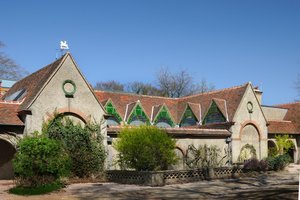 Watts Gallery – Artists' Village
Discover Watts Gallery – Artists’ Village in Surrey, showcasing Victorian art by G.F. Watts, Arts & Crafts history, Limnerslease studio, and the stunning Watts Mortuary Chapel. A unique, single-artist art experience in the UK.
Today, the best place to experience the breadth and depth of Watts's artistic vision is at Watts Gallery – Artists’ Village in Surrey. This unique institution houses a remarkable collection of his paintings, drawings, and sculptures, offering a comprehensive overview of his career. The gallery also provides insight into his personal life and artistic process, showcasing his studio, Limnerslease, and the stunning Watts Mortuary Chapel—a testament to his enduring legacy.
Visiting Watts Gallery is more than just viewing art; it’s immersing oneself in the world of a visionary artist who dared to challenge conventions and pursue universal truths. His work continues to resonate with contemporary audiences, offering a powerful reminder of the enduring power of art to inspire, provoke thought, and illuminate the human condition. Explore the captivating works of George Frederic Watts at ArtsDot.com and discover high-quality reproductions that bring his timeless masterpieces into your home.