Early Life & Artistic Awakening: From Orléans to London
 Henri Gaudier-Brzeska
Discover Henri Gaudier-Brzeska (1891-1915): French sculptor of powerful, primitive figures & landscapes. Explore his Vorticist style & tragic early life – a key Modernist artist.
Henri Gaudier-Brzeska’s story is one of incandescent, almost feverish creativity compressed into a tragically short life. Born Henri Gaudier in Saint-Jean-de-Braye near Orléans, France, in 1891, his artistic journey was not one of gradual development through formal training, but rather an immediate and consuming passion that propelled him towards self-expression with remarkable force. A pivotal moment arrived in 1910 when he relocated to London, a city poised on the cusp of radical artistic change. This move wasn’t simply geographical; it was a deliberate immersion into a burgeoning avant-garde scene, though initially undertaken without any structured plan or established network. Crucially, he arrived accompanied by Sophie Brzeska, a Polish writer over twice his age – a relationship that would prove both intensely formative and profoundly complex. Their connection, born from shared intellectual pursuits at the Bibliothèque Sainte-Geneviève in Paris, defied convention and became an integral part of Gaudier-Brzeska’s artistic identity; he adopted her surname, a symbolic act reflecting their intertwined lives.
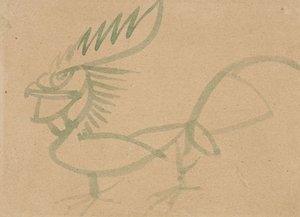
Early sketches reveal a restless energy, a desire to capture form not through meticulous replication but through intuitive feeling. He initially grappled with the weight of artistic tradition, expressing conflicting sentiments about the value of art itself in letters to Dr. Uhlmayr – a yearning for the purity of nature juxtaposed with an appreciation for the complexities born from urban life. This internal tension would ultimately resolve itself in his embrace of sculpture, a medium that allowed him to directly engage with material and translate his visceral emotions into tangible form.
The Vorticist Embrace: Collaboration, Manifestos, and 'Blast'
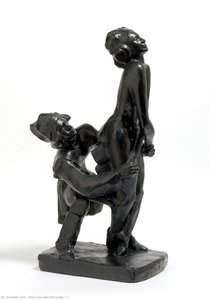
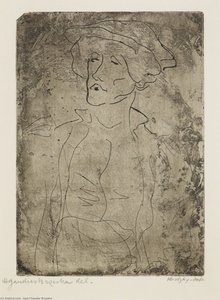 Half-length Figure
Explore 'Half-length Figure' by Henri Gaudier Brzeska – a powerful early Modernist sculpture. Discover its raw emotion & Vorticist style. A unique art investment.
London proved to be the catalyst for Gaudier-Brzeska’s artistic maturation. He quickly became entangled with a circle of forward-thinking artists and writers, most notably those associated with the Vorticist movement led by Wyndham Lewis. Vorticism, a distinctly British response to Cubism and Futurism, sought to capture the dynamism of modern life through abstract geometric forms and bold lines. Gaudier-Brzeska’s raw energy and unconventional approach resonated deeply with the group's ethos. He wasn’t merely an adherent; he became a vital contributor, signing the Vorticist Manifesto in 1914 alongside figures like Lewis, Ezra Pound, and Jacob Epstein.
His involvement extended beyond mere endorsement. Gaudier-Brzeska actively participated in the movement's publication, Blast, contributing articles that articulated his artistic philosophy. These writings reveal a sculptor deeply concerned with the fundamental principles of form, space, and energy – a rejection of representational accuracy in favor of conveying the inherent vitality of the subject. The manifesto itself, with its aggressive pronouncements and stark typography, mirrored Gaudier-Brzeska’s own uncompromising vision. This period saw his work become increasingly abstract, characterized by angular shapes and a deliberate emphasis on the materiality of the sculpture.
Direct Carving & Primitivism: A Rejection of Tradition
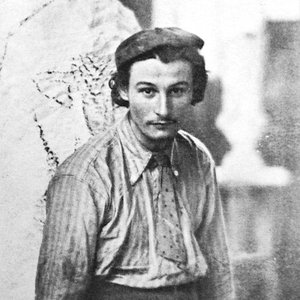
Henri Gaudier-Brzeska (né Gaudier; 4 October 1891 – 5 June 1915) was a French artist and sculptor who developed a rough-hewn, primitive style of direct carving.
A defining characteristic of Gaudier-Brzeska's style was his commitment to direct carving. Rejecting the traditional methods of modeling clay or plaster before casting in bronze, he preferred to work directly with stone and wood, allowing the inherent qualities of the material to inform the final form. This approach resulted in sculptures that possessed a rough-hewn quality, bearing visible tool marks – a deliberate aesthetic choice that emphasized the artist’s physical engagement with the process. These weren't polished, idealized figures; they were imbued with a sense of immediacy and authenticity.
This technique was deeply intertwined with his fascination with “primitive” art—specifically, non-European sculptures from Africa, Japan, and the Pacific Islands. He studied these works extensively in the British Museum and Victoria and Albert Museum, recognizing their power lay not in technical virtuosity but in their directness of expression and spiritual resonance. He sought to emulate this quality in his own work, stripping away superfluous detail and focusing on essential forms. This wasn’t an appropriation, but rather a search for universal principles of artistic expression that transcended cultural boundaries.
Key Works & Sculptural Innovations: Exploring Gaudier-Brzeska’s Oeuvre
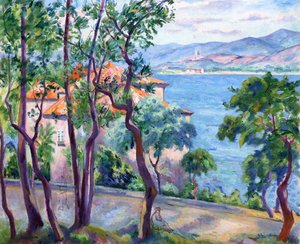
Gaudier-Brzeska's relatively short career produced a remarkably diverse body of work. Trees Near Cavaliere, for example, showcases his ability to capture the serene beauty of the French countryside while subtly incorporating Vorticist influences in its simplified forms and dynamic composition. The sculpture embodies a sense of peaceful contemplation, yet retains an underlying energy that hints at the artist’s restless spirit. Half-length Figure, created around 1913, exemplifies his early Modernist style – a powerful depiction of raw emotion rendered with bold lines and a deliberate lack of refinement. The sculpture's intensity is palpable, conveying a sense of psychological depth rarely seen in contemporary works.
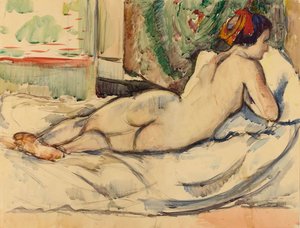
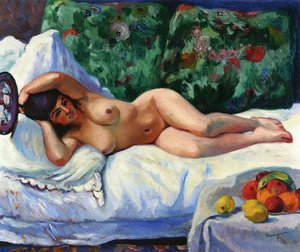
Odalisque, though a painting, reveals his exploration of Post-Impressionist techniques alongside his sculptural concerns. Its vibrant colors and fluid lines demonstrate his versatility and willingness to experiment with different mediums. However, it is his sculptures that truly define his legacy. He fearlessly experimented with materials – stone, wood, bronze – often combining them in unconventional ways. His work challenged conventional notions of beauty and form, paving the way for a new generation of sculptors who embraced abstraction and directness.
A Tragic End & Lasting Legacy: The Impact of a Short Life
The outbreak of World War I brought Gaudier-Brzeska’s artistic journey to an abrupt and devastating end. Driven by a sense of patriotic duty, he enlisted in the French army despite his fragile health. He fought with reckless abandon, earning a decoration for bravery before being killed in action at Neuville-St.-Vaast in June 1915, at the age of just twenty-three. His death was not only a personal tragedy but also a loss for the burgeoning Modernist movement.
Despite his brief career, Henri Gaudier-Brzeska left an indelible mark on British sculpture. His commitment to direct carving, his embrace of primitivism, and his uncompromising artistic vision continue to inspire artists today. He represents a pivotal moment in the transition from traditional representational art to the abstract forms that would dominate the 20th century. His sculptures are not merely objects; they are expressions of raw emotion, intellectual curiosity, and a profound connection to the materiality of the world. At ArtsDot.com, we offer meticulously crafted reproductions of Gaudier-Brzeska’s key works, allowing you to experience the power and beauty of his art firsthand.