Early Life & Academic Foundations: Toulouse Beginnings
Henri-Jean Guillaume Martin, a name perhaps less readily recognized than his Impressionist contemporaries, nevertheless occupies a significant and fascinating position within the evolution of late 19th and early 20th century French painting. Born in Toulouse in 1860, Martin’s artistic journey began not with revolutionary fervor but with solid academic training at the École des Beaux-Arts in his hometown. This initial grounding proved crucial, providing him with a mastery of form and technique that would later be subtly yet powerfully interwoven with more experimental approaches. He wasn't immediately drawn to the fleeting impressions of light favored by Monet or Renoir; instead, he initially excelled in historical painting, tackling classical subjects imbued with poetic narratives – notably those inspired by Dante’s Divine Comedy. His early successes at the Salon, culminating in a first-class medal, demonstrated a clear talent for traditional representation, yet hinted at an underlying desire to move beyond mere imitation.
A bursary allowed Martin to continue his studies in Paris from 1879, where he entered the studio of Jean-Paul Laurens, a prominent history painter. This mentorship further solidified his academic skills but also exposed him to a growing sense of artistic restlessness. The prevailing currents of change were undeniable, and while Martin didn’t immediately abandon established methods, he began to seek new avenues for expression, foreshadowing the unique synthesis that would define his mature style. His 1883 self-portrait as John the Baptist reveals a nascent confidence and a willingness to explore psychological depth – qualities that would become increasingly prominent in his later work.
The Embrace of Divisionism: A Unique Pointillist Approach
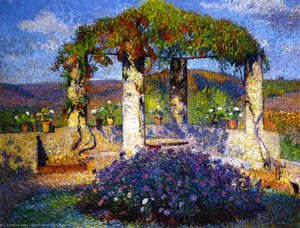 La Tonelle de L'Angle Nord-Ouest du Parc de Marquayrol
Step into a tranquil garden scene with Henri Martin's 'La Tonelle...' (1910). This Pointillist masterpiece captures light & color, offering serenity & beauty.
A pivotal moment arrived in 1885 with Martin’s journey to Italy. Immersed in the works of Giotto and Masaccio, he developed a profound appreciation for early Renaissance masters – an influence that would remain subtly present throughout his career. Upon returning to Paris, however, Martin began experimenting with Divisionist techniques, often referred to as Pointillism. This marked a significant departure from his earlier realism, yet it wasn’t a wholesale adoption of Seurat’s scientific approach. In 1889, he received a gold medal at the Salon for a painting employing these methods – a noteworthy achievement, representing the first official recognition of Divisionism within this prestigious institution.
Martin's version of Divisionism differed significantly from that of Seurat. Where Seurat meticulously constructed images with precise dots of color based on optical principles, Martin’s application was more spontaneous and intuitive. He used shorter, less mechanical brushstrokes to build form, creating a sense of vibrancy and texture that distinguished his work. This nuanced approach often led to his omission from standard accounts of Neo-Impressionism and Post-Impressionism, despite his contemporary success. His 1891 *Lauragais Landscape* exemplifies this transitional phase, showcasing strokes of paint moving towards Divisionism while retaining a distinctly personal touch.
Symbolic Visions & The Salon de la Rose + Croix
As Martin delved deeper into Divisionism, he simultaneously explored Symbolist themes. This dual pursuit culminated in his participation in the Salon de la Rose + Croix in 1892, led by Joséphin Péladan – a controversial figure who championed mystical and esoteric art. His *Man Between Vice and Virtue* (1892) perfectly encapsulates this period, expressing Symbolist ideas through a distinctly Post-Impressionist lens. The painting is notable for its unusual realism in depicting the male form, contrasting with the often ethereal quality of other Symbolist works.
The exploration of allegorical subjects and psychological states became increasingly central to Martin’s artistic vision. *The Poets of Gay Knowledge* (1893) further demonstrates this shift, featuring classical muses in a barren nocturnal landscape. His wife frequently served as his model during this time, notably for *The Poet Clémence Isaure* (c 1890), a portrait of a semi-legendary figure from Toulouse’s local history. These works reveal a growing interest in myth, spirituality, and the subtle complexities of human emotion – themes that set him apart from purely Impressionistic concerns.
Nature's Influence: Labastide-du-Vert and a Shift in Focus
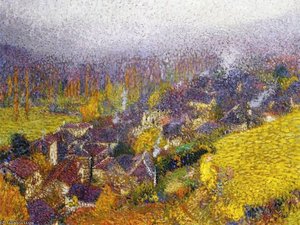
The purchase of a property in Labastide-du-Vert, north of Cahors, in 1900 proved to be a transformative event in Martin’s career. This marked a decisive move away from the allegorical and towards a more direct engagement with nature. He abandoned the overt symbolism of his earlier work, embracing the rhythms of the countryside and the subtle beauty of rural life. This wasn't simply a change of subject matter; it represented a fundamental shift in artistic philosophy.
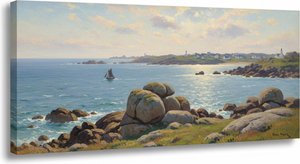
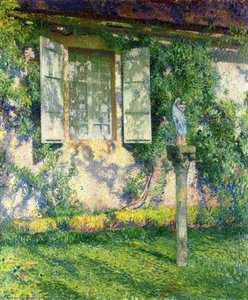
Martin continued to employ his distinctive Post-Impressionist technique – delicate brushstrokes building color and form – but now focused on capturing the essence of the French landscape. Paintings like *Shepherd Returning His Sheep* (1894) could easily be mistaken for Pissarro’s Divisionist works, yet Martin's unique texture and longer strokes set his style apart. He also explored themes paralleling those of Théo van Rysselberghe, but remained rooted in the northern French countryside rather than Provence. This period saw a remarkable consistency in his output, producing a wealth of idyllic scenes that celebrated the beauty and tranquility of nature.
Martin’s Legacy: Bridging Movements and Enduring Appeal
Henri Martin remains a somewhat overlooked figure in art history, often categorized as existing *between* movements rather than fully belonging to one. This is precisely what makes his work so compelling – he successfully synthesized elements of Impressionism, Post-Impressionism, and Symbolism into a unique and harmonious style. His bold use of color, combined with his meditative approach to landscape painting, created works that are both visually stunning and emotionally resonant.
Widely exhibited during his lifetime, Martin’s paintings now grace the walls of major museums such as the Musée d'Orsay, the Petit Palais, and the Musée des Augustins in Toulouse. His contribution lies not in initiating a new school but in bridging existing ones, offering a distinctive voice within a period of intense artistic experimentation. At ArtsDot
- We offer high-quality reproductions of Henri Martin’s masterpieces, allowing you to experience the beauty and tranquility of his landscapes firsthand.
- Explore our collection today and discover a hidden gem of French Post-Impressionism.