Early Life & Academic Foundations: From Law to Luminism
 Wikipedia: Igor Grabar
Igor Emmanuilovich Grabar (Russian: И́горь Эммануи́лович Граба́рь, 25 March 1871 – 16 May 1960) was a Russian Post-Impressionist painter, publisher, restorer and historian of art. Grabar, descendant of a wealthy Rusyn family, was trained as a painter...
Igor Emmanuilovich Grabar’s journey toward becoming a defining voice of Russian Modernism was not one initially charted for the world of art. Born in 1871 into a family steeped in intellectual and political activism – his ancestry traced back to Rusyn roots, a heritage that would subtly inform his later dedication to preserving national artistic identity – young Igor’s early path led him toward law. He studied at Saint Petersburg University, diligently pursuing legal studies while simultaneously nurturing a burgeoning passion for drawing, sketching prolifically in his spare moments and even supporting himself through illustrations for humorous publications. This duality—the rigorous discipline of the academic world alongside the intuitive freedom of artistic expression—would prove formative. However, the pull of aesthetics proved too strong to resist. A pivotal moment arrived with his enrollment at the Academy of Arts, followed by studies under Anton Ažbe in Munich, where he honed his technical skills and began to absorb the currents of European painting. It was a period of intense learning, but it wasn’t until his return to Russia that Grabar truly discovered his artistic voice.
The Mir Iskusstva Circle & Grabar’s Artistic Awakening
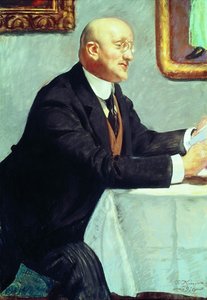 Igor Grabar
Igor Grabar (1871-1960) was a pivotal Russian Post-Impressionist painter, art historian, restorer & publisher. Known for his divisionist landscapes, snow scenes, and crucial role in modernizing the Tretyakov Gallery. Explore his legacy!
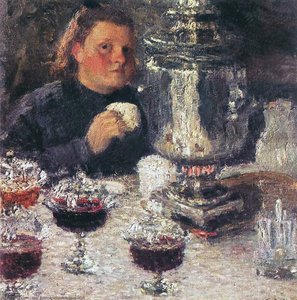
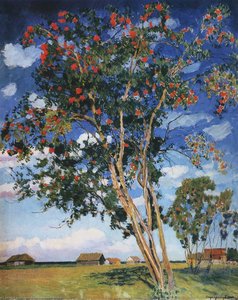
The late 19th century in Russia was a time of profound social and cultural upheaval. Amidst this ferment, the art movement *Mir Iskusstva* (World of Art) emerged as a beacon for those seeking to break from academic tradition and embrace new aesthetic possibilities. Grabar joined this influential circle around 1899, finding himself amongst a group of artists, writers, and intellectuals who championed Symbolism, Aestheticism, and a renewed interest in the decorative arts. While his relationship with key figures like Sergei Diaghilev and Mstislav Dobuzhinsky was often complex, marked by intellectual disagreements rather than outright conflict, *Mir Iskusstva* provided Grabar with a crucial platform for exhibiting his work and engaging in critical discourse. His early paintings, showcased at the group’s exhibitions beginning in 1902, signaled a departure from conventional realism. He began to experiment with color and light, seeking to capture fleeting impressions rather than precise representations of reality.
Divisionism, Snowscapes & the Pursuit of Light
Impressionism was a 19th-century art movement characterized by visible brush strokes, open composition, emphasis on accurate depiction of light in its changing qualities (often accentuating the effects of the passage of time), ordinary subject matter...
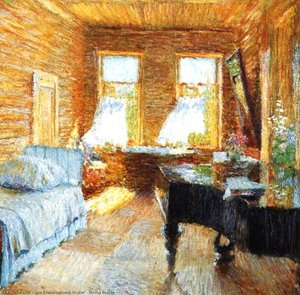
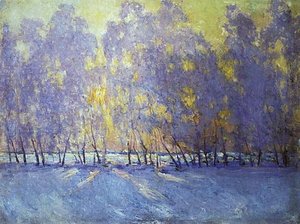
Grabar's artistic breakthrough came with his embrace of Divisionism – a technique pioneered by Georges Seurat and Paul Signac that involved applying small, distinct dots of color to create luminous effects. However, Grabar didn’t simply adopt this style wholesale; he infused it with a distinctly Russian sensibility. He became particularly captivated by the nuances of light reflecting off snow, transforming winter landscapes into shimmering studies of color and atmosphere. Paintings like “Ray of Sun” (1901) and “February Azure” (1904) are testaments to this obsession. He wasn’t merely depicting snow; he was dissecting its optical properties, analyzing the interplay of light and shadow, and translating those observations into a vibrant tapestry of color. This pursuit of capturing ephemeral moments of light became a defining characteristic of his work, setting him apart from his contemporaries.
Grabar as Historian: Revolutionizing Russian Art Scholarship
Beyond his accomplishments as a painter, Igor Grabar was a formidable art historian and critic. Recognizing the need for a comprehensive and authoritative account of Russian art, he embarked on an ambitious project in 1908 – the multi-volume *History of Russian Art*. This monumental undertaking wasn’t simply a chronological recounting of artistic styles; it was a passionate attempt to define a national aesthetic identity. Grabar personally wrote the sections dedicated to architecture, setting a new standard for scholarly rigor and insightful analysis. He assembled a team of leading artists and critics, ensuring that each volume reflected the latest research and perspectives. The *History* employed exquisite illustrations and meticulous documentation, making it an invaluable resource for generations of scholars and art enthusiasts. His writing wasn’t confined to grand historical narratives; he also published numerous monographs on individual Russian masters, further solidifying his reputation as a leading authority.
Preserving a Nation's Heritage: Grabar and the Tretyakov Gallery
Igor Grabar lived in the XIX – XX cent., a remarkable figure of Russian Impressionism and Post-Impressionism. Find more works of this artist at Wikiart.org ...
The tumultuous events of the Russian Revolution presented unprecedented challenges for the preservation of cultural heritage. In 1913, Grabar was appointed executive director of the Tretyakov Gallery, a position that would define his later career. He immediately launched an ambitious reform program aimed at modernizing the museum’s collection and expanding its scope to include contemporary art. This decision proved controversial, as many traditionalists resisted the inclusion of avant-garde movements. However, Grabar persevered, recognizing the importance of representing the full spectrum of Russian artistic expression. He also played a crucial role in safeguarding the gallery's treasures during the chaos of the revolution and subsequent civil war. Beyond simply protecting existing artworks, he actively sought to redistribute nationalized church art, establishing new museums to house these previously inaccessible collections. His efforts were instrumental in ensuring that Russia’s artistic legacy survived one of its most turbulent periods.
A Legacy Forged in Transformation: Grabar’s Enduring Influence
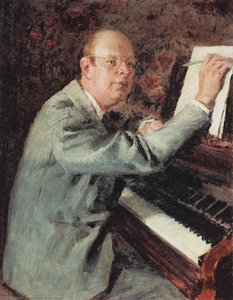
Igor Grabar's life spanned a period of immense transformation, encompassing the waning years of Imperial Russia and the rise of the Soviet era. He navigated these shifting landscapes with remarkable resilience, adapting his artistic style and professional pursuits to meet the demands of each new context. His paintings, characterized by their luminous color and evocative atmosphere, continue to captivate audiences today. His scholarship remains a cornerstone of Russian art history, providing invaluable insights into the nation’s cultural identity. And his tireless efforts to preserve and promote Russia’s artistic heritage have left an enduring legacy. From his early explorations of Impressionism to his later role as a leading figure in Soviet art administration, Grabar embodied a rare combination of artistic talent, intellectual rigor, and unwavering dedication. His work – including the poignant “Portrait of Sergei Prokofiev” (1941) – serves as a testament to the power of art to transcend political boundaries and capture the essence of human experience. Explore the breadth of his oeuvre at ArtsDot.com, where you can discover high-quality reproductions of his masterpieces and delve deeper into the world of Russian Modernism.