Early Life & Artistic Foundations: A Moscow Beginning
 Wikipedia: Konstantin Korovin
Konstantin (Constantin) Alekseyevich Korovin (Russian: Константи́н Алексе́евич Коро́вин; 5 December [O.S. 23 November] 1861 – 11 September 1939) was a leading Russian Impressionist painter. == Biography == === Youth and education === Konstantin w...
Konstantin Alekseyevich Korovin’s story begins not with a grand artistic declaration, but within the comfortable, yet somewhat unconventional, walls of a prosperous merchant family in 19th-century Moscow. Born in 1861 – though records often reflect the older Julian calendar date – Korovin inherited a fascinating duality: the practicality and ambition of his father, a university graduate who favored arts and music over commerce, and the artistic sensibility of his mother, whose own inclinations lay within the realms of painting and performance. This blend would prove pivotal in shaping the artist’s trajectory. While officially registered as “peasants” from Vladimir Gubernia – a bureaucratic quirk reflecting Russia's complex social structures – the family’s wealth afforded young Konstantin access to education and, crucially, artistic training at the Moscow School of Painting, Sculpture and Architecture at the remarkably early age of fourteen.
It was here, amongst the burgeoning art scene of the Russian capital, that Korovin began to lay the foundations for his future mastery. His initial studies focused on architecture, but a natural inclination towards color and form soon led him to embrace painting fully. The influence of his professors – Vasily Perov, known for his meticulous realism in portraiture, and Alexei Savrasov, whose evocative landscapes like “The Rooks Have Come Back” captured the melancholic beauty of the Russian countryside – were formative. However, it was perhaps his burgeoning friendships with fellow students Valentin Serov and Isaac Levitan that would prove most enduring, fostering a spirit of collaboration and mutual inspiration that characterized their early artistic explorations.
Embracing Impressionism: Korovin's Parisian Influences & Unique Style
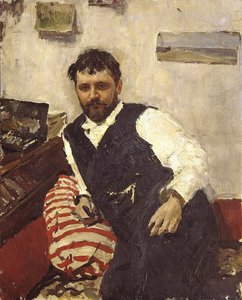 Konstantin Alexeievitch Korovin
Konstantin Korovin (1861-1939) was a leading Russian Impressionist renowned for his vibrant landscapes, innovative theater designs & masterful capturing of light and atmosphere. Explore his art!
While Russia possessed a rich artistic tradition, the revolutionary currents of Impressionism sweeping across France in the late 19th century exerted an undeniable pull on a generation of young Russian artists. Korovin was among the first to fully embrace this new aesthetic, though his journey wasn’t one of simple imitation. Under the guidance of Vasily Polenov, who had recently returned from Paris imbued with the principles of *plein air* painting and broken color, Korovin began to experiment with capturing fleeting moments of light and atmosphere. This exposure ignited a passion for depicting the vibrancy of modern life – a departure from the more traditional historical or mythological subjects favored by earlier generations.
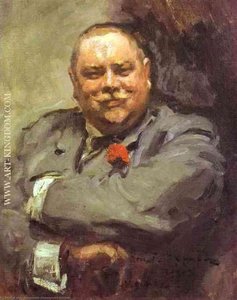
However, Korovin didn’t merely transplant French techniques onto Russian soil; he infused them with a distinctly national spirit. His early work, such as “Portrait of a Chorus Girl” (1887), often cited as a pivotal moment in the development of Russian Impressionism, demonstrates this fusion. While exhibiting the loose brushwork and vibrant palette characteristic of the movement, it also captures a uniquely Russian sensibility – a fascination with the energy and spectacle of urban life. This willingness to blend influences, coupled with his exceptional eye for color, quickly established Korovin as a leading figure in the burgeoning Russian art scene.
Landscapes of Russia: Capturing the Soul of the Homeland
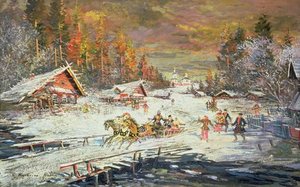 The Russian Winter
Konstantin Korovin’s "The Russian Winter" captures a vibrant rural scene with thick brushstrokes & warm colors. An oil painting showcasing festive winter life in Russia, reflecting 19th-century realism & romanticism.
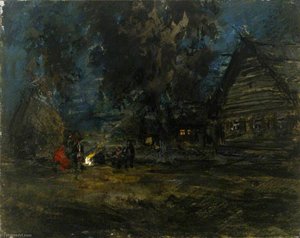
Though captivated by Parisian modernity, Korovin’s artistic heart remained deeply rooted in the landscapes of Russia. His paintings of rural scenes – from serene winter vistas like “Russian Village under Snow” to vibrant depictions of festive life as seen in “The Russian Winter” – are not simply representations of place; they are evocations of a particular mood and atmosphere. He possessed an extraordinary ability to capture the quality of light, transforming ordinary scenes into moments of breathtaking beauty.
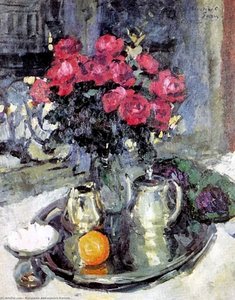
Korovin’s technique was characterized by thick brushstrokes, warm color palettes, and a masterful use of impasto – creating texture that almost allows the viewer to feel the crispness of winter air or the warmth of sunlight on skin. He wasn't interested in photographic realism; instead, he sought to convey the *impression* of a scene, prioritizing emotional resonance over precise detail. His landscapes are imbued with a sense of nostalgia and romanticism, reflecting a deep love for his homeland and a desire to capture its fleeting beauty before it disappeared.
Beyond Canvas: Korovin’s Innovative Theater Designs
While celebrated as a painter, Konstantin Korovin's artistic contributions extended far beyond the canvas. He revolutionized Russian theater design, transforming stagecraft into an art form in its own right. Beginning in the 1890s, he became deeply involved with the Bolshoi Theatre and other prominent institutions, creating sets and costumes that were as innovative as they were visually stunning.
Korovin’s approach to theater design was groundbreaking. He moved away from traditional realism, prioritizing atmosphere and emotional impact over meticulous historical accuracy. He used color, light, and texture to create immersive environments that transported audiences to other worlds. His designs weren't merely backdrops; they were integral components of the performance, enhancing the narrative and amplifying the emotions of the characters. He pioneered the use of staging as a means of expressing mood, anticipating the elaborate productions seen in modern cinema. This innovative spirit cemented his legacy not only as a painter but also as a visionary stage designer.
Korovin’s Legacy and Enduring Appeal in Modern Collections
Konstantin Korovin's influence on Russian art is undeniable. He bridged the gap between traditional academic painting and the burgeoning Impressionist movement, forging a uniquely Russian style that continues to captivate audiences today. His vibrant landscapes, innovative theater designs, and masterful capturing of light and atmosphere have earned him a place among the most celebrated artists of his generation.
Today, Korovin’s works are held in prominent museums around the world, and continue to command attention at auction. His paintings offer a glimpse into a bygone era – a time of rapid social change, artistic experimentation, and a deep appreciation for the beauty of the natural world. ArtsDot.com offers high-quality reproductions of Korovin’s masterpieces, allowing art enthusiasts to experience the brilliance of this Russian Impressionist in their own homes. His enduring appeal lies not only in his technical skill but also in his ability to evoke a sense of nostalgia and wonder – reminding us of the power of art to transport us to another time and place. Explore our collection today and discover the captivating world of Konstantin Korovin.