
Early Influences: From Vienna to London – The Seeds of Psychological Inquiry
Lucian Freud, a name synonymous with unflinching realism and penetrating psychological portraiture, did not emerge from a vacuum. His artistic lineage is deeply interwoven with intellectual currents that spanned continents and generations. Born in Berlin in 1922, the grandson of Sigmund Freud, he inherited an atmosphere steeped in the exploration of the human psyche – though his own path diverged into visual rather than verbal analysis. The family’s emigration to London in 1933, fleeing the rising tide of Nazism, proved formative, transplanting a young Lucian into a new cultural landscape while simultaneously anchoring him to a legacy of profound introspection. This early displacement, coupled with a familial preoccupation with the subconscious, laid the groundwork for his lifelong fascination with the complexities of human identity and vulnerability.
Freud’s initial artistic training at institutions like the Central School of Art and Cedric Morris’ East Anglian School of Painting and Drawing provided him with technical foundations. However, it was the atmosphere at Benton End, Morris's home and school, that proved particularly influential. Here, amidst a community of artists, he began to experiment with form and composition, though his early works reveal a tentative exploration rather than a fully formed style. The shadow of Surrealism loomed large during this period, evident in unusual juxtapositions and dreamlike imagery. Yet, even within these experiments, a nascent focus on the individual – a desire to capture something beyond mere physical likeness – began to emerge.
The Shift to Realism: Abandoning Surrealism for Unflinching Observation
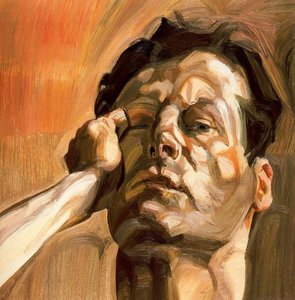 Man's Head, Self Portrait
Explore Lucian Freud's 'Man's Head, Self Portrait' (1963). This powerful Expressionist oil painting captures intense emotion and reveals the artist's introspective gaze.
By the early 1950s, Freud underwent a significant stylistic transformation. He consciously rejected the subjective distortions of Surrealism in favor of an increasingly rigorous realism. This wasn’t merely a change in technique; it was a fundamental shift in his artistic philosophy. He sought not to interpret or symbolize the human form but to *present* it – raw, unidealized, and often unsettlingly direct. This commitment to observation demanded a new level of intimacy with his subjects, requiring extended sittings and a willingness to confront uncomfortable truths about physicality and mortality.
This period saw a move away from the small-scale works of his earlier years towards more substantial canvases, allowing for greater detail and complexity. Paintings like ‘Boy’s Head’ (1952) demonstrate this evolving approach – a powerful expressionist portrait that hints at the psychological depth to come, yet still retains elements of early linearity. Freud began to study the Old Masters—Rembrandt, Titian, Courbet—absorbing their techniques for rendering skin tones and textures, but ultimately forging his own distinct path. He wasn’t interested in replicating their styles; rather, he sought to understand *how* they achieved such compelling realism.
Technique as Revelation: Impasto, Texture, and the Physicality of Being
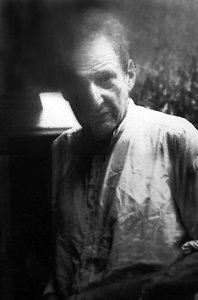 Lucian Freud
Explore the intense realism of Lucian Freud (1922-2011), renowned British portraitist known for unflinching depictions of the human form, psychological depth & thickly impastoed paintings. Discover his legacy.
Freud's signature technique – a thickly impastoed application of paint – became inextricably linked to his psychological exploration. The sheer physicality of the medium mirrored the weight and substance of his subjects. He worked exclusively from life, demanding prolonged sittings that often stretched for hours, days, or even months. This relentless observation allowed him to build up layers of paint, sculpting the form with a tactile intensity rarely seen in modern portraiture.
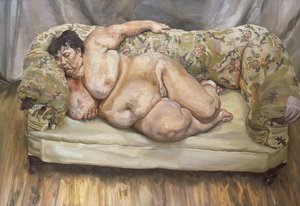
The brushstrokes themselves are not merely descriptive; they *become* part of the subject’s character, revealing the artist's struggle to capture their essence. Folds of flesh, subtle shifts in light and shadow, the very texture of skin – all were rendered with a meticulous attention to detail that bordered on obsessive. This wasn’t about creating a flattering likeness; it was about conveying the truth of being, imperfections and all. ‘Benefits Supervisor Sleeping’ (1995) exemplifies this approach, its monumental scale and visceral realism forcing viewers to confront the vulnerability and physicality of the human body.
Intimacy and Discomfort: Exploring Freud’s Portraiture of Friends and Family
The vast majority of Freud's subjects were drawn from his close circle – friends, family, lovers. This intimacy allowed for a level of access rarely afforded to other artists, but it also created a complex dynamic fraught with tension and vulnerability. His portraits are not celebrations of beauty or status; they are unflinching examinations of the human condition, often revealing hidden anxieties and unspoken truths.
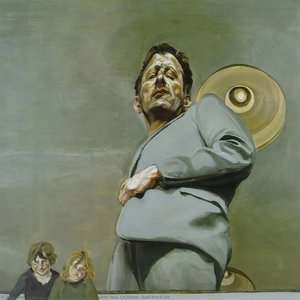
The direct gaze of his sitters is particularly striking – unwavering, confrontational, and often unsettling. He avoided idealization, instead presenting his subjects with a brutal honesty that could be both captivating and disturbing. This willingness to expose vulnerability extended to self-portraits as well, such as ‘Reflection’ (1985), which depicts the artist aged and gaunt, stripped of any pretense. These works function not merely as representations of individuals but as visual case studies – explorations of identity, mortality, and the complexities of human relationships.
Freud and Bacon: A Complex Dialogue of Form and Emotion
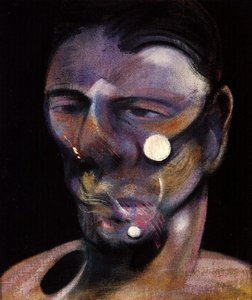
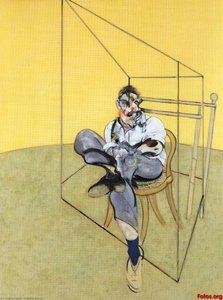 three studies of lucian freud, 1969 b
Experience Francis Bacon's 'Three Studies of Lucian Freud,' 1969 B – a visceral triptych exploring human emotion and the complex relationship between two artistic giants. A masterpiece of expressionism, now available as a stunning hand-painted reprod...
The relationship between Lucian Freud and Francis Bacon was one of the most significant artistic dialogues of the 20th century. Bacon’s visceral triptych ‘Three Studies for Lucian Freud’ (1969) stands as a testament to their mutual influence and profound respect, though it also reveals a complex interplay of power dynamics and artistic interpretation. Bacon's distorted figures, rendered with raw energy and psychological intensity, offer a counterpoint to Freud’s meticulous realism.
Three Studies for Lucian Freud, while based on photographs taken by Freud, is not simply a portrait *of* Freud but an exploration of his presence – a distillation of his character into pure form and emotion. The paintings capture a sense of anxiety and alienation that resonates with both artists’ broader concerns about the human condition. This exchange highlights the power of artistic collaboration and the ways in which two masters can challenge and inspire one another, pushing the boundaries of figurative painting.
Legacy and Influence: Lucian Freud's Enduring Impact on Contemporary Art
Lucian Freud’s legacy extends far beyond his own prolific output. He redefined modern portraiture, rejecting conventional notions of beauty and idealization in favor of an unflinching realism that captured the complexities of human identity. His influence can be seen in the work of countless contemporary artists who continue to explore themes of vulnerability, physicality, and psychological depth.
His commitment to working from life – a practice increasingly rare in today’s digital age – serves as a powerful reminder of the importance of direct observation and intimate connection. Freud's paintings are not merely representations of individuals; they are profound meditations on the human condition, offering viewers a glimpse into the raw truths of existence. For collectors seeking works that possess both technical mastery and psychological insight, Lucian Freud remains an unparalleled figure in the history of art. Explore the world of Lucian Freud with ArtsDot.com, where museum-quality reproductions bring his masterpieces to life.