Introducing Mary Cassatt: An American Impressionist in Paris
Impressionism was a 19th-century art movement characterized by visible brush strokes, open composition, emphasis on accurate depiction of light in its changing qualities (often accentuating the effects of the passage of time), ordinary subject matter...
Mary Cassatt’s story is one of determined artistic pursuit, transatlantic identity, and a quiet revolution within the established art world. Born in Allegheny City, Pennsylvania, in 1844, she wasn't merely an observer of Parisian life; she became an integral part of it, forging a path for herself as a respected – and often solitary – female artist during a period when such recognition was exceptionally rare. Unlike many American artists who briefly sojourned in Europe to complete their training, Cassatt made France her permanent home, immersing herself in the burgeoning Impressionist movement and developing a style uniquely her own. Her early artistic inclinations were nurtured through travel with her family, exposing her to European masters, but it wasn’t until she settled in Paris that her talent truly blossomed, fueled by a relentless dedication to capturing modern life on canvas.
Cassatt's initial reception was mixed; while possessing undeniable skill, her work didn’t immediately align with the academic standards of the time. However, a pivotal encounter with Edgar Degas in 1874 proved transformative. He recognized her potential and invited her to exhibit with the Impressionists – a bold move that would forever alter the course of her career. This association wasn't simply about joining a group; it was about embracing a new way of seeing, a focus on fleeting moments, light, and color, and a rejection of traditional subject matter.
Challenging Conventions: Cassatt's Focus on Women’s Lives
What truly set Cassatt apart wasn’t just her Impressionist technique but *what* she chose to paint. While many of her contemporaries depicted bustling cityscapes or historical scenes, Cassatt turned her gaze inward, focusing on the intimate lives of women – mothers, daughters, sisters, and friends. This was a radical departure from the prevailing artistic norms that largely relegated women to roles as muses rather than subjects in their own right. She didn’t portray idealized goddesses or allegorical figures; she depicted real women engaged in everyday activities: reading, sewing, sharing tea, caring for children.
This focus wasn't merely a matter of personal preference; it was a deliberate challenge to the established artistic hierarchy. Cassatt sought to elevate the domestic sphere, demonstrating its inherent dignity and emotional complexity. Her paintings weren’t simply pretty pictures; they were insightful explorations of female identity, social relationships, and the subtle nuances of modern life. She captured a world often overlooked by male artists, offering a uniquely feminine perspective that resonated with a growing audience.
The Intimacy of Motherhood: A Defining Theme
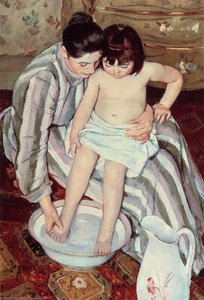
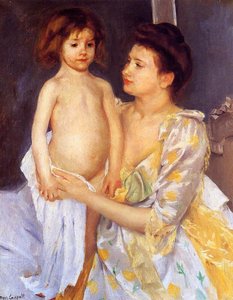 Jules Being Dried by His Mother
Mary Cassatt's "Jules Being Dried" (1900) captures a tender mother-child moment with Impressionist softness. Explore intimacy & familial love in this oil painting.
Perhaps no subject is more closely associated with Mary Cassatt than motherhood. Her depictions of mothers and children are renowned for their tenderness, psychological depth, and remarkable realism. Paintings like Jules Being Dried by His Mother (1900) capture the quiet intimacy of these everyday moments – a mother’s gentle touch, a child’s trusting gaze, the unspoken bond between them. These weren't sentimentalized portrayals; they were honest and unflinching observations of the joys and challenges of parenthood.
Cassatt’s approach to motherhood was particularly innovative in its rejection of traditional iconography. She didn’t depict idealized Madonnas or religious scenes; she portrayed mothers as real women, with all their complexities and imperfections. Her paintings often feature a sense of immediacy and spontaneity, capturing fleeting moments of connection and affection. Sara in Dark Bonnet (1879) exemplifies this – the delicate brushstrokes and soft pastels evoke a poignant sense of childhood innocence and quiet contemplation. Similarly, Elsie in a Blue Chair (1880) captures a timeless portrait of domestic life with remarkable charm.
Pastel and Printmaking: Expanding the Boundaries of Impressionism
While Cassatt is celebrated for her oil paintings, she also made significant contributions to the art of pastel and printmaking. She embraced pastel as a medium that allowed for greater spontaneity and immediacy, perfectly suited to capturing fleeting moments of light and color. Her modernist technique involved layering colors with bold strokes, creating vibrant textures and luminous effects. A paper conservator at The Met recently shed light on her innovative use of pastel in Mother and Child (1914), highlighting the experimental nature of her approach.
Cassatt’s foray into printmaking was equally groundbreaking. Inspired by Japanese woodblock prints, she developed a unique technique that combined etching, drypoint, and aquatint to create richly textured images with delicate tonal variations. These prints weren't merely reproductions of her paintings; they were original works of art in their own right, showcasing her mastery of line, form, and composition. Her work helped introduce Japanese aesthetics to Western audiences and influenced a generation of artists.
Cassatt's Legacy: Influence and Modern Feminist Perspectives
Mary Cassatt’s influence extends far beyond the Impressionist movement. She paved the way for future generations of female artists, demonstrating that women could achieve critical acclaim and professional success in a male-dominated field. Her unwavering dedication to her craft, her innovative techniques, and her insightful portrayals of modern life continue to inspire artists today.
In recent years, Cassatt’s work has been reevaluated through a feminist lens, recognizing her as a pioneer who challenged conventional gender roles and celebrated the experiences of women. Her paintings aren't simply depictions of domestic scenes; they are powerful statements about female identity, social relationships, and the complexities of modern life. Her legacy is one of artistic courage, intellectual curiosity, and a profound empathy for the human condition.
Explore the timeless beauty and enduring impact of Mary Cassatt’s art at ArtsDot.com, where you can discover high-quality reproductions of her most iconic works and bring a touch of Impressionist elegance to your home. From oil paintings to exquisite prints, we offer a range of options to suit every taste and budget.