The Dawn of a Revolution: Breaking from Academic Tradition
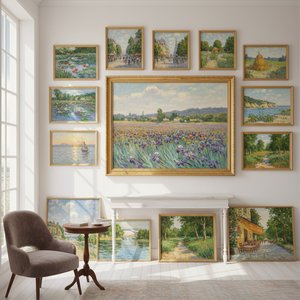 Impressionist Landscapes: 10 Masterpieces for Your Home | ArtsDot
Introduction Imagine stepping into a world bathed in dappled sunlight, where colors dance and shimmer with an ethereal quality. This is the realm of Impressionism – a revolutionary art movement that forever altered how we perceive light, color, and t...
To understand the seismic shift brought about by Impressionism, one must first envision the rigid, somber atmosphere of the mid-19th-century French art world. For decades, the Académie des Beaux-Arts held an iron grip on aesthetic values, enforcing a strict hierarchy that prioritized historical, mythological, and religious subjects rendered with invisible brushwork and polished, photographic precision. The Salon, the era's most prestigious exhibition, served as the ultimate gatekeeper; to be excluded was to be rendered invisible in the eyes of history. However, beneath this veneer of classical perfection, a quiet rebellion was brewing among a group of young, restless visionaries who found the academic obsession with "finished" surfaces stifaining and disconnected from the pulse of modern life.
This movement, which would eventually be mockingly labeled "Impressionism" by critics, was born of a profound dissatisfaction with the artificiality of studio-bound painting. Artists such as Claude Monet, Pierre-Auguste Renoir, and Camille Pissarro sought to dismantle the heavy shadows and muted palettes of their predecessors. They rejected the demand for meticulous detail in favor of something far more elusive: the sensation of a moment. By embracing brighter colors and spontaneous compositions, they challenged the very definition of what constituted a completed work of art. This was not merely a change in technique, but a radical declaration that reality is not a fixed, static entity, but a shimmering, subjective experience shaped by the observer's eye.
The 1874 exhibition organized by the Anonymous Society of Painters, Sculptors, Printmakers, etc., marked the official fracture from tradition. It was here that Monet’s work, specifically Impression, soleil levant, provided the movement with its name and its manifesto. The art world was shocked by the vibrant, almost unfinished appearance of these canvases, yet this very "imperfection" held the key to a new way of seeing. This era of rebellion paved the way for a modern consciousness, proving that the true essence of a subject lies not in its anatomical or historical accuracy, but in the emotional resonance of its light and atmosphere.
The Poet of Light: Claude Monet’s Artistic Evolution
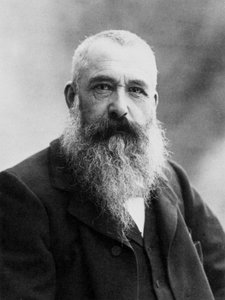 Claude Monet
A Life Immersed in Light: The World of Claude Monet Oscar-Claude Monet, a name synonymous with Impressionism, wasn't merely a painter of landscapes; he was a chronicler of fleeting moments, a poet of light and color. Born in Paris on November 14, 184...
Oscar-Claude Monet was far more than a mere painter of landscapes; he was a chronicler of the ephemeral, a poet who used oil and pigment to write verses about the passing of time. Born in Paris in 1840, his journey toward becoming the figurehead of Impressionism was shaped by both early talent and pivotal mentorship. His formative years in Le Havre, under the influence of Eugène Boudin, instilled in him the revolutionary concept of en plein air painting—the practice of working directly from nature. This fundamental shift allowed Monet to move beyond mere representation, turning his gaze toward the way light interacts with surfaces, water, and air.
Monet’s evolution was marked by a relentless pursuit of visual truth. His early works, while demonstrating technical proficiency, began to shed the weight of traditional composition as he experimented with the interplay of color and shadow. The Franco-Prussian War even provided an unexpected period of growth; while in London, he absorbed the atmospheric mastery of English landscape artists like J.M.W. Turner, learning how to dissolve form into mist and light. This period of upheaval deepened his understanding of how weather and atmosphere could transform a familiar scene into something entirely new and emotionally charged.
As his career progressed, Monet’s focus shifted from the subject itself to the light that illuminated it. He became obsessed with the way a single haystack or a cathedral facade could appear radically different at dawn, noon, or dusk. This dedication led to his famous series paintings, where he would revisit the same motif under varying conditions to capture the subtle shifts in temperature and mood. His life was an endless dialogue with the sun, a lifelong attempt to pin down the fleeting glint of light on a wave or the soft glow of a summer afternoon, ensuring that his legacy would forever be synonymous with the very concept of luminosity.
En Plein Air: The Science and Soul of Capturing the Fleeting Moment
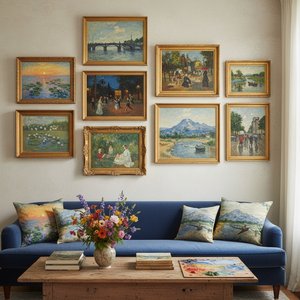 Impressionistic Landscapes: 10 Masterpieces That Changed Art & Decor
Introduction To gaze upon these ten canvases is to step directly into a world transformed by light, color, and an unprecedented embrace of the fleeting moment. The Impressionistic Landscape movement wasn’t merely a shift in painting technique; it was...
The technique of en plein air was the heartbeat of the Impressionist revolution. It required more than just a willingness to work outdoors; it demanded a profound psychological presence and a rapid, decisive application of paint. To capture a moment before the sun shifted or a cloud obscured the view, Monet and his contemporaries developed a language of short, broken brushstrokes. These "dabs" of color were not intended to blend smoothly on the canvas but to remain distinct, allowing the viewer's eye to optically mix the pigments from a distance. This created a sense of vibration and movement that traditional, blended techniques could never achieve.
This method was deeply scientific, rooted in an understanding of how color perception works. By placing complementary colors side-by-side—such as a stroke of orange against a field of blue—the artists heightened the brilliance of the light. They moved away from using black for shadows, discovering instead that shadows are composed of reflected light and deep blues or purples. This discovery revolutionized the tonal range of landscape painting, bringing a newfound vitality to the canvas. The texture of the paint itself became an essential element; the visible impasto—thick, raised applications of oil—added a tactile dimension that mimicked the physical presence of nature.
Yet, beyond the science of optics lay the soul of the technique. Painting outdoors meant embracing the unpredictability of the elements. It meant contending with wind, rain, and the rapid movement of light. For Monet, this unpredictability was not a hindrance but a collaborator. The spontaneity required by en plein air forced an emotional honesty upon the work. There was no time for the calculated artifice of the studio; there was only the immediate, visceral response to the world as it unfolded. In this way, the technique became a bridge between the artist's perception and the raw, unmediated beauty of the natural world.
Giverny and the Water Lilies: A Masterpiece in Perpetual Motion
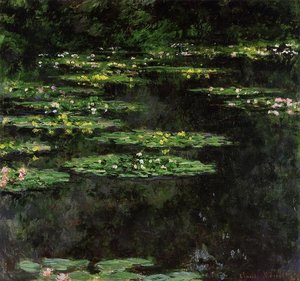
 Water Lilies (Monet series)
Water Lilies (French: Nymphéas [nɛ̃.fe.a]) is a series of approximately 250 oil paintings by French Impressionist Claude Monet (1840–1926). The paintings depict his flower garden at his home in Giverny, and were the main focus of his artistic product...
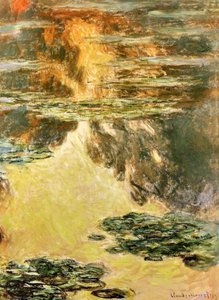
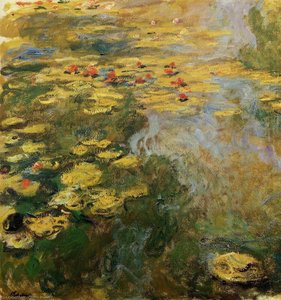
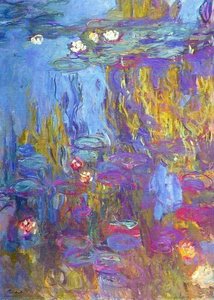
In the later years of his life, Claude Monet found his ultimate sanctuary at Giverny. Here, he was no longer just a visitor to nature; he became its architect. Through meticulous cultivation, he created a water garden that would serve as the setting for some of the most profound achievements in art history. The Water Lilies (or Nymphéas) series, comprising approximately 250 oil paintings, represents the zenith of his career and the culmination of his lifelong obsession with light and reflection.
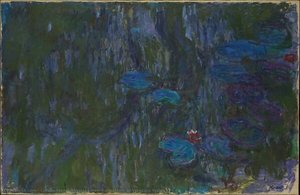
These works are far more than botanical studies; they are immersive environments. In the later stages of his life, even as cataracts began to cloud his vision, Monet’s ability to perceive color and form remained undiminuted by a heightened sense of abstraction. The paintings often lack a horizon line or a fixed perspective, drawing the viewer into a world where sky and water merge. The surface of the pond becomes a mirror, reflecting not just the lilies themselves, but the shifting clouds, the weeping willows, and the ever-changing light of the French sky. The boundaries between the physical object and its reflection dissolve, creating a sense of infinite depth and movement.
The Water Lilies series serves as a testament to the power of persistence. These massive canvases, some designed for large-scale installation, demand that the viewer slow down and breathe deeply. They invite a meditative state, where one can lose themselves in the rhythmic patterns of the flora and the soft, ethereal textures of the water. In these works, Monet achieved a rare feat: he captured the eternal within the ephemeral. Even as the light changed by the minute, the essence of the garden remained—a permanent monument to the beauty of the fleeting moment.
The Impressionist Legacy: How a Movement Red#ined Modern Perception
--- title: Impressionism: Art and Modernity - The Metropolitan Museum of Art author: Margaret Samu url: https://www.metmuseum.org/essays/impressionism-art-and-modernity hostname: metmuseum.org description: In addition to their radical technique, the ...
The impact of Impressionism extends far beyond the boundaries of the 19th century. By breaking the shackles of academic realism, Monet and his peers provided the foundational DNA for nearly every modern art movement that followed. From the expressive distortions of Post-Impressionism to the fragmented planes of Cubism, the permission to prioritize subjective experience over objective accuracy is a gift from the Impressionists. They taught us that art does not have to be a window into a literal world, but can instead be a mirror reflecting the internal landscape of human emotion and perception.
Today, we see the legacy of this revolution in our very way of seeing the world. The movement's emphasis on the beauty of everyday life—the stroll through a park, the light on a haystack, the simple joy of a garden—democratized art, making it accessible and relatable to the human experience. It encouraged a fascination with modern life, urbanization, and the changing social fabric of a rapidly industrializing world. The Impressionists taught us to find wonder in the mundane and to recognize that there is profound complexity in a single, sun-drenched moment.
For the modern collector and history lover, these masterpieces offer more than just aesthetic pleasure; they offer a connection to a pivotal era of human creativity. Whether through the study of a museum original or the acquisition of a high-quality reproduction, the works of Monet continue to transform our spaces. At ArtsDot.com, we honor this legacy by bringing these iconic visions into the modern home. Our master artists specialize in hand-painted oil reproductions that capture the true soul of the Impressionist movement—the visible brushstrokes, the deep tonal ranges, and the luminous light that continue to inspire awe over a century later. We invite you to explore our collection and bring the revolutionary spirit of Claude Monet into your own sanctuary.