The Primordial Record: From Ancient Stone Friezes to the First Herbals
Long before the advent of the microscope or the sophisticated taxonomies of Linnaeus, humanity possessed an innate drive to document the verdant world surrounding it. This impulse was not merely aesthetic but deeply survivalist. The earliest echoes of botanical art can be found in the silent stone friezes of Karnak, Egypt, dating back to 1465 B.C., where flora were etched into the very fabric of civilization. These ancient markings served as a primitive ledger of the natural world, capturing the essence of life long before the concept of "art" was decoupled from utility.
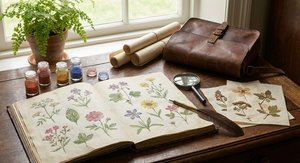
As civilizations progressed, this need for documentation evolved into the creation of herbals—the foundational manuscripts of botanical history. By the fourth and fifth centuries, the systematic recording of plants began to take shape, driven by a critical necessity: the distinction between life-saving medicine and lethal poison. The difference between a healing herb and a deadly toadstool was often a matter of visual recognition. These early books, such as the influential works emerging around 512 A.D., were more than mere catalogs; they were vital repositories of knowledge, where a carefully rendered leaf or root served as an essential guide for the physician and the herbalist alike.
In these formative centuries, the art was inseparable from the science of survival. There was no room for the romanticized abstraction found in later eras; instead, there was a raw, earnest pursuit of likeness. Every line drawn was a claim to knowledge, an attempt to tether the ephemeral beauty of a blooming flower to the permanence of parchment.
The Renaissance Revolution: Art as an Instrument of Scientific Discovery
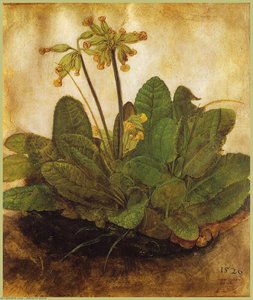
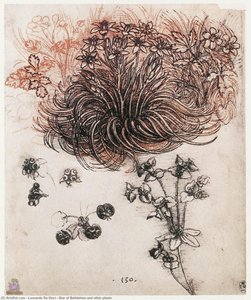
The Renaissance brought with it a profound shift in human consciousness, a period where the boundaries between the artist’s studio and the scientist’s laboratory began to dissolve. This era witnessed a rebirth of inquiry, where the meticulous observation of nature became a spiritual and intellectual pursuit. Masters such as Leonardo da Vinci and Albrecht Dürer did not merely paint plants; they interrogated them. Through their eyes, the botanical specimen became a subject of profound anatomical study, revealing the hidden mechanics of growth, light, and structure.
During this golden age of discovery, the artist’s brush became an instrument of empirical truth. The works of Leonhart Fuchs and John Gerard exemplify this transition, as their illustrations moved beyond simple identification toward a deeper understanding of botanical morphology. This was an era where the precision of the engraver's tool allowed for a level of detail previously unimaginable, enabling the dissemination of scientific findings through beautifully crafted printed books. The flora depicted were no longer just symbols in a religious manuscript but were subjects of rigorous, observational study.
This period established the fundamental principle that true beauty is found in accuracy. To capture the precise curvature of a stem or the delicate serration of a leaf was to honor the divine order of nature. The Renaissance artist taught us that to see clearly is an act of devotion, and in doing and documenting these details, they laid the groundwork for the modern scientific tradition.
Mastery of the Lens and Brush: The Golden Age of Botanical Naturalism
As we moved into the 18th and 19th centuries, botanical illustration entered its most opulent and technically refined phase. This was the era of the great florilegia and the expansion of global botanical expeditions. Artists like Claude Aubriet in France and Johann Simon von Kerner in Germany pushed the boundaries of what could be achieved on paper, blending exquisite aesthetic grace with an uncompromising commitment to scientific rigor.
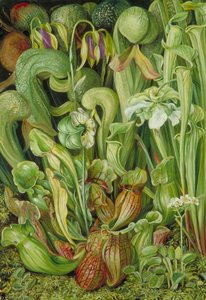
The technical mastery displayed during this period was nothing short of extraordinary. Utilizing advanced layering and hatching techniques, artists such as Amédée Masclef were able to imbue their works with a sense of three-dimensional vitality. The use of watercolor allowed for a luminous translucency that mimicked the delicate petals of a rose or the waxy surface of a leaf, while fine engravings provided the structural backbone necessary for scientific classification. In America, artists like Frederick E. Cohen continued this legacy, bringing a meticulous, detailed approach to the study of North American flora.
The Epistemology of Detail: Where Scientific Accuracy Meets Aesthetic Elegance
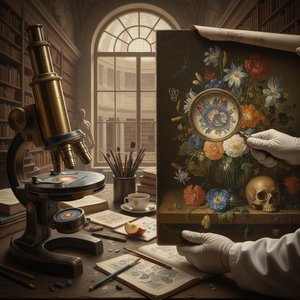
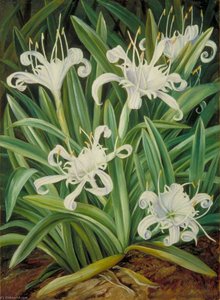
To understand the true depth of botanical illustration, one must look past the surface beauty and contemplate its epistemological roots. At its core, this art form is a study in perception. It asks: how much of the world can we truly capture through observation? The precision required for scientific illustration demands a level of focus that borders on the meditative. Artists like Karl Blossfeldt and Maud H. Purdy demonstrated that by magnifying the minute details of plant life, one could reveal an architectural grandeur often invisible to the naked eye.
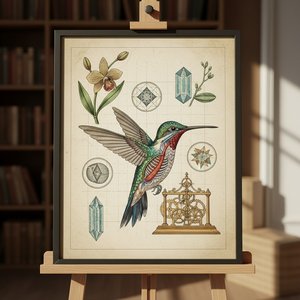
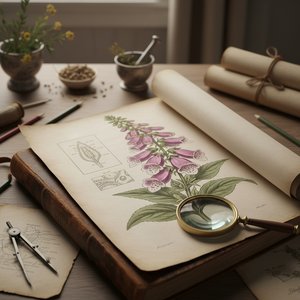
This intersection of art and science creates a unique form of knowledge. A painting does not merely show us what a plant looks like; it teaches us how it functions, how it interacts with light, and how it occupies space. The technical mastery—the way an artist uses light to suggest volume or color to suggest texture—is not just a display of skill, but a method of conveying complex biological information. It is a language of precision where every stroke carries weight.
In this pursuit, the distinction between "art" and "science" becomes an artificial one. The botanical illustrator operates in a space where aesthetic elegance serves as the vehicle for scientific truth. The beauty of the work is not a distraction from its accuracy, but rather the very thing that makes the accuracy memorable and enduring.
Legacy in Bloom: The Enduring Influence of Botanical Studies on Modern Fine Art
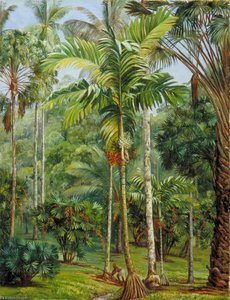
Today, the legacy of botanical illustration continues to resonate through the halls of art history and the collections of modern enthusiasts. While the advent of color photography changed the way we document the natural world, it did not diminish the power of the hand-drawn specimen. The influence of these classical studies can be seen in everything from contemporary botanical painting to the way modern artists approach texture and form in landscape art.
For the modern collector, these works offer a window into a time when the world was still being discovered, piece by precious piece. There is a profound sense of permanence in a hand-painted reproduction that a digital image simply cannot replicate. The visible brushstrokes, the depth of tonal range, and the tactile presence of oil on canvas allow the spirit of the original masters to live on in contemporary spaces.
At ArtsDot.com, we celebrate this enduring connection between history and artistry. We specialize in bringing these canonical masterpieces back to life through meticulous, hand-painted oil reproductions. Our artists, trained in the highest academic traditions, work to ensure that every petal and every stem reflects the same precision and passion as the masters of the past. Whether you are seeking a museum-quality piece for a private collection or looking to transform a personal memory into a classical masterpiece through our custom services, we invite you to rediscover the timeless elegance of nature's most precise art form.