The Convergence of Observation and Artistry: Defining Scientific Illustration
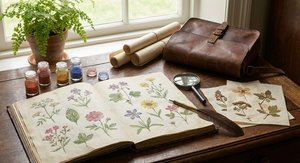
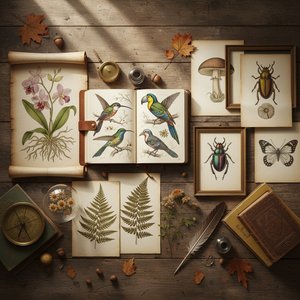
To gaze upon a true scientific illustration is to witness a profound dialogue between the analytical mind and the creative soul. It is an art form born from necessity, where the objective requirement for accuracy meets the subjective pursuit of aesthetic grace. Unlike purely expressive fine art, which may seek to convey emotion through abstraction or distortion, scientific illustration demands a rigorous fidelity to reality. Yet, within this discipline, there is no room for the sterile or the mundane; rather, the illustrator must find the hidden poetry in the structure of a leaf, the delicate curve of an insect's wing, or the intricate vascularity of a petal.
This unique intersection creates a specialized form of beauty—a beauty rooted in truth. The artist acts as both a scholar and a virtuoso, translating the complex data of the natural world into a visual language that is universally legible. Through meticulous observation, the illustrator captures not just the likeness of a specimen, and its anatomical essence, but also its vitality. It is this delicate balance of empirical precision and artistic intuition that allows scientific illustration to transcend its educational purpose, becoming a celebrated genre within the broader canon of fine art history.
The Golden Age of Botanical Precision: From Keulemans to Purdy
The history of botanical art is a testament to human curiosity and the enduring allure of the natural world. During the heights of botanical exploration, illustrators were the primary witnesses to new species being introduced to the global scientific community. One cannot discuss this era without evoking the name of John Gerrard Keulemans, whose 1868 watercolor studies, such as his exquisite depiction of a brown wren, exemplify the 18th-century tradition of unparalleled precision. His work does not merely document; it celebrates the textures and subtle color gradations that define life.
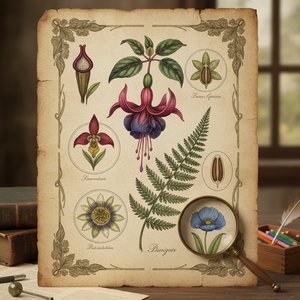
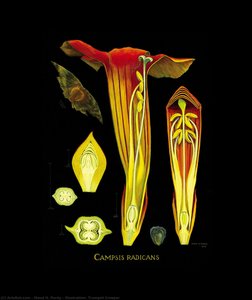
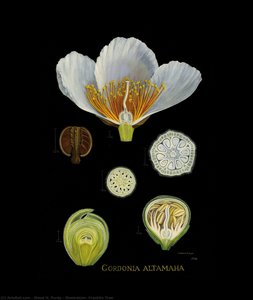
As the centuries progressed, this tradition of excellence was carried forward by masters who blended scientific rigor with a lush, painterly sensibility. The early 20th century saw the remarkable contributions of Maud H. Purdy, whose 1932 illustration of the Trumpet Creeper stands as a pinnacle of the medium. Her watercolor study of Campis rademon showcases how botanical art can achieve a level of detail that serves both the taxonomist and the connoisseur. Similarly, the legacy of German illustrators like Johann Simon von Kerner, known for his detailed plant illustrations in the Hortus Sempervirens, reminds us that the pursuit of botanical truth has always been accompanied by a deep reverence for the organic elegance of the flora being documented.
Nature’s Geometry: Exploring Structural Beauty through German Expressionism
While much of scientific illustration focuses on the delicate and the colorful, there exists a parallel movement that finds majesty in the structural and the monochromatic. This is perhaps most strikingly realized in the work of Karl Blossfeldt. Through his lens, nature is reimagined as a series of architectural marvels. His series, Art Forms in Nature, utilizes the stark clarity of black and white photography to highlight the rhythmic patterns and geometric complexities found in plant life.
Influenced by the burgeoning movements of German Expressionism, Blossfeldt’s approach strips away the distraction of color to reveal the underlying skeletal strength of the natural world. In his compositions, a simple stem or a budding flower becomes a sculptural element, echoing the industrial and organic geometries of the modern age. This perspective invites the viewer to look beyond the surface beauty of a plant and instead contemplate the profound mathematical order that governs all biological existence. It is a transformative way of seeing, where science provides the subject, but art provides the profound, structural revelation.
The Technical Mastery of the Medium: Watercolor, Ink, and Anatomical Accuracy
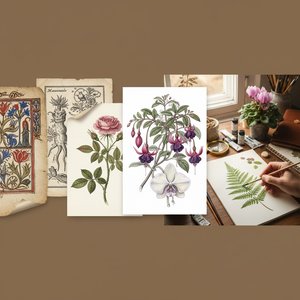
The achievement of such breathtaking accuracy is never accidental; it is the result of immense technical discipline. The choice of medium plays a critical role in how scientific truth is communicated. Watercolor remains perhaps the most cherished medium for botanical illustrators due to its translucency and ability to mimic the delicate, light-filled nature of living tissue. By layering thin washes of pigment, an artist can build depth and luminosity, capturing the subtle shifts in hue that occur within a ripening fruit or a blooming rose.
In contrast, ink illustration offers a different kind of precision, utilizing fine lines to delineate the sharp edges, textures, and microscopic details of anatomical structures. The interplay between the fluid grace of watercolor and the disciplined certainty of ink allows for a comprehensive documentation of life. This technical mastery requires an intimate understanding of chemistry—how pigments react with paper, how light interacts with moisture, and how much detail can be rendered before a composition loses its clarity. It is this rigorous application of technique that ensures the artwork remains a reliable scientific record while simultaneously functioning as a masterpiece of fine art.
The Enduring Legacy: How Scientific Illustration Shapes Modern Aesthetic Appreciation
In our contemporary era, dominated by high-resolution digital photography, one might wonder if the role of the scientific illustrator has diminished. On the contrary, the essence of this art form has only grown in value. While a photograph captures a single moment in time, an illustration can synthesize multiple observations into a single, perfect specimen—showing the plant at various stages of growth or highlighting specific anatomical features that a camera might miss. The illustrator possesses the unique ability to curate reality, emphasizing the essential and de-emphasating the incidental.
The legacy of these masters continues to influence modern design, fine art, and our collective aesthetic sensibilities. We see their influence in the intricate patterns of textile design, the minimalist elegance of modern branding, and the continued fascination with naturalism in contemporary painting. Scientific illustration teaches us a vital lesson: that true beauty is found in the details, and that there is profound wisdom to be gained from looking closely at the world around us. It remains an enduring bridge between the intellect and the eye, reminding us that the study of nature is, in itself, one of the highest forms of art.
At ArtsDot.com, we celebrate this timeless intersection of precision and passion. As a global leader in fine art reproduction, we are dedicated to preserving the legacy of the Old Masters and scientific illustrators alike. Whether you are seeking a museum-quality Giclée print of a botanical study or a bespoke, hand-painted oil reproduction that captures the tactile texture of a historical masterpiece, our mission is to bring the beauty of art history into your personal space. From custom portrait commissions to expert art consultations, we provide the bridge between the legendary works of the past and the collectors of the future.