![The Anatomy Lecture Of Dr. Nicolaes Tulp [1632] — Rembrandt Van Rijn](/media/artworks/images-thumb/e5/fc/e5fcb33447eac6b24ab049b22effa1a3.jpg)
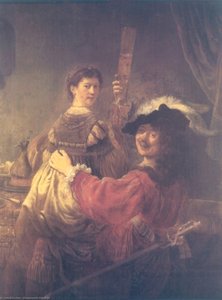
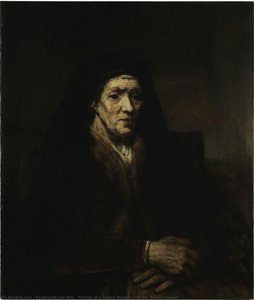

The Silent Language: Hands as Conduits of Human Emotion
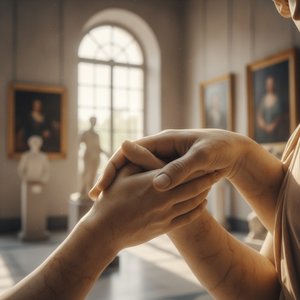 The Art of Touch: Exploring Masterpieces That Capture the Power of Human Hands
The Silent Language: The Hand as an Instrument of Emotion In the vast lexicon of visual art, few elements possess the profound communicative power of the human hand. Beyond mere anatomical structures of bone and sinew, hands serve as the primary cond...
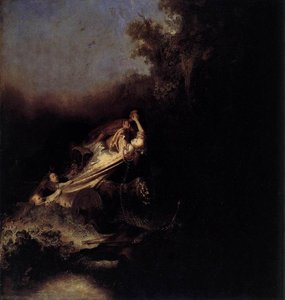
In the vast, silent lexicon of visual art, few elements possess a communicative power as profound as the human hand. Beyond the mere anatomical arrangement of bone, tendon, and skin, hands serve as the primary conduits for our most intimate and unutterable emotions. They are the instruments through which fear trembles, tenderness caresses, and conviction finds its resolute strength. To observe a masterfully rendered hand is to witness a tactile vocabulary that transcends linguistic barriers, speaking directly to the soul of the observer without the need for a single spoken word.
The subtle curvature of a finger or the tension held within a palm can evoke empathy and recognition across centuries. A clenched fist may signal an impending storm of rage, while an open, relaxed palm suggests a state of grace or profound vulnerability. This ability to externalize the internal—to make the invisible weight of thought or feeling visible through gesture—is what elevates the study of hands from simple observation to high art. When we gaze upon these works, we are not merely looking at anatomy; we rather witness the silent language of human connection.
Anatomical Precision: The Renaissance Pursuit of Realism
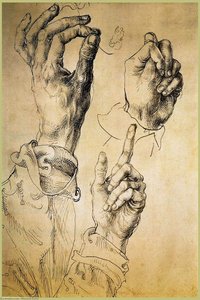 Study of Three Hands
A Study in Human Form: Dürer's "Study of Three Hands" Albrecht Dürer’s “Study of Three Hands” is not merely a depiction of anatomical detail; it’s a profound meditation on the very nature of human existence, rendered with an almost unsettling precisi...
The Renaissance era marked a pivotal moment in this artistic evolution, as scholars and creators alike turned their gaze toward the scientific observation of nature. This period was characterized by an intense interest in classical antiquity and a renewed focus on human potential, often referred to as Humanism. No artist embodied this rigorous pursuit of truth more profoundly than Albrecht Dürer. His meticulous studies of human anatomy elevated the hand from a supporting detail to a subject worthy of intense, singular focus.
In works such as his Study of Three Hands, created around 1508, Dürer captures the intricate architecture of the human form with an almost unsettling precision. His mastery is evident in the meticulous rendering of texture and shadow, where every knuckle and vein is treated with reverence. This era’s dedication to anatomical accuracy was not merely about technical bravado; it was a profound meditation on the nature of existence itself. By capturing the marks of age and wear, these artists invited viewers into a state of quiet contemplation regarding the fragility and beauty of the human form.
Chiaroscuro and Form: Mastering Light and Shadow in Gesture
 Chiaroscuro
In art, chiaroscuro (English: kee-AR-ə-SKOOR-oh, -SKURE-, Italian: [ˌkjaroˈskuːro]; lit. 'light-dark') is the use of strong contrasts between light and dark, usually bold contrasts affecting a whole composition. It is also a technical term used by a...
To truly breathe life into the anatomy of a hand, one must master the interplay of light and shadow. This is perhaps most brilliantly achieved through chiaroscuro, the dramatic use of strong contrasts between light and dark to achieve a sense of volume and three-dimensionality. The great Dutch master Rembrandt van Rijn utilized this technique to create a profound, quiet intimacy within his work. In his paintings, light does not merely illuminate a scene; it breathes life into the very soul of the subject.
When applied to the study of hands, chiaroscuro allows the artist to model the fingers and palms so effectively that they appear almost tangible to the viewer. The deep shadows in the recesses of the knuckles and the luminous highlights on the fingertips create a sense of weight and presence. This mastery of light allows for a psychological depth where one might witness the subtle flicker of thought passing through a subject. At ArtsDot.com, our artists strive to honor this tradition, using 100% hand-painted oil techniques on cotton canvas to ensure that every brushstroke captures that same essential depth and tonal range found in the masters.
From Scientific Study to Symbolic Expression: A Historical Evolution
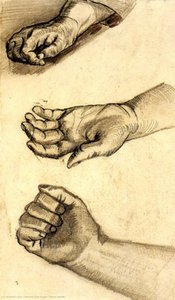 Three Hands
An Anatomical Exploration: Vincent van Gogh’s ‘Three Hands’ (1884) Subject and Composition: This striking charcoal drawing presents a meticulous study of the human hand, rendered with an almost scientific precision. Van Gogh depicts three hands – one...
The history of the hand in art is a journey from the scientific to the symbolic. While the Enlightenment brought an era of anatomical idealism—seen in the meticulous engravings of artists like Arnould Eloi Gautier Dagoty—the 19th century introduced a more expressive, psychological dimension. Vincent van Gogh’s Three Hands (1884) serves as a remarkable example of this shift. While his work maintains an exceptional realism and technical mastery of charcoal and graphite, the arrangement is far from purely scientific. The stacked hands—one open in offering, one clenched in tension, and one poised in rest—represent a deliberate exploration of potential action and emotional state.
This evolution continued into the contemporary era, where artists like Rena Small have used the hand to explore much broader conceptual themes. In her Artists’ Hands Grid Continuum, the focus shifts from anatomy to identity, using the hands of influential creators as a meditation on artistic history and the enduring power of gesture. This progression shows that while the tools and styles change, the fundamental fascination with the hand as a symbol of creation, communication, and human legacy remains an unbroken thread in the tapestry of art history.
The Enduring Legacy: Contemporary Interpretations of the Human Hand
Today, the study of hands continues to inspire both the classical enthusiast and the modern creator. The ability to capture the "human touch" remains one of the most challenging yet rewarding pursuits in fine art. Whether it is through the academic realism of a Renaissance drawing or the expressive impasto of a post-impressionist study, the hand remains our most potent tool for storytelling. It is this enduring legacy that allows us to connect with the masters of the past, finding pieces of ourselves in their rendered gestures.
For those looking to bring this profound history into their own spaces, we offer more than mere copies; we offer a continuation of the craft. At ArtsDot.com, our professional artists—holders of degrees from prestigious Fine Arts academies—specialize in recreating these legendary works. From the intricate line work of Dürer to the light-drenched textures of the Dutch masters, our hand-painted oil reproductions are designed to serve as a permanent, tactile connection to the eternal. Whether you seek a museum-quality reproduction or wish to "remix" history by having a personal photo transformed into the style of Van Gogh, we invite you to experience the power of the human touch in your own home.