The Primordial Mark: Tracing the Ancient Roots of Line and Form
 The Enduring Power of Line: Exploring Themes & Techniques in Drawing Across Art History
The Primordial Mark: Drawing’s Ancient Roots & Early Functions Before the vibrant hues of paint and the enduring solidity of sculpture, there was line. The impulse to mark a surface – to capture form, narrate experience, or simply explore the possibi...
Before the first vibrant pigment was ground from lapis lazuli, and long before the enduring weight of oil on canvas commanded the halls of the Louvre, there was the line. It is perhaps the most fundamental impulse of the human spirit—a primal urge to mark a surface, to trace the boundary between the self and the void. This impulse stretches back into the deep mists of prehistory, where ochre handprints in the caves of Lascately and Altamira served not merely as depictions, but as profound acts of creation. These early marks were the precursors to language itself, a way to narrate experience and capture the fleeting essence of movement through simple, rhythmic gestures.
As civilization progressed, the line evolved from a tool of survival into a sophisticated instrument of narrative and divinity. In the delicate sketches found on ancient Egyptian papyrus, we see the birth of a structured visual grammar, where every stroke was imbued with symbolic weight. The line became a vessel for the sacred, capable of defining the contours of gods and the trajectories of the stars. This foundational period established a truth that remains unshakeable in art history: that the most complex compositions are built upon the strength of a single, deliberate mark. To understand the masterworks of the Renaissance or the Baroque, one must first respect this ancient, silent language of the stroke.
The Language of Weight and Contour: Mastering Technical Precision
 Mastering the Line: A Comprehensive Expert Guide to Technical Precision and Expressive Depth in Drawing
The Fundamentals of Line: Understanding Weight, Direction, and Contour The genesis of every profound masterpiece begins with a single, deliberate mark upon a void. For the aspiring artist, understanding the line is not merely about tracing edges, but...
To the untrained eye, a line may appear as a simple boundary, yet to the master, it is a living entity possessing its own pulse and rhythm. The genesis of every profound masterpiece begins with an understanding of what we might call the silent language of weight, direction, and contour. A line is never truly static; it can be as light as a whispered breath, suggesting a fleeting shadow or a distant horizon, or it can be heavy and assertive, acting as a structural boundary that anchors a composition. When an artist manipulates line weight, they introduce a sense of hierarchy and movement, guiding the viewer’s eye through a carefully choreographed journey across the paper.
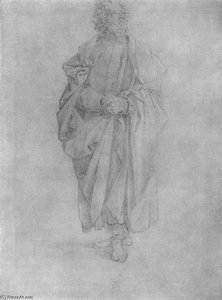
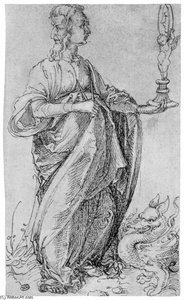
Consider the way a thickening stroke can imply gravity, proximity, or the density of a physical form, while a tapering end suggests recession into space or the grace of motion. This is particularly evident in the study of contour—the outline that defines the boundary between an object and its surrounding atmosphere. By mastering the contour, the artist learns to perceive form not as a flat silhouette, of mere decoration, but as a three-dimensional entity occupying real space. Whether it is the sweeping, curvilinear contours reminiscent of classical figure studies or the sharp, angular lines that introduce architectural tension, the precision of these marks dictates the emotional temperature of the work.
From Silverpoint to Graphite: The Alchemy of Evolving Media
 The Nuances of Graphite: Exploring Emotional Depth & Technical Mastery in Pencil Drawing
A History Rooted in Earth: The Origins & Evolution of Graphite Wikipedia: Colored pencil A colored pencil (American English), coloured pencil (Commonwealth English), colour pencil (Indian English), map pencil, pencil crayon, or coloured/colouring lea...
The history of drawing is also a history of material alchemy, a tale of how humble substances from the earth were transformed into tools of profound expression. Before the widespread use of graphite, the artist often relied on silverpoint—a demanding and unforgiving medium that required specialized surfaces and yielded only the most delicate, permanent lines. Silverpoint demanded an absolute mastery of hand control, as every mark was etched into the very soul of the prepared ground. However, the rise of graphite offered a liberating alternative, introducing a subtle, silvery spectrum that invited a more nuanced dance between light and shadow.
The story of graphite is one of unassuming origins blossoming into technical revolution. Derived from naturally occurring carbon, its early use was far more practical than artistic—notably used in 16th-century England for marking sheep. Yet, as the medium evolved through innovations like Nicolas-Jacques Conté’s 1795 invention of mixing powdered graphite with clay, the artist gained unprecedented control over hardness and darkness. This democratization of the medium allowed for a greater range of tonal values, bridging the gap between a mere mark and a profound statement. Unlike the heavy, dramatic presence of charcoal, graphite offers a precision that allows for the meticulous rendering of fine detail, making it the preferred companion for the academic pursuit of realism and depth.
Subtractive Mastery: The Art of Light through Erasure
Subtractive drawingSubtractive drawing is a technique in which the drawing surface is covered with graphite or charcoal marks and then erased to make the image. This technique is often used to add texture, establish tonal shapes, or create the appearance of reflected l...
While we often think of drawing as an additive process—the accumulation of marks upon a void—there exists a secondary, equally vital discipline known as subtractive drawing. In this technique, the artist begins not with a white surface, but with one already saturated with pigment, such as charcoal or heavy graphite. The image is then "found" through the act of erasure. This method is far more than a way to correct mistakes; it is a sophisticated tool used to establish tonal shapes and create the ethereal appearance of reflected light.
Using tools like the kneaded or putty eraser, which can be manipulated into fine, precise tips, the artist absorbs pigment to pull light out of the darkness. This process is particularly essential in charcoal figure drawing, where the interplay between additive strokes and subtractive highlights creates a sense of volume and atmosphere that purely additive methods struggle to achieve. It allows for the creation of soft transitions and the "glow" of skin or fabric, turning the act of erasing into an act of sculpting with light. In this way, the artist does not just draw the shadow; they carve the light.
Architectural Vision and Topographical Detail: The Line in Masterworks
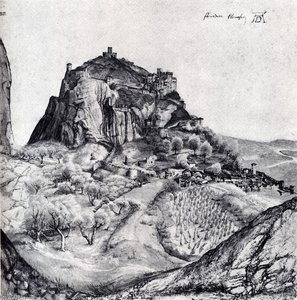 The Citadel Of Arco In The South Tyrol
A Monument to Resilience: Albrecht Dürer’s ‘The Citadel of Arco in South Tyrol’ Albrecht Dürer's ‘The Citadel of Arco in South Tyrol’ is more than just a drawing; it’s a meticulously crafted testament to the enduring power of human endeavor and the s...
The true power of the line is perhaps most visible when it is applied to the monumental tasks of topography and architecture. Few artists embodied this technical rigor more completely than Albrecht Dürer. In his 1528 masterpiece,
The Citadel of Arco in South Tyrol, we witness a symphony of hatching and cross-hatching that transforms flat paper into a breathtakingly three-dimensional landscape. Dürer’s technique is a masterclass in rendering texture—the ruggedness of stone walls, the density of foliage, and the sheer scale of mountain peaks are all achieved through the disciplined application of linear precision.
In such works, the line serves as both a structural blueprint and an emotional anchor. The composition is often governed by strong diagonal perspectives that draw the viewer upward, amplifying the sense of grandeur. This marriage of geometric harmony—using triangles for mountains and rectangles for fortifications—and organic detail demonstrates how the line can capture the essence of the natural world while maintaining intellectual rigor. Similarly, in the architectural archives of institutions like the Riba Library, we see how the line preserves the very blueprint of civilization, where the meticulous drafts of legendary architects turn paper into a living testament to human vision and structural ambition.
The Living Legacy: Preserving the Soul of Drawing in the Modern Era
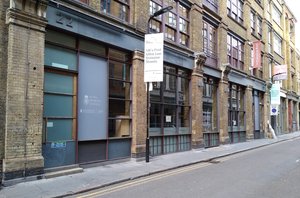 Royal Drawing School
The Soul of the Line: Discovering the Royal Drawing School In the heart of Shoreditch, where the industrial grit of London meets a burgeoning contemporary spirit, lies a sanctuary dedicated to the most fundamental of artistic acts: the act of seeing....
In an era increasingly dominated by the fleeting glow of digital screens, the practice of observational drawing remains a vital sanctuary for the human spirit. Institutions like the Royal Drawing School in London serve as bastions for this tradition, emphasizing the slow, deliberate movement of graphite across paper and the meticulous study of light and shadow. This dedication to the "act of seeing" ensures that the fundamental discipline of draughtsmanship is not lost to the convenience of modern technology.
The beauty of drawing lies in its intimacy; it is a medium where the breath of the artist is still palpable in every stroke. Whether through the delicate engravings of the past or the contemporary explorations of texture and value, the line continues to be our most essential tool for navigating the world. For those who seek to bring this historical depth into their own lives, the preservation of these techniques allows us to connect with a lineage of masters that spans centuries. Through the careful study and reproduction of these works, we ensure that the profound dialogue between the artist, the line, and the viewer continues to resonate for generations to come.