The Delft Master: Pieter de Hooch’s Early Life & Artistic Beginnings
Pieter Hendricksz de Hooch, a name synonymous with the quiet dignity of Dutch domestic life, emerged from the bustling port city of Rotterdam in 1629. While biographical details remain somewhat elusive, we know he was born into a family of artisans – his father a bricklayer – a background that perhaps instilled an early appreciation for structure and meticulous detail. His initial artistic training is shrouded in some mystery; Arnold Houbraken, the 18th-century art historian, suggests studies under Nicolaes Berchem in Haarlem, but evidence supporting this remains scant. What *is* clear is de Hooch’s rapid development during his time in Delft, a city then experiencing a flourishing of artistic talent alongside figures like Jan Vermeer. Early works from this period, often depicting lively tavern scenes and soldiers engaged in boisterous activity – paintings like “Woman Drinking with Soldiers” (1658) – reveal a nascent skill for capturing light and movement, though still somewhat rough around the edges compared to his later masterpieces. These early compositions, while less refined than his iconic interiors, offer valuable insight into his artistic evolution, showcasing a willingness to experiment with perspective and narrative.
Capturing the Intimacy of Home: De Hooch's Genre Paintings & Daily Life
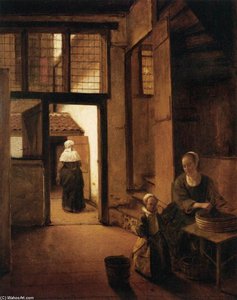
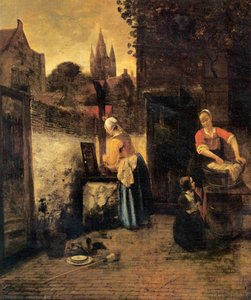 Two women with a child in court
Pieter de Hooch’s "Two Women with a Child in Court" (1657) captures Dutch Golden Age life with realism & dramatic lighting. Explore this iconic genre painting's details & historical context.
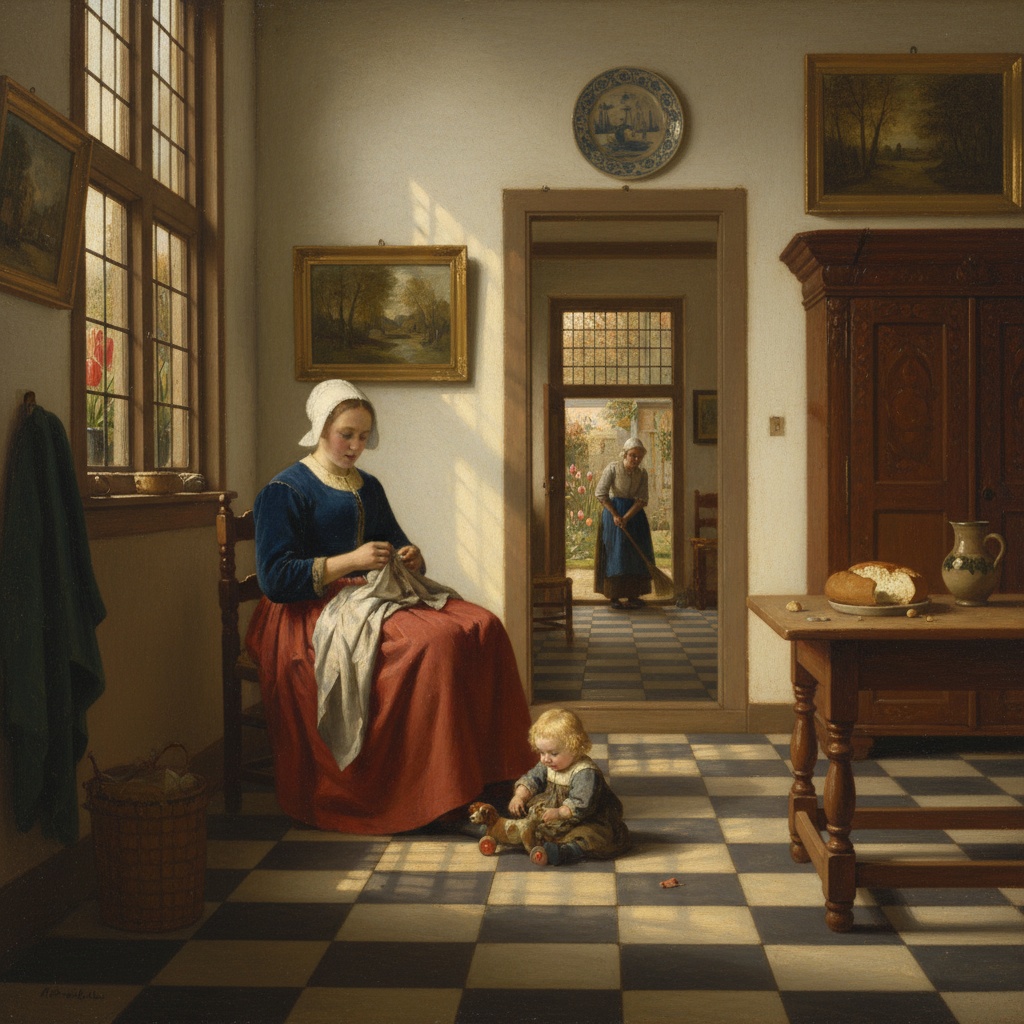
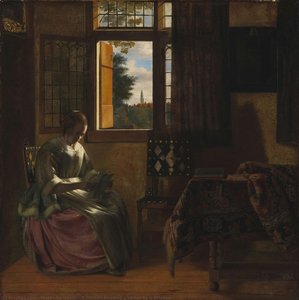
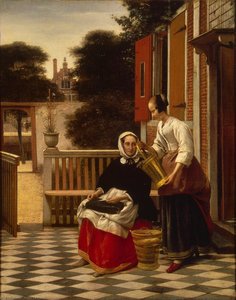
De Hooch’s true genius blossomed when he turned his attention inward, focusing on the seemingly mundane yet profoundly revealing scenes of everyday life within Dutch homes. He wasn’t interested in grand historical narratives or mythological allegories; instead, he found beauty and significance in the quiet moments of domesticity – a mother peeling turnips while a child enters with a playful dog, a woman paying a hostess in a well-appointed room, two women engaged in conversation near a courtyard. These are not idealized depictions, but rather glimpses into the realities of middle-class life, rendered with remarkable sensitivity and observation. His paintings aren’t simply *about* these scenes; they evoke a feeling – a sense of warmth, order, and contentment. He masterfully portrays the interplay between individuals within their environment, capturing subtle gestures and expressions that speak volumes about their relationships and social standing. This focus on genre painting—depicting ordinary people in everyday settings—was becoming increasingly popular during the Dutch Golden Age, reflecting a growing interest in realism and the lives of common citizens.
Light and Perspective: The Innovative Techniques of a Dutch Visionary
 Wikipedia: Pieter de Hooch
Pieter Hendricksz. de Hooch (Dutch: [ˈpitər ˈɦɛndrɪksoːn də ˈɦoːx]; also spelled Hoogh or Hooghe; bapt. 20 December 1629 – after 1683), was a Dutch Golden Age painter famous for his genre works of quiet domestic scenes with an open doorway. He was a...
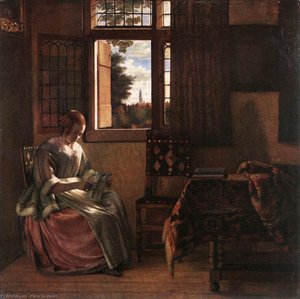
What truly sets de Hooch apart is his groundbreaking use of light and perspective. He wasn’t merely *representing* space; he was creating an illusion of depth and atmosphere that drew viewers into the scene. His interiors are bathed in a luminous, natural light that seems to emanate from within, illuminating textures and casting subtle shadows. This effect isn't achieved through dramatic chiaroscuro like Rembrandt, but rather through a delicate layering of tones and a keen understanding of how light interacts with different surfaces – polished wood floors reflecting sunlight, the soft glow on ceramic objects, the way light filters through open doorways. Crucially, de Hooch pioneered what became known as the “doorkirkjie” technique—the inclusion of doorways or windows that offer glimpses into adjacent spaces. This wasn’t simply a compositional device; it expanded the picture plane, creating a sense of continuity and inviting the viewer to explore beyond the immediate foreground. It's this masterful manipulation of light and perspective that gives his paintings their remarkable realism and immersive quality.
Beyond the Walls: Symbolism and Social Commentary in De Hooch’s Work
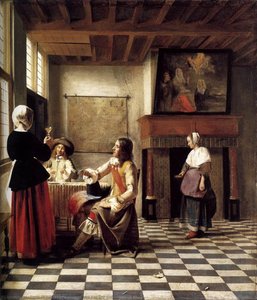
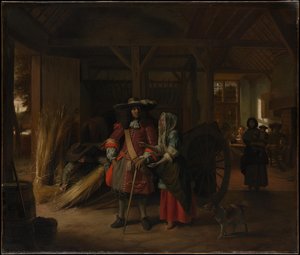 Paying the Hostess
Pieter de Hooch’s ‘Paying the Hostess’ (1670) – a dramatic Dutch Golden Age oil painting of a tense transaction. Explore its chiaroscuro, rich textures & social commentary.
While de Hooch’s scenes appear straightforward, a closer examination reveals subtle layers of symbolism and social commentary. The meticulously rendered interiors weren't merely aesthetic choices; they were statements about wealth, status, and moral values. The presence of expensive objects – oriental carpets, Delftware pottery, polished furniture – signaled the prosperity of the household. Cleanliness and order were also significant indicators of virtue and respectability. Even seemingly innocuous details, like a child’s toys or a pet bird, could carry symbolic weight. For example, “Paying the Hostess” (1670) is not simply a depiction of a financial transaction; it's a nuanced portrayal of social interaction and potential tension, with the composition hinting at underlying power dynamics. The careful arrangement of figures and objects within these spaces suggests a deliberate attempt to convey meaning beyond the literal representation of daily life. De Hooch’s work offers a fascinating window into the values and aspirations of 17th-century Dutch society.
De Hooch and Vermeer: A Comparison of Two Delft Masters
Inevitably, any discussion of Pieter de Hooch must include a comparison to his contemporary, Jan Vermeer. Both artists shared a fascination with domestic interiors, quiet realism, and the subtle effects of light. However, their approaches differed significantly. Vermeer’s work is characterized by its meticulous detail, psychological depth, and almost ethereal quality. He focused on single figures engaged in contemplative activities, often bathed in a soft, diffused light. De Hooch, conversely, was more interested in capturing the dynamics of social interaction within larger groups, with his paintings typically featuring multiple figures and a greater emphasis on spatial arrangement. While Vermeer excelled at portraying individual character, de Hooch masterfully conveyed the atmosphere and rhythm of everyday life. It’s often debated who influenced whom; some scholars believe Vermeer was initially inspired by de Hooch's innovative use of perspective, while others argue that de Hooch learned from Vermeer’s mastery of light and color. Regardless of their influence on each other, both artists remain cornerstones of the Dutch Golden Age, representing different facets of its artistic brilliance.
The Legacy of Pieter de Hooch: Influence & Enduring Appeal
Despite facing financial hardships later in his life – a decline often attributed to personal tragedies and a shifting art market – Pieter de Hooch left an indelible mark on the history of painting. His innovative techniques, particularly his use of light and perspective, influenced generations of artists. His focus on genre painting paved the way for new approaches to realism and social commentary. Today, his works are celebrated for their quiet beauty, intimate atmosphere, and profound understanding of human relationships. De Hooch’s paintings offer a timeless glimpse into the lives of ordinary people, reminding us that even in the most mundane moments, there is beauty, dignity, and meaning to be found. At ArtsDot, we are proud to offer high-quality reproductions of de Hooch's masterpieces, allowing you to bring the charm and tranquility of his Dutch interiors into your own home. Explore our collection today and discover the enduring appeal of this Delft master.