Early Life & Artistic Foundations: Baltimore Roots and Düsseldorf Training
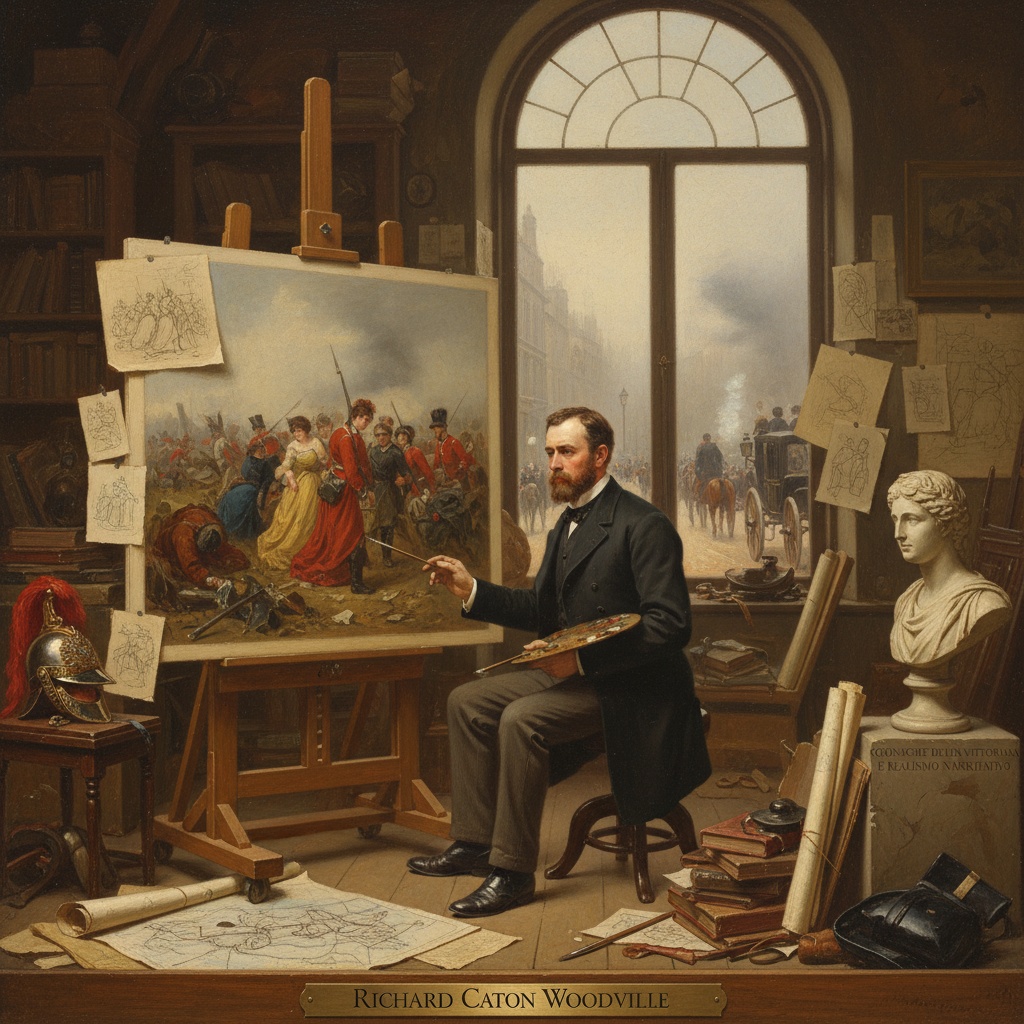
Richard Caton Woodville (30 April 1825 – 13 August 1855) was an American artist from Baltimore who spent his professional career in Europe, after studying in Düsseldorf under the direction of Karl Ferdinand Sohn. He died of an overdose of morphine in...
Richard Caton Woodville, born in 1825 into a prominent Baltimore family, possessed an artistic inclination evident from his earliest years. While initially pursuing medical studies at the University of Maryland – a brief foray suggesting a pragmatic bent – it was caricature that first captured his imagination, hinting at a keen observational eye and a nascent talent for capturing character. However, it was the expansive private collection of Robert Gilmor Jr., a Baltimore art collector, that truly ignited Woodville’s passion. This early exposure to a world of artistic refinement undoubtedly shaped his aesthetic sensibilities. In 1845, he exhibited his first painting, “Two Figures at a Stove,” signaling a commitment to the path of an artist and demonstrating a burgeoning skill. A pivotal decision followed: at the age of twenty, Woodville embarked for Düsseldorf, Germany, seeking formal training at the prestigious Kunstakademie under Karl Ferdinand Sohn.
The Düsseldorf Academy was a magnet for American artists in the mid-19th century, fostering a distinct “Düsseldorf school of painting.” Woodville joined a vibrant community that included figures like Emanuel Leutze and Worthington Whittredge. Under Sohn’s guidance, he honed his technique, developing a meticulous approach celebrated for its attention to detail and nuanced color palette. This period wasn't merely about mastering brushstrokes; it was an immersion in the European artistic tradition, laying the groundwork for Woodville’s unique style – one that would soon captivate audiences on both sides of the Atlantic.
The Ambiguous Interiors: Exploring Woodville’s Contemporary Scene Paintings
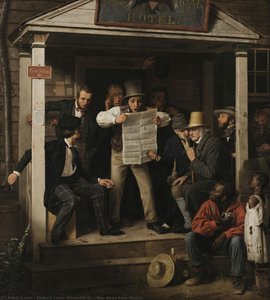
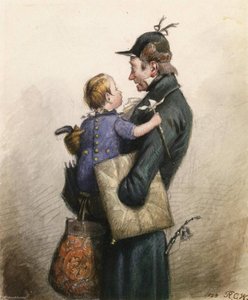
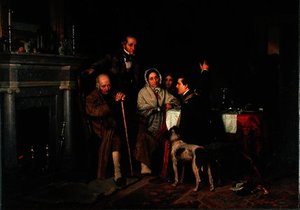 Old ' and Young
Admire 'Old & Young' by Richard Caton Woodville – a captivating black & white portrait of a 19th-century gathering. Explore this exquisite reproduction and discover American art history.
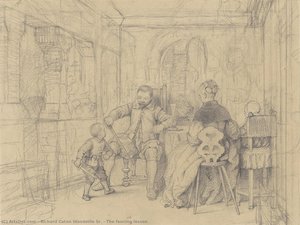
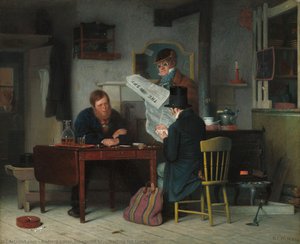
Woodville distinguished himself through his detailed depictions of contemporary interior scenes. Unlike grand historical narratives or idealized portraits, he chose subjects often shrouded in ambiguity, inviting viewers to interpret the stories unfolding within domestic spaces. “The Card Players” (1846), for example, achieved immediate success upon its exhibition in the United States, lauded for its realism and subtle narrative tension. This wasn’t simply a depiction of a game; it was a glimpse into a world of social interaction, perhaps even veiled intrigue.
Commissioned in 1848, “Politics in an Oyster House” further cemented Woodville's reputation. Patron John H.B. Latrobe tasked him with capturing the lively – and often raucous – atmosphere of Baltimore’s oyster cellars, spaces frequented by a diverse cross-section of society. The painting became widely known through reproductions as popular prints, showcasing his ability to translate complex scenes into accessible imagery. Woodville's meticulous attention to detail is striking; every object, every gesture contributes to the overall sense of realism and invites speculation about the characters’ motivations and allegiances. Perhaps most compellingly, “Old ’76 and Young ’48” (1849) presents a poignant generational contrast – a Revolutionary War veteran juxtaposed with a wounded soldier returning from the Mexican-American War. The painting is rich in symbolism, using objects within the interior to highlight the differences between these two eras.
Patronage, Prints, and Popular Appeal: The American Art-Union's Influence
Woodville’s success was inextricably linked to his relationship with the American Art-Union. This subscription-based organization played a crucial role in shaping the art market of the mid-19th century, holding annual exhibitions that were highly influential and publishing the monthly “Bulletin of the American Art-Union.” The journal consistently praised Woodville’s work, purchasing his paintings and distributing them to patrons – effectively creating a dedicated audience for his art. This system provided not only financial support but also critical validation, ensuring his paintings reached a wide viewership.
The Art-Union's emphasis on accessibility was key. By reproducing Woodville’s works as prints, they democratized art ownership, bringing his scenes of contemporary life into homes across the country. This widespread dissemination contributed to his growing popularity and established him as a leading figure in American genre painting.
A Master of Detail: Examining Woodville’s Technique and Renaissance Influences
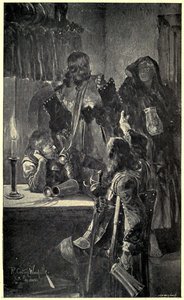
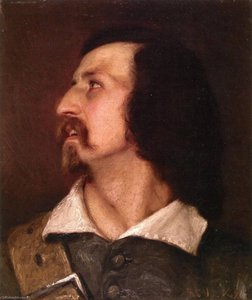 Head of a Soldier
Discover Richard Caton de Woodville’s ‘Head of a Soldier’ (1847). A stunning oil portrait in Renaissance style, showcasing rich detail & dramatic lighting. Explore academic realism & historical allure.
Woodville's artistic prowess stemmed from a dedication to meticulous detail, honed during his time at the Düsseldorf Academy. He wasn’t merely replicating reality; he was constructing it with painstaking precision. His technique involved careful sketching, layering of oils on canvas, and a patient approach to drying and finishing. This commitment resulted in paintings that possessed an almost photographic quality – capturing textures, light, and shadow with remarkable accuracy.
However, Woodville’s artistry wasn't solely about realism. His work reveals a clear understanding of Renaissance principles, particularly the emphasis on composition and narrative clarity. While rejecting the idealized forms favored by earlier academic painters, he retained a sense of order and balance in his scenes. This blend of realism and classical influence created a unique aesthetic that resonated with Victorian audiences seeking both accuracy and artistic refinement.
Woodville’s Legacy & the Rise of Narrative Realism in Victorian Painting
Despite a tragically short career – Woodville died from a morphine overdose in London in 1855 at the age of thirty – his impact on American painting was significant. He produced fewer than twenty paintings, yet they were widely exhibited and reproduced during his lifetime, leaving an enduring mark on the artistic landscape.
Woodville’s focus on contemporary life, coupled with his meticulous technique, paved the way for the rise of narrative realism in Victorian painting. He demonstrated that compelling stories could be found not in historical epics but in the everyday lives of ordinary people. His paintings offered a glimpse into the social and political currents of the era, inviting viewers to contemplate the complexities of modern society. While his work was sometimes criticized for its ambiguity – lacking explicit moral messages – it was precisely this openness that allowed audiences to connect with his scenes on a personal level.
The Short but Impactful Career: A Retrospective on a Lost Talent
Woodville’s untimely death cut short a promising career, leaving behind a relatively small body of work. He left sixteen finished paintings and no personal letters or journals, adding to the mystique surrounding his life and artistry. His second wife, Antoinette Marie Schnitzler, and their two children – including Richard Caton Woodville Jr., who would also become a noted British battle scene painter – were left to carry on his legacy.
Today, Woodville’s paintings are held in prominent collections such as the Walters Art Museum in Baltimore. A 2013 retrospective exhibition, “New Eyes on America: The Genius of Richard Caton Woodville,” showcased the entirety of his career, reaffirming his position as a pivotal figure in American art history. His work continues to captivate audiences with its meticulous detail, subtle narrative tension, and evocative portrayal of Victorian life.
Discover more exceptional artworks and explore the rich tapestry of art history at ArtsDot.com