The German Roots of Severin Roesen: A Transatlantic Journey
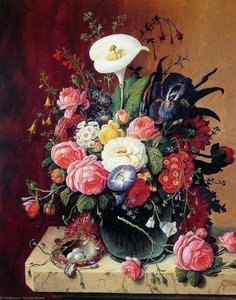
Severin Roesen (c. 1815 in Boppard – c. 1872) was a Prussian-American painter known for his abundant fruit and flower still lifes, and is today recognized as one of the major American painters in that genre from the nineteenth century. == Life == ...
Severin Roesen’s story is one woven with the threads of displacement, adaptation, and artistic ambition. Born around 1815 in Boppard, Prussia – a region now part of Germany – his early life remains shrouded in mystery, yet it's crucial to understanding the genesis of his distinctive style. The year of his birth places him squarely within the Romantic era, a period characterized by an intense focus on emotion, individualism, and a reverence for nature. However, Roesen’s path diverged from the grand landscapes favored by many of his German contemporaries; he would find his voice in the intimate world of still life. The political turmoil of 1848 proved pivotal. As revolutions swept across Europe, Roesen, like countless others, sought refuge and opportunity across the Atlantic. His arrival in New York in 1848 marked not merely a change of location but a profound cultural shift. He wasn’t simply transplanting his art; he was forging a new identity as an American painter, informed by both his European heritage and the burgeoning artistic landscape of his adopted homeland.
Dutch Masters and American Ideals: Influences on Roesen’s Style
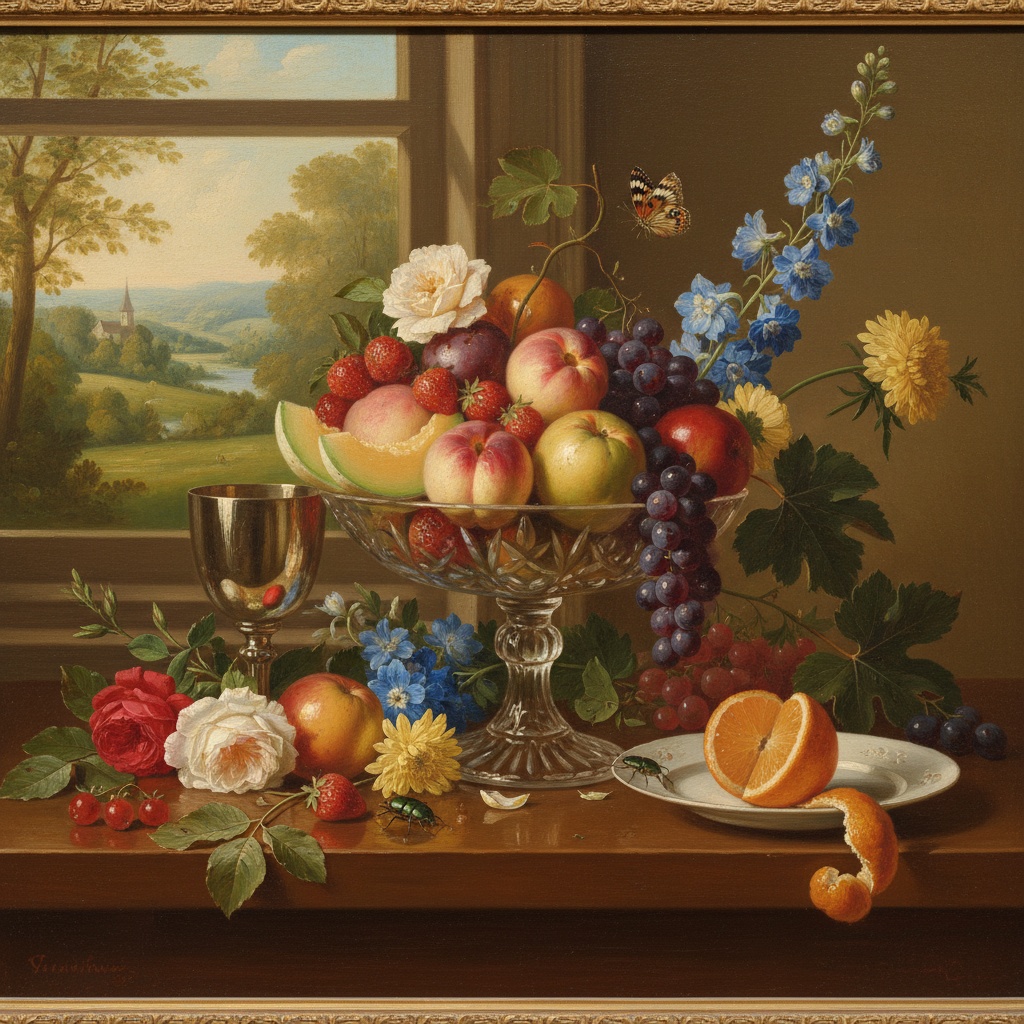
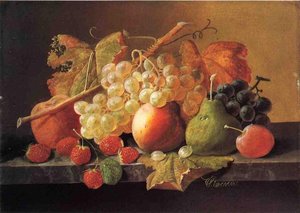 Fruit on a Marble Ledge
Experience Severin Roesen’s ‘Fruit on a Marble Ledge,’ a stunning Baroque still life brimming with opulent detail & rich color. Explore this German immigrant artist's masterful oil painting.
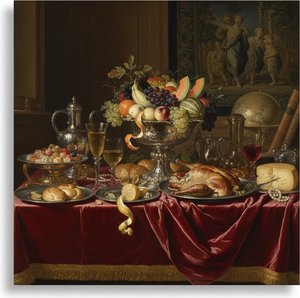
Roesen didn't arrive in America with a blank canvas. He brought with him a deep appreciation for the meticulous realism of 17th-century Dutch still life painting – a tradition celebrated for its exquisite detail, luminous textures, and symbolic depth. Artists like Jan van Huysum and Willem Kalf served as foundational influences, their mastery of light and composition clearly visible in Roesen’s early works. However, Roesen wasn't merely an imitator. He adapted these techniques to suit the tastes and sensibilities of his American audience. While Dutch still lifes often carried moralizing undertones or reflected the wealth of a burgeoning merchant class, Roesen’s paintings tended towards a celebration of nature’s abundance – a theme resonating with the optimistic spirit of a nation rapidly expanding westward. This shift reflects a broader cultural context: America, unlike Europe, lacked the centuries-old artistic traditions and aristocratic patronage systems. Roesen found success by offering works that spoke to a new kind of prosperity—one rooted in the land itself.
Nature's Abundance: Symbolism and Composition in Roesen’s Still Lifes
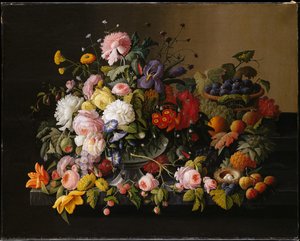
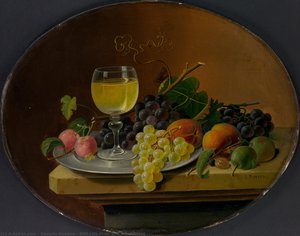
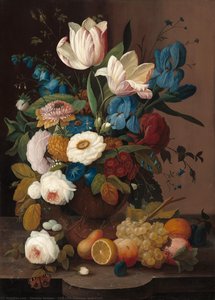
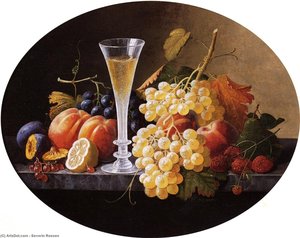
A glance at paintings like Still Life with Fruit and Bird’s Nest, Natures Bounty, or Fruit on a Marble Ledge reveals an almost overwhelming profusion of fruit, flowers, and foliage. But Roesen's compositions are far from haphazard. Each element is carefully arranged to create a harmonious balance – a visual feast that delights the eye. The grapes, often cascading in lush bunches, symbolize prosperity and abundance, while peaches represent longevity and immortality. The delicate bird’s nest, as seen in one of his most iconic works, hints at themes of domesticity and new beginnings. Roesen's masterful use of light is also key to understanding the symbolic power of his paintings. He employed a dramatic chiaroscuro – a strong contrast between light and shadow – to highlight the textures and colors of the fruit, imbuing them with a sense of realism and vitality. The subtle inclusion of a half-peeled lemon or a partially consumed glass of wine adds a touch of human presence, reminding us of the fleeting nature of beauty and pleasure.
Roesen and the Rise of American Still Life Painting
Severin Roesen played a significant role in establishing still life painting as a legitimate genre within the American art world. In the early 19th century, history painting – depicting grand narratives from mythology or current events – was considered the highest form of artistic expression. Still lifes were often relegated to a lower status, viewed as mere decorative exercises. Roesen, along with other still life specialists like Raphaelle Peale, challenged this hierarchy by demonstrating the technical skill and symbolic depth achievable within the genre. His paintings found a ready market among affluent Americans who appreciated their beauty and craftsmanship. The American Art-Union, a prominent art society of the time, regularly exhibited Roesen’s work, helping to raise his profile and introduce his style to a wider audience. His success paved the way for future generations of American still life painters, solidifying its place within the national artistic canon.
A Legacy of Craftsmanship: Rediscovering Severin Roesen Today
Despite achieving considerable recognition during his lifetime, Severin Roesen’s reputation waned in the decades following his death around 1872. His paintings were often dismissed as overly decorative or lacking in intellectual depth. However, recent scholarship has begun to reassess his work, recognizing him as a major figure in American art history. Today, museums like the Smithsonian American Art Museum and the National Gallery of Art showcase his stunning compositions, allowing viewers to appreciate his technical virtuosity and symbolic richness. Roesen’s story also serves as a reminder of the contributions made by immigrant artists to the development of American culture. He brought with him not only artistic skills but also a unique perspective – one shaped by both his European heritage and his experiences in a new land. ArtsDot.com offers high-quality reproductions of Roesen’s masterpieces, allowing art enthusiasts to experience the beauty and craftsmanship of this remarkable painter firsthand. Through these reproductions, we can continue to celebrate his legacy and explore the enduring power of American still life painting.