The Rise of Trompe L'Oeil: A Historical Context
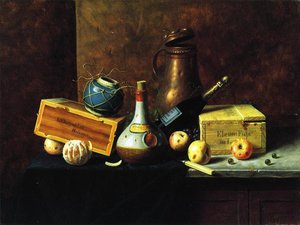 Still Life (also known as Copper tankard, bos, apples, wine bottles, ginger pot, cigar box and peeled orange)
Discover William Michael Harnett’s ‘Still Life’ – a captivating 1884 oil painting showcasing meticulous detail & Dutch-inspired realism. Explore its rich composition and timeless beauty.
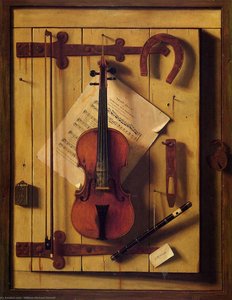
Before William Michael Harnett’s meticulously rendered still lifes captivated a nation, the art of illusion – trompe l'oeil, meaning “deceive the eye” in French – held a long and fascinating history. Emerging as early as classical antiquity, the technique found renewed vigor during the Renaissance, adorning ceilings and walls with convincing architectural fantasies. However, it was within the Dutch Golden Age of the 17th century that trompe l'oeil truly flourished, evolving into a distinct genre of still life painting. Artists like Pieter Claesz and Willem Kalf didn’t merely depict objects; they constructed worlds of tactile realism, celebrating both material abundance and the fleeting nature of earthly pleasures. This tradition, emphasizing precise detail and masterful light play, would prove to be a crucial foundation for Harnett's own artistic endeavors, providing not just a stylistic precedent but also a philosophical framework – a meditation on perception, representation, and the very act of seeing.
Harnett’s Early Life & Artistic Development
William Michael Harnett (August 10, 1848 – October 29, 1892) was an American painter known for his trompe-l'œil still lifes of ordinary objects. == Early life == Harnett was born in Clonakilty, County Cork, Ireland, during the time of the Great Fam...
Born in 1848 in Clonakilty, County Cork, Ireland, William Michael Harnett's early life was marked by emigration and adaptation. His family sought refuge from the Great Famine in Philadelphia, a burgeoning American city brimming with opportunity – and hardship. Initially trained as an engraver, a profession demanding precision and attention to detail, Harnett honed skills that would later define his painting style. He supplemented this training with studies at the Pennsylvania Academy of the Fine Arts, but financial constraints often led him to focus on less conventional subjects. Unable to afford live models, he turned inward, finding inspiration in the everyday objects surrounding him. This necessity proved fortuitous, steering him towards a unique artistic path that would ultimately distinguish him as a leading figure in American realism.
Mastering Realism: Technique, Composition, and Subject Matter
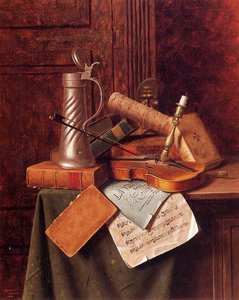 Munich Still Life
Discover William Michael Harnett’s ‘Munich Still Life,’ a stunning trompe-l'oeil masterpiece! Explore intricate detail & Dutch realism in this captivating 1884 painting.
Harnett’s technical prowess was undeniable. He didn't simply copy reality; he reconstructed it with painstaking accuracy on canvas. His brushstrokes, though visible upon close inspection, blended seamlessly to create an astonishingly lifelike effect. He employed a sophisticated understanding of light and shadow, rendering textures – the sheen of copper, the roughness of wood, the delicate translucence of fruit – with remarkable fidelity. Paintings like “Still Life” (1884), also known as “Copper Tankard, Bos, Apples…”, exemplify this mastery. The composition is deceptively simple: a collection of everyday items arranged on a tabletop. Yet, within this apparent simplicity lies an extraordinary level of detail and careful arrangement. He wasn’t merely interested in depicting objects; he was fascinated by their inherent qualities – the weight of metal, the ripeness of fruit, the worn surfaces that spoke to time and use. His “Munich Still Life” further showcases his trompe l'oeil skill, challenging viewers to discern where reality ends and representation begins.
Beyond Representation: Materiality and American Identity in Harnett’s Work
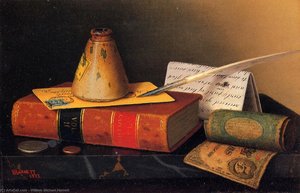
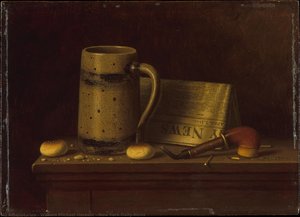
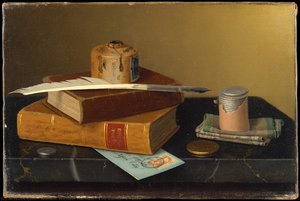
While celebrated for his technical skill, Harnett’s work transcends mere imitation. His still lifes offer a compelling commentary on the burgeoning materialism of late 19th-century America. The objects he depicted – tankards, cigars, musical instruments, books – weren't simply aesthetic choices; they were symbols of prosperity, leisure, and cultural aspiration. The inclusion of items like sheet music or worn books suggests a desire for refinement and intellectual pursuits alongside material comfort. This juxtaposition reflects the complex social landscape of the time—a nation grappling with industrialization, immigration, and evolving notions of identity. Harnett’s paintings can be seen as visual records of this era, capturing not just what Americans possessed but also their values and ambitions.
The Critical Reception of Harnett's Art: From Novelty to Recognition
Despite his commercial success, Harnett faced a mixed critical reception during his lifetime. Many critics dismissed his work as mere trickery, lacking the intellectual depth or emotional resonance they sought in “high art.” His paintings were often praised for their technical skill but derided for their lack of originality or profound meaning. There was even an incident in 1886 where he was briefly arrested on suspicion of counterfeiting after exhibiting a painting of a five-dollar bill – a testament to the astonishing realism of his work! However, despite these challenges, Harnett continued to paint, driven by his own artistic vision and a growing clientele who appreciated his unique style. It wasn’t until well into the 20th century that his contributions were fully recognized, with scholars acknowledging his mastery of trompe l'oeil and his insightful commentary on American culture.
Harnett’s Legacy & Influence on Subsequent Artists
William Michael Harnett left an indelible mark on American art. His pioneering work in still life painting paved the way for subsequent generations of artists, inspiring a renewed interest in realism and the depiction of everyday objects. His influence can be seen in the works of John F. Peto, another master of trompe l'oeil, though Peto’s style often leaned towards a more sentimental and narrative approach. Harnett’s emphasis on meticulous detail, sophisticated composition, and subtle symbolism continues to resonate with artists today. His paintings remain powerful reminders of the beauty found in the ordinary, and a testament to the enduring allure of illusion and representation. Explore the world of William Michael Harnett further at ArtsDot.com, where you can discover museum-quality reproductions of his iconic works and bring a touch of American realism into your own home.