The Primordial Gaze: Early Conceptions of Seeing & Representation
Visual perception is the ability to detect light and use it to form an image of the surrounding environment. Photodetection without image formation is classified as light sensing. In most vertebrates, visual perception can be enabled by photopic visi...
Before the advent of formal artistic training, before the codification of perspective and anatomy, lay a fundamental human impulse: to capture the world around us. This initial drive wasn’t merely about replication; it was an attempt to understand, to possess, to *become* part of the observed reality. Early cave paintings, far from being simple depictions of hunts, suggest a sympathetic magic – a belief that by representing the animal, one could influence its fate. The very act of seeing was intertwined with ritual and necessity. The ancient Greeks grappled with the mechanics of vision itself, debating whether sight emanated *from* the eye (emission theory) or entered it from external objects (intromission). These philosophical inquiries weren’t abstract; they directly informed artistic practice. Euclid's Optics, while mathematically rigorous, still operated within a framework that prioritized geometric precision as the key to accurate representation. The emphasis wasn’t on subjective experience but on objective truth – a striving for an idealized form mirroring a perceived cosmic order. This foundational belief in a knowable reality would underpin artistic endeavors for centuries.
From Mimesis to Symbolism: Shifting Paradigms in Artistic Observation (Renaissance – 19th Century)
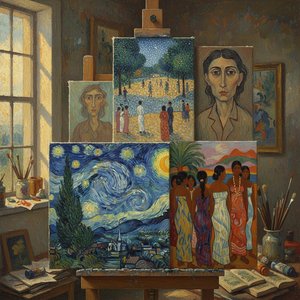
 Pastorales Tahitiennes
Paul Gauguin's 'Pastorales Tahitiennes,' created in 1892, embodies Post-Impressionism with vibrant colors and symbolic imagery capturing Tahiti’s idyllic beauty.
The Renaissance witnessed a dramatic shift, fueled by rediscovery of classical texts and a burgeoning humanist philosophy. Artists like Leonardo da Vinci didn’t simply copy nature; they dissected it, studied its underlying structures—anatomy, botany, geology—to achieve an unprecedented level of realism. This wasn't merely technical prowess; it was a profound engagement with the world as a complex system worthy of meticulous observation. Perspective became not just a technique but a means of organizing space and creating a convincing illusion of depth. However, even within this pursuit of mimetic accuracy, symbolism persisted. Religious iconography demanded specific representations, layering meaning onto observed forms. As art evolved through the Baroque and Rococo periods, observation became increasingly filtered through emotional lenses. The dramatic chiaroscuro of Caravaggio wasn’t about precise light measurement but about evoking a powerful psychological response. The 19th century saw further fragmentation. Realism, as championed by Courbet, rejected idealized forms in favor of depicting everyday life with unflinching honesty. Yet, even here, the artist's *selection* of subject matter—the plight of laborers, the mundane realities of rural existence—revealed a deliberate act of interpretation, a conscious framing of observation.
Challenging Perception: The Rise of Subjectivity and the Avant-Garde (Early 20th Century)
 The treachery of images (This is not a pipe)
Explore René Magritte’s ‘This is not a pipe.’ A surrealist masterpiece challenging reality & representation. Minimalist, iconic, perfect for art lovers & collectors.
The early 20th century irrevocably shattered traditional notions of representation. Impressionism, with its focus on fleeting moments and subjective experience, prioritized *how* we see rather than *what* we see. Monet’s water lilies aren't precise botanical studies but explorations of light, color, and atmosphere. Post-Impressionism pushed this further, with artists like Gauguin using vibrant colors and symbolic imagery to convey emotional states and spiritual beliefs – as exemplified in his ‘Pastorales Tahitiennes’. Then came Cubism, dismantling objects into geometric fragments and presenting multiple perspectives simultaneously. This wasn’t a rejection of observation but a radical re-evaluation of it. Picasso and Braque weren't trying to depict reality as it appeared; they were attempting to represent its underlying structure, its inherent complexity. Surrealism took this even further, delving into the subconscious mind and challenging the very boundaries of logic and reason. René Magritte’s ‘The Treachery of Images’ (“This is not a pipe”) famously questioned the relationship between image and reality, forcing viewers to confront the limitations of representation itself. The act of seeing became inherently problematic, mediated by language, psychology, and cultural conditioning.
The Psychology of Vision: Gestalt Theory, Phenomenology & Art
The burgeoning field of psychology in the 20th century profoundly influenced artistic thought. Gestalt theory, with its emphasis on perceptual organization—how the brain groups visual elements into meaningful wholes—provided a scientific framework for understanding how we make sense of the world. Artists began to consciously exploit these principles, using composition, color, and form to guide the viewer’s eye and create specific emotional responses. Phenomenology, focusing on subjective experience and consciousness, further emphasized the importance of individual perception. Artists like Rudolf Arnheim explored the interplay between Gestalt theory and art, demonstrating how visual elements aren't simply received passively but actively constructed by the mind. This understanding led to a greater appreciation for abstract forms and non-representational imagery. The focus shifted from depicting external reality to exploring the internal processes of perception itself – the very act of seeing became the subject matter.
Beyond the Visible: Conceptual Art and the Deconstruction of Observation
Conceptual art, emerging in the 1960s, represented a radical departure from traditional artistic values. The idea behind the artwork—the concept—became paramount, often overshadowing any physical manifestation. This challenged the very notion of observation; if the artwork existed primarily as an intellectual construct, what was there to *see*? Sol LeWitt’s wall drawings, for example, were defined by instructions rather than execution, emphasizing the process of creation over the finished product. This deconstruction extended to questioning the role of the artist and the viewer. The act of observation became a collaborative one, requiring active participation and interpretation. Artists began to explore language, systems, and social contexts, often rejecting traditional aesthetic criteria altogether. This wasn’t an abandonment of engagement with the world but a shift in focus—from representing external reality to examining the structures that shape our perception of it.
Contemporary Perspectives: Technology, Surveillance & the Future of Seeing
Today, we live in a visually saturated world, bombarded by images from countless sources. Technology has fundamentally altered how we see and experience reality – from digital manipulation and virtual reality to the omnipresence of surveillance cameras. Artists are grappling with these new realities, exploring themes of identity, privacy, and control. The proliferation of artificial intelligence raises profound questions about the nature of perception itself—can machines truly “see”? Contemporary artists often utilize video, installation, and performance art to challenge traditional notions of representation and engage with the complexities of the digital age. The act of observation is no longer a passive process but an active negotiation within a complex network of information and power. As we continue to develop new technologies and explore the boundaries of consciousness, the future of seeing promises to be as challenging and transformative as its past.