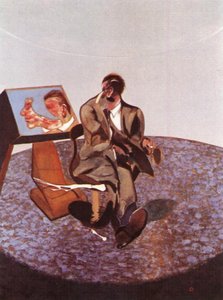
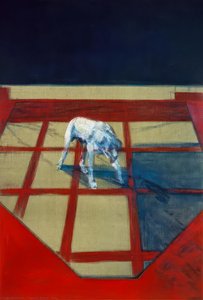
The Crucible of Experience: Bacon’s Early Life & Psychological Landscape
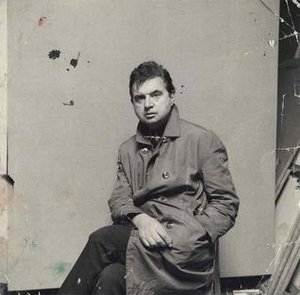 Francis Bacon
Explore Francis Bacon's (1909-1992) emotionally charged figurative paintings. Known for distorted forms, existential themes & bold expressionism, he remains a cornerstone of modern art. Discover key works & legacy.
Francis Bacon, a name synonymous with the visceral depiction of human suffering, was not born into a world of artistic privilege but rather forged in the fires of personal and societal turmoil. Born in Dublin in 1909 to a stern, controlling father – Sir Nicholas Bacon, a prominent figure in British intelligence – young Francis experienced a childhood marked by instability and emotional repression. This early environment, coupled with his own awareness of being an outsider, profoundly shaped the artist’s sensibility. His mother's distant affection and his father’s disapproval of his effeminate nature created a deep-seated sense of alienation that would become a recurring theme in his work. The asthma that plagued him physically further isolated him, fostering a period of intense introspection and observation. These formative experiences weren’t merely biographical details; they were the very bedrock upon which Bacon built his artistic universe – one defined by vulnerability, anxiety, and a relentless questioning of existence.
Bacon's early travels through Berlin and Paris in the 1920s proved pivotal. Exposure to the avant-garde movements of the time—Surrealism, Cubism—initially influenced his style, but he quickly diverged from their formal constraints. More importantly, these cities exposed him to a world of psychological complexity and social upheaval, further solidifying his fascination with the darker aspects of human nature. He absorbed the anxieties of a post-war Europe grappling with disillusionment and uncertainty, laying the groundwork for an artistic vision that would unflinchingly confront the fragility and brutality of life.
Deconstructing Representation: Form, Distortion & the Human Figure in Bacon's Oeuvre
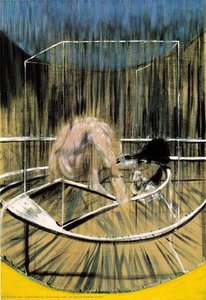 Crouching nude The Detroit Institute of Arts
Francis Bacon’s "Crouching Nude" – a haunting expressionist masterpiece of confinement & despair. Explore this iconic 1952 painting's raw emotion and unique style.
Bacon’s revolutionary approach to painting lay not in a rejection of figuration altogether, but rather in its radical deconstruction. He didn’t seek to depict reality as it *appeared* but as it *felt*. This pursuit led him to distort and fragment the human form, often placing his figures within claustrophobic spaces—cages, boxes, or amorphous voids—that amplified their sense of isolation and despair. The traditional conventions of anatomy were deliberately abandoned in favor of a more expressive, almost violent rendering of flesh, bone, and muscle. His brushwork is characterized by its raw energy and immediacy, creating textures that evoke both pain and vulnerability.
The influence of photography cannot be overstated. Bacon drew heavily from Eadweard Muybridge’s studies of human movement, particularly his series capturing animals in motion. These images provided him with a source of dynamic forms and unsettling perspectives, which he then manipulated to create figures that were simultaneously recognizable and profoundly alienating. He wasn't interested in photographic realism; instead, he used photography as a springboard for exploring the psychological depths of the human subject. The resulting paintings are not portraits in the conventional sense but rather embodiments of inner turmoil—visceral representations of anxiety, fear, and the inescapable reality of mortality.
Post-War Anguish and Existential Themes: A Response to a Shattered World
Existentialism is a family of philosophical views and inquiry that explore the human individual's struggle to lead an authentic life despite the apparent absurdity or incomprehensibility of existence. In examining meaning, purpose, and value, existen...
The aftermath of World War II served as a catalyst for Bacon’s most powerful work. The horrors of the Holocaust, the atomic bomb, and the pervasive sense of societal breakdown created an atmosphere of profound existential dread—a feeling that resonated deeply with the artist's own psychological landscape. His paintings became a visual manifestation of this collective trauma, reflecting the fragility of human existence in a world seemingly devoid of meaning or hope. Bacon’s work is not explicitly about war; rather, it explores the *consequences* of violence and the enduring scars it leaves on the human psyche.
Central to understanding Bacon's art is his engagement with existentialist philosophy. The writings of Friedrich Nietzsche—with their emphasis on the absurdity of existence and the rejection of traditional morality—had a profound impact on his thinking. He also drew inspiration from Jean-Paul Sartre and Albert Camus, whose explorations of freedom, responsibility, and the search for meaning in a godless universe resonated with his own artistic vision. Bacon’s figures are often depicted as isolated individuals grappling with their own mortality, trapped within the confines of their own consciousness—a visual embodiment of the existential angst that defined the post-war era.
Key Works as Manifestations of Despair: ‘Three Studies for Figures at the Base of a Crucifixion’ & Beyond
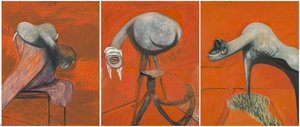
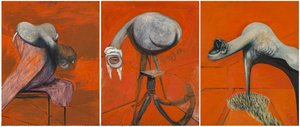 Three Studies for Figures at the Base of a Crucifixion
Explore Francis Bacon’s haunting ‘Three Studies for Figures at the Base of a Crucifixion.’ A visceral post-war masterpiece of expressionism, capturing anguish & isolation.
Perhaps no work encapsulates Bacon's artistic vision more powerfully than ‘Three Studies for Figures at the Base of a Crucifixion’ (1944). This haunting triptych, created in the immediate aftermath of World War II, depicts three distorted figures—grotesque, almost animalistic creatures—writhing in agony. The painting is not a literal depiction of the crucifixion scene but rather an evocation of primal suffering and existential despair. The claustrophobic space, the raw brushwork, and the unsettling color palette all contribute to a sense of overwhelming dread.
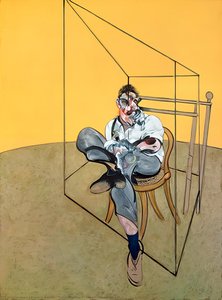
‘Crouching Nude’ (1952) offers another compelling example of Bacon's exploration of human vulnerability. This painting depicts a solitary figure contorted in a state of profound isolation, trapped within the confines of its own body. The distorted form and the unsettling color palette create a sense of claustrophobia and anxiety, reflecting the artist’s preoccupation with themes of confinement and despair. These works are not merely depictions of physical suffering; they are visual embodiments of inner turmoil—representations of the human condition stripped bare.
Bacon's Legacy: Influence, Interpretation & the Enduring Power of Raw Emotion
Francis Bacon remains one of the most influential artists of the 20th century. His revolutionary approach to figuration—his willingness to confront the darker aspects of human nature—has had a profound impact on generations of artists. From Lucian Freud to Jenny Saville, countless contemporary painters have drawn inspiration from his work. Beyond his technical innovations, Bacon’s enduring legacy lies in his ability to tap into universal themes of anxiety, isolation, and mortality.
His paintings continue to resonate with audiences today because they speak to the fundamental human condition—the inescapable reality of suffering and the search for meaning in a world often devoid of hope. While interpretations of Bacon’s work vary widely—ranging from psychoanalytic readings to explorations of existential philosophy—they all acknowledge the power of his raw emotion and unflinching honesty. At ArtsDot.com, we are proud to offer meticulously crafted reproductions of Bacon's iconic paintings, allowing art enthusiasts to experience the visceral impact of his work firsthand. Explore our collection today and discover the enduring power of Francis Bacon’s artistic vision.