Early Life & Artistic Beginnings: From Coach Painter to South African Scenery
 Wikipedia: Thomas Baines
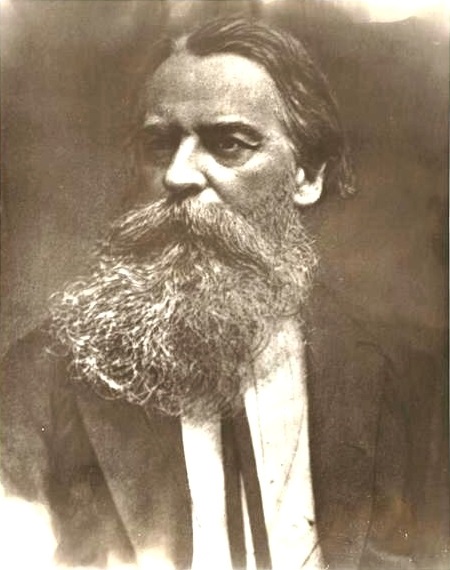
(John) Thomas Baines (27 November 1820 – 8 May 1875) was an English artist and explorer of British colonial southern Africa and Australia. == Life and work == Born in King's Lynn, Norfolk, on 27 November 1820, Baines was apprenticed to a coach pai...
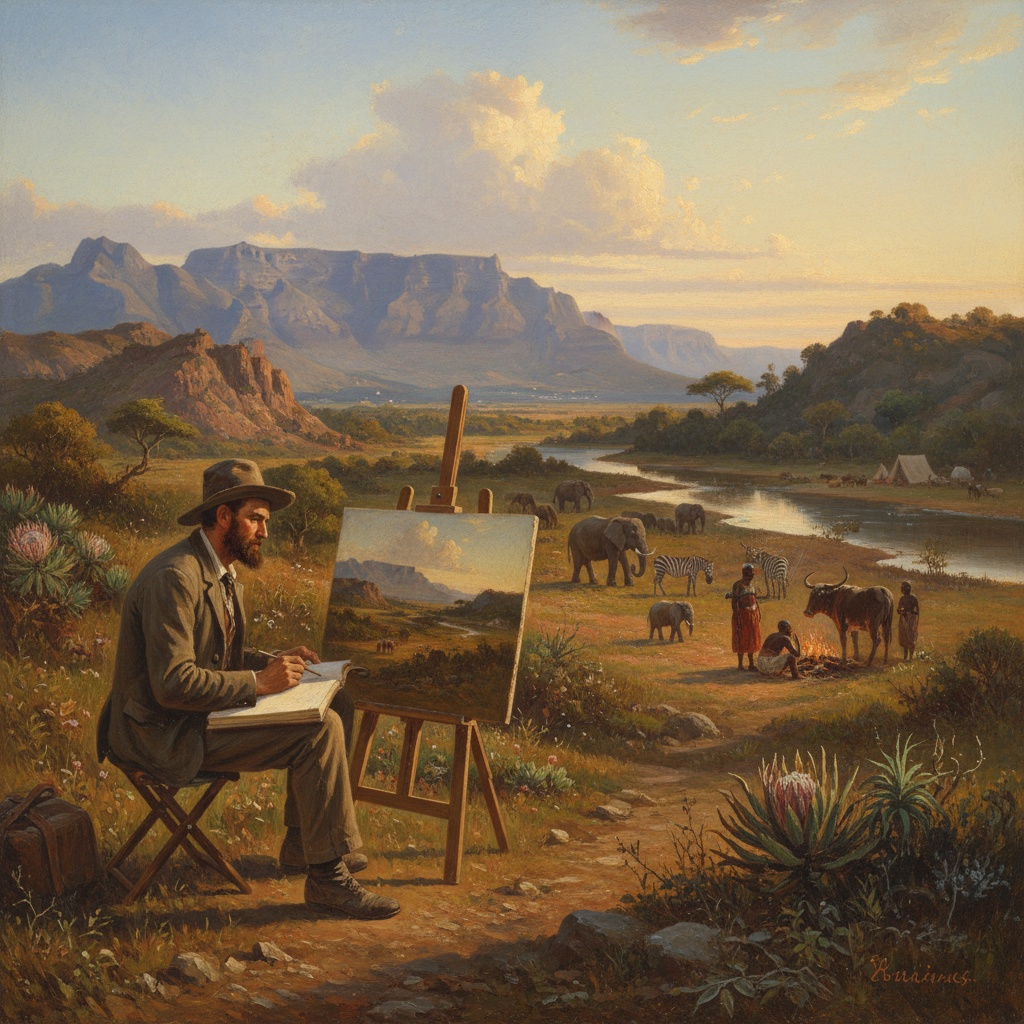
The story of Thomas Baines is one of remarkable self-transformation, a journey from the humble trade of coach painting in King’s Lynn, Norfolk, to becoming arguably the most important visual chronicler of 19th-century Southern Africa and Australia. Born in 1820, young Baines initially honed his skills adorning carriages, a practical apprenticeship that instilled a keen eye for detail and an understanding of light and shadow – qualities that would later define his breathtaking landscapes. However, the allure of distant horizons proved too strong to resist. At the age of twenty-two, he embarked on a voyage aboard the Olivia, captained by a family friend, William Roome, setting course for Cape Town with little more than brushes and ambition. This relocation marked not merely a change in geography but a fundamental shift in Baines’s artistic focus. He quickly established himself as both a scenic and portrait artist, catering to the burgeoning colonial society, yet it was his involvement in documenting the turbulent events of the Eighth Frontier War that would first bring him recognition – and reveal his unique talent for capturing the drama and complexity of life on the frontier.
Baines as War Artist: Documenting Conflict on the Eastern Frontier
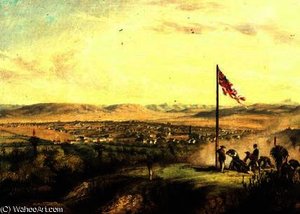 A View of Fort Beaufort
A View of Fort Beaufort by Thomas Baines: A stunning 19th-century oil painting depicting colonial South Africa. Explore this detailed landscape & historical scene.
The appointment as official war artist during the Eighth Frontier War in 1851 was a pivotal moment. Unlike many battlefield depictions focused solely on heroic action, Baines’s work offered a nuanced perspective. He didn't shy away from portraying the harsh realities of colonial conflict – the rugged terrain, the logistical challenges faced by British troops, and the often-strained interactions with indigenous populations. “A View of Fort Beaufort”, for example, isn’t simply a topographical rendering; it’s a carefully composed scene that conveys a sense of isolation, vulnerability, and the imposing presence of the landscape itself. His paintings from this period are characterized by meticulous detail, a direct result of his earlier training, but also imbued with an emerging sensitivity to the cultural context surrounding him. He wasn't merely recording events; he was beginning to interpret them, offering viewers back home a glimpse into a world far removed from their own. This commitment to observation and accurate representation would become a hallmark of his career.
The Australian Expeditions: Mapping the Untamed Interior with Gregory
In 1855, Baines joined Augustus Gregory’s ambitious expedition across northern Australia, a venture sponsored by the Royal Geographical Society. This was no mere artistic commission; it demanded resilience, resourcefulness, and an ability to work under incredibly challenging conditions. Baines served as both official artist and storekeeper, tasks that required equal measures of skill and adaptability. The expedition’s primary goal – to assess the suitability of northern Australia for colonial settlement – placed a significant burden on Baines to accurately document the landscape, flora, fauna, and potential resources. His paintings from this period are remarkable not only for their aesthetic quality but also for their scientific value. He meticulously recorded geographical features, providing invaluable data that aided in mapping the untamed interior. The naming of Mount Baines and the Baines River stands as a testament to his contribution – a lasting recognition of his dedication and skill.
Victoria Falls and the Zambezi River: A Landmark Discovery in Art and Exploration
Perhaps the most iconic chapter in Baines’s life unfolded during his 1858 expedition along the Zambezi River with David Livingstone. To be among the first Europeans to witness Victoria Falls – *Mosi-oa-Tunya*, “The Smoke That Thunders” – was a transformative experience, and one that he captured with breathtaking immediacy. His depictions of the falls weren’t simply landscapes; they were expressions of awe and wonder, conveying the sheer power and majesty of nature. He skillfully used light and shadow to emphasize the scale of the cataract, creating images that resonated with both scientific accuracy and artistic emotion. This period also saw Baines documenting the local communities along the river, offering valuable insights into their customs, traditions, and way of life. His paintings from this time are particularly notable for their sensitivity and respect, a departure from some of the more stereotypical representations prevalent in colonial art.
Cartographic Contributions & Scientific Observation: Beyond the Canvas
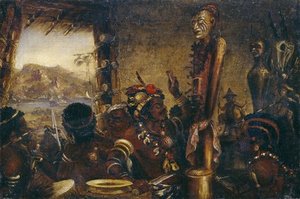 African War Fetish
Discover 'African War Fetish' by Thomas Baines – a detailed colonial painting of indigenous life. Explore this realistic depiction of cultural interaction & historical insight.
While celebrated as an artist, Baines’s contributions extended far beyond the realm of painting. He was a remarkably skilled cartographer, meticulously mapping vast stretches of Southern Africa and Australia during his expeditions. His diaries are filled with detailed geographical observations, sketches, and calculations – invaluable data that aided in understanding these previously uncharted territories. He wasn't simply creating aesthetically pleasing images; he was actively contributing to the scientific knowledge of the time. “African War Fetish”, for instance, while seemingly a depiction of indigenous cultural practices, also provides valuable ethnographic detail about the material culture and beliefs of the local communities. His approach was holistic – art and science were inextricably linked, each informing and enriching the other. Recent scholarship has highlighted the importance of his manuscript maps, revealing their accuracy and sophistication.
Legacy and Rediscovery: Baines’s Enduring Impact on African Landscape Painting
Thomas Baines died in 1875, leaving behind a legacy of nearly 400 extant oil paintings, watercolors, and sketches. For many years, his work was appreciated primarily for its historical value – as documentation of colonial life and exploration. However, recent scholarship has begun to recognize the aesthetic merit of his art, acknowledging his skill in capturing light, color, and atmosphere. “The Great Tree-aloe Of Damaraland”, with its striking composition and vivid depiction of the African landscape, exemplifies his artistic prowess. His paintings are now held in prestigious collections around the world – the National Library of Australia, the National Archives of Zimbabwe, and the Royal Geographical Society in London among them. Today, Thomas Baines is rightly celebrated as a pioneering artist whose work continues to inspire and captivate audiences with its beauty, accuracy, and enduring historical significance. At ArtsDot.com, we are proud to offer high-quality reproductions of his masterpieces, allowing you to experience the wonder of 19th-century Africa through the eyes of this remarkable explorer and artist.