
The Dawn of a New Vision: Breaking Free from Academic Tradition
--- title: Impressionism: Art and Modernity - The Metropolitan Museum of Art author: Margaret Samu url: https://www.metmuseum.org/essays/impressionism-art-and-modernity hostname: metmuseum.org description: In addition to their radical technique, the ...
To understand the profound impact of Impressionism, one must first envision the rigid, somber world of the mid-19th century French art establishment. For decades, the Académie des Beaux-Arts held an iron grip on aesthetic values, championing a style defined by meticulous detail, historical grandeur, and a polished, almost invisible brushwork. The Salon, the era's most prestigious exhibition, favored subjects of mythological or historical significance, rendered with a dark, controlled palette that sought to idealize reality rather than reflect it. To the eyes of a young, rebellious artist, these canvases felt like closed doors—static, heavy, and disconnected from the vibrant pulse of a modernizing France.
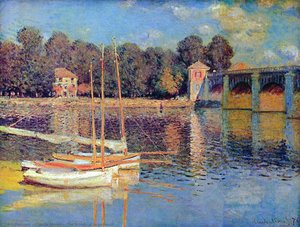
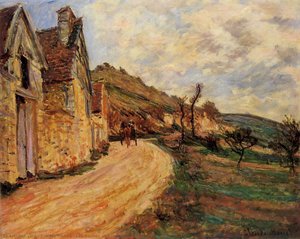
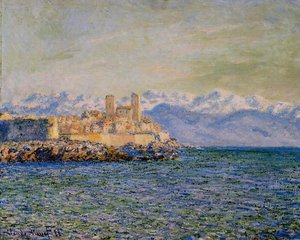
The revolution began not with a loud proclamation, but with a quiet defiance against these stifling constraints. A group of artists, including Claude Monet, Auguste Renoir, and Camille Pissarro, found themselves increasingly disillusioned by the academic insistence on perfection over perception. They sought to reject the heavy shadows and staged compositions of the studio in favor of something far more elusive. This movement was a bold declaration that reality is not a fixed, permanent state, but a shimmering, subjective experience. By choosing to focus on the contemporary, the everyday, and the ephemeral, these pioneers challenged the very definition of what constituted "finished" art, much to the initial scorn of critics who viewed their loose, broken brushstrokes as mere unfinished sketches.
This period of upheaval was more than just a change in technique; it was a fundamental shift in artistic consciousness. As the industrial revolution transformed the landscape of France, these artists felt an urgent need to capture the changing rhythm of life. They moved away from the grand narratives of the past to embrace the beauty found in a sun-drenched meadow or a bustling street corner. This transition laid the essential groundwork for modernism, proving that the artist's true duty was not to replicate the world with photographic accuracy, but to translate the emotional resonance of a single, fleeting moment onto the canvas.
En Plein Air: The Revolutionary Art of Painting Outdoors
 Capturing Ephemeral Light: Plein Air Painting from Impressionism to Today
The Genesis of 'En Plein Air': From Studio Tradition to Landscape Portraiture Wikipedia: En plein air En plein air (pronounced [ɑ̃ plɛ.n‿ɛʁ]; French for 'outdoors'), or plein-air painting, is the act of painting outdoors. This method contrasts with s...
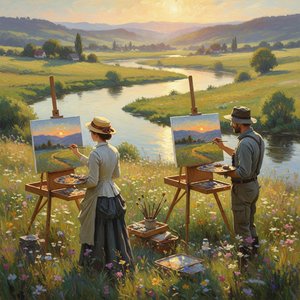
At the heart of this aesthetic rebellion lay a transformative practice known as en plein air—the act of painting directly outdoors. For centuries, the artist's sanctuary had been the controlled environment of the studio, where light was predictable and compositions were carefully constructed from sketches and memory. However, under the profound influence of mentors like Eugène Boudin, Claude Monet embraced the radical idea that to truly capture nature, one had to exist within it. This method required a complete abandonment of the safety of the studio walls, forcing artists to contend with the unpredictable elements: shifting winds, changing temperatures, and, most importantly, the relentless movement of light.
Painting outdoors introduced a new sense of immediacy and urgency to the creative process. The artist could no longer afford the luxury of slow, meticulous layering; instead, they had to work with speed and intuition to catch the sun before it dipped below the horizon or disappeared behind a cloud. This necessity birthed the signature Impressionist technique: the use of short, broken brushstrokes applied in rapid succession. Rather than blending pigments into smooth gradients, artists layered colors side-by-side, allowing the viewer's eye to perform an optical mix. This created a sense of vibration and luminosity that studio-bound painting simply could not replicate.
This connection to the natural world also fostered a new way of seeing color. In the bright light of the outdoors, shadows were no longer merely black or brown; they were infused with reflected blues, purples, and violets. The landscape became a living, breathing entity. Whether it was the turbulent sea at Etretat or the dappled sunlight filtering through the trees in Giverny, the practice of plein air painting allowed the artists to document the atmosphere itself. It was a pursuit of truth—not a truth of form, but a truth of sensation, where the texture of the paint mirrored the very energy of the environment being depicted.
A Symphony of Light and Color: The Mastery of Claude Monet
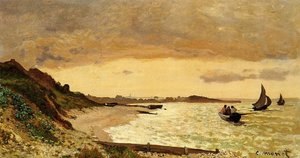
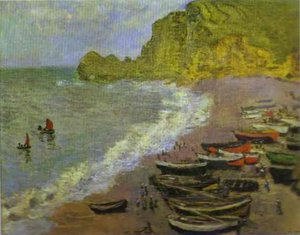 The Beach at Etretat
The Beach at Etretat: A Symphony of Light and Texture Claude Monet’s “The Beach at Etretat” isn't merely a depiction of a coastal scene; it’s an embodiment of Impressionism itself—a radical departure from academic painting that prioritized capturing ...
No name is more inextricably linked to this luminous revolution than Claude Monet. To gaze upon his work is to enter a world where light is the true protagonist. Monet was not merely a painter of landscapes; he was a chronicative poet of the ephemeral. His life's work became an obsessive, beautiful study of how light interacts with different surfaces at varying times of day. He understood that a haystack, a cathedral, or a water lily is never truly the same object from one hour to the next; it is constantly being redefined by the atmosphere surrounding it.
Consider his monumental work, The Beach at Etretat. In this canvas, we see a symphony of blues—from deep indigo to pale turquoise—capturing the restless spirit of the Normandy coast. Monet’s ability to use color to convey texture and depth is unparalleled. He utilized accents of orange and pink to mirror the warmth of the cliffs, creating a breathtaking panorama that feels as though it might shift if you blink. His dedication was so profound that he would often paint the same subject in series, documenting the progression of seasons and the passing of hours, effectively turning his canvases into a temporal record of light's eternal dance.
Monet’s mastery extended into his later years at Giverny, where his garden became his greatest masterpiece. Here, the boundaries between art and nature blurred entirely. His water lily series represents the pinnacle of his ability to dissolve form into pure color and light. In these works, the horizon often disappears, leaving the viewer suspended in a sea of reflections and floating blossoms. It is a profound testament to his vision: a world where the physical weight of the subject is replaced by the ethereal weight of the impression, inviting us to slow down, breathe deeply, and find solace in the shimmering beauty of the present moment.
Beyond the Canvas: The Emotional Resonance of the Impressionist Moment
 Impressionistic Landscapes: 10 Masterpieces That Changed Art & Decor
Introduction To gaze upon these ten canvases is to step directly into a world transformed by light, color, and an unprecedented embrace of the fleeting moment. The Impressionistic Landscape movement wasn’t merely a shift in painting technique; it was...
While we often discuss Impressionism in terms of technique and light, its true power lies in its profound emotional resonance. Beyond the vibrant palettes and broken brushstrokes, there is a deeply human element at play—a shared recognition of the beauty found in the transient. The movement speaks to our innate connection with the natural world and our collective capacity for wonder. There is a certain melancholy in the Impressionist gaze; it acknowledges that the moment being painted is already passing, lost to the continuum of time even as the paint dries on the canvas.
This emotional depth is what allows these works to transcend their era. When we look at a Renoir or a Pissarro, we are not just observing a landscape; we are experiencing a feeling. There is an intimacy in the way they capture the warmth of a summer afternoon or the quiet stillness of a morning mist. This resonance is why these paintings continue to captivate us across generations. They offer a sanctuary of tranquility and contemplation in an increasingly fast-paced and industrial world. They remind us that there is profound value in the small, the overlooked, and the fleeting.
Furthermore, the movement reflects a broader cultural shift toward the celebration of modern life and leisure. The rise of a middle class, the expansion of urban spaces, and the newfound ability to escape to the countryside provided the subject matter for this new era of art. The joy found in a sunlit garden or a riverside stroll is palpable on the canvas. By elevating these simple, everyday experiences to the level of high art, the Impressionists taught us that beauty does not require grand historical themes; it only requires an eye capable of seeing the magic within the mundane.
The Enduring Legacy: How Impressionism Redefined Modern Perception
 Impressionist Landscapes: 10 Masterpieces for Your Home | ArtsDot
Introduction Imagine stepping into a world bathed in dappled sunlight, where colors dance and shimmer with an ethereal quality. This is the realm of Impressionism – a revolutionary art movement that forever altered how we perceive light, color, and t...
The legacy of Impressionism is nothing less than the foundation of modern art. By breaking the shackles of academic realism, these artists opened the floodgates for every movement that followed, from Post-Impressionism to the abstractions of the 20th century. They proved that art could be a subjective expression of the soul rather than a mere mirror of reality. The freedom they championed—the freedom to experiment with color, to distort form for emotional effect, and to prioritize perception over precision—is the very essence of artistic liberty that continues to define the creative spirit today.
Today, we see the echoes of their revolution in every corner of our visual culture. The way we perceive light in photography, the expressive textures in modern illustration, and even our contemporary appreciation for the "aesthetic" moment all owe a debt to the pioneers of 1874. They changed the way we look at the world, teaching us to seek out the dappled sunlight, the shifting shadows, and the vibrant colors that exist in the periphery of our busy lives. Their work remains a testament to the power of vision—the ability to look at a common scene and see something extraordinary.
As we continue to cherish these masterpieces, we are reminded of the importance of presence. In an age of digital permanence, the Impressionist's focus on the ephemeral serves as a beautiful provocation. They invite us to embrace the beauty of the temporary, to find meaning in the passing shadows, and to celebrate the light that illuminates our lives, however briefly it may stay. Theirs is a legacy of light, color, and an eternal, breathtaking impression.
At ArtsDot.com, we share this lifelong passion for the luminous world of the masters. We specialize exclusively in the curated beauty of Impressionist and Post-Impressionist art, providing a dedicated destination for those who find solace in the works of Monet, Renoir, Degas, and beyond. Whether you are looking to bring the sunlight of Giverny into your own home through a hand-painted oil reproduction or seeking expert consultation to find the perfect piece for your collection, we are here to celebrate the enduring magic of light with you.