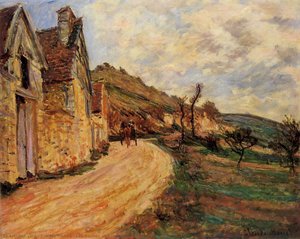
The Prelude to Perception: Breaking from Academic Tradition
To understand the seismic shift brought about by Claude Monet, one must first envision the rigid, somber world of the nineteenth-century French Academy. For decades, the Académie des Beaux-Arts dictated the boundaries of acceptable beauty, demanding historical accuracy, polished finishes, and a certain moral gravity. The canvases of this era were often characterized by dark, muted palettes and invisible brushstrokes that sought to erase the hand of the artist in favor of a photographic, almost sterile perfection. This was an art of permanence, designed to immortalize grand narratives and classical myths through a lens of controlled, studio-bound precision.
However, beneath this veneer of academic stability, a quiet rebellion was brewing. A group of young, spirited artists—led by the visionary Monet—began to find the Academy’s constraints suffocating. They were no longer interested in the static legends of antiquity; they sought the pulse of the contemporary world. This movement did not merely seek to change subject matter; it sought to redefine the very act of seeing. By rejecting the heavy glazes and dark shadows of the traditionalists, these rebels paved the way for a new visual language that prioritized the sensory experience over historical instruction, setting the stage for a revolution that would forever alter the trajectory of Western art.
The Science of Sight: Monet’s Obsession with Ephemeral Light
At the heart of Monet’s revolutionary spirit lay an almost scientific obsession with the behavior of light. He understood, perhaps more profoundly than any contemporary, that color is never a fixed entity; rather, it is a fleeting phenomenon, constantly reshaped by the atmosphere and the time of day. To Monet, a haystack or a cathedral was not a static object of stone or straw, but a vessel for the sun’s rays. He became a master of capturing the transient, documenting how a single landscape could transform from the cool, blue whispers of dawn to the searing, golden intensity of midday.
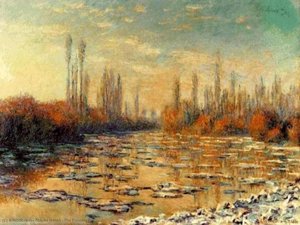
This pursuit required a radical departure from traditional color theory. Instead of using black to create shadows—as was the academic custom—Monet utilized complementary colors, observing that shadows are often composed of deep violets, blues, and reflected hues from the surrounding environment. In works such as Floating Ice at Bennecourt, one can witness this profound understanding of reflection and refraction. He did not paint the ice itself so much as he painted the way light danced upon its frozen surface, capturing the ephemeral shimmer that exists only for a heartbeat before the sun shifts. This focus on the optical truth transformed the canvas from a window into a story into a mirror of human perception.
Plein Air Revolution: The Liberation of the Canvas
The true liberation of Impressionism was achieved through the practice of en plein air painting—the act of stepping out of the controlled, dim environment of the studio and into the unpredictable brilliance of the outdoors. Influenced by the early landscape traditions of artists like Boudin, Monet took the easel into the elements. This was a physically demanding and technically daunting endeavor; to paint outdoors is to engage in a race against time, attempting to record a visual impression before the light changes or a cloud obscures the sun.
< even more significant than the change in location was the change in methodology. The necessity of working quickly forced a new kind of spontaneity. The artist could no longer afford the slow, meticulous layering of glazes that defined the Old Masters. Instead, they embraced short, broken brushstrokes that allowed colors to blend optically in the eye of the viewer. This technique gave the works an unprecedented sense of vitality and movement. Whether capturing the serene beauty of Spring or the bustling energy of a Parisian street, the plein air method infused the canvas with the very breath of nature, making the landscape feel alive, vibrating, and profoundly immediate.A Symphony of Color: Texture, Brushwork, and Atmospheric Depth
The aesthetic triumph of Monet’s era lies in the tactile richness of his technique. Impressionism is an art of texture; it celebrates the impasto—the thick, sculptural application of paint that gives a painting its physical soul. When one observes a high-quality reproduction of a Monet masterpiece, the magic resides in those visible, rhythmic strokes. These are not mere marks on a surface; they are energetic traces of the artist's movement, creating a topographical map of light and shadow. This texture allows for a deeper tonal range and a luminosity that flat, printed images simply cannot replicate.
Furthermore, Monet utilized color to create atmospheric depth without relying on traditional linear perspective. By layering different hues and varying the thickness of the paint, he could simulate the hazy moisture of a riverbank or the crisp clarity of a summer afternoon. In his still lifes, such as Flowers and Fruits, the interplay of vibrant pigments creates a sense of volume and life that feels almost tactile. This symphony of color and texture works in harmony to envelop the viewer, pulling them into a world where the boundaries between the observer and the observed begin to dissolve into a beautiful, chromatic haze.
The Enduring Legacy: From Impressionism to Modern Visual Language
The revolution ignited by Monet did more than just introduce a new style; it dismantled the hierarchy of art itself. By elevating the "impression" to the status of high art, he paved the way for every modern movement that followed, from the emotive distortions of Post-Impressionism to the pure abstraction of the twentieth century. The legacy of his work is found in our modern appreciation for the subjective experience—the understanding that truth in art lies not in the literal depiction of a subject, but in the emotional resonance of how that subject is perceived.
Today, the influence of Monet continues to permeate our visual culture, reminding us to find beauty in the fleeting and the overlooked. His ability to transform a simple scene from Normandy or Giverny into a timeless masterpiece remains an inspiration to collectors and enthusiasts alike. As we look upon these works, we are not merely looking at paint on canvas; we are participating in a historical dialogue about light, life, and the eternal dance of perception.
Discover the Masterpieces of Impressionism at ArtsDot.com
At ArtsDot.com, we honor this profound legacy by bringing the brilliance of Monet and his contemporaries into your personal space. We specialize in premium, hand-painted oil reproductions that capture the true essence of Impressionism—from the thick, textured brushstrokes to the luminous, light-drenched palettes. Our master artists, trained in the finest academies, meticulously recreate these iconic works on 100% cotton canvas, ensuring that every painting possesses the soul and depth of the original.
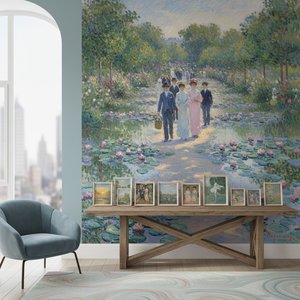
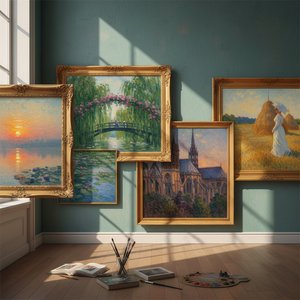
Whether you are looking to transform a room with a large-scale landscape or seeking a custom commission that reimagines a personal memory in the style of a master, ArtsDot offers an unparalleled service. From our Professional Digital Mockup Service to our global logistics and 100% satisfaction guarantee, we provide a sophisticated experience for the discerning collector. Explore our vast collection of museum-quality reproductions and let the revolution of light transform your home.