The Shattered Lens: Understanding the Cubist Departure from Traditional Realism
For centuries, the portrait served as a window into the soul, governed by the strict laws of linear perspective and the pursuit of anatomical fidelity. The artist’s duty was to mimic the light hitting a surface, creating an illusion of depth that respected the viewer's single point of view. However, at the dawn of the twentieth century, this tranquil mirror was shattered. Cubism emerged not merely as a new style, but as a radical ontological shift in how we perceive reality. It rejected the notion that a subject could be captured from a solitary, static vantage point. Instead, it proposed that truth is found in the accumulation of views, the overlapping of moments, and the rejection of the deceptive "flatness" of traditional realism.
This movement stripped away the decorative veneer of the Belle Époque to reveal the structural essence of the subject. By abandoning the singular perspective, Cubist artists invited the viewer to participate in a reconstruction of the image. The portrait was no longer a passive reflection but an active intellectual puzzle. This departure from tradition demanded a new kind of literacy from the observer—a willingness to embrace ambiguity and to find beauty in the fragmented, the disjointed, and the reconstructed. It was the birth of a modern visual language that prioritized the conceptual over the perceptual, forever altering the trajectory of Western art.
Geometric Deconstruction: The Evolution of Form and Multi-Dimensional Perspective
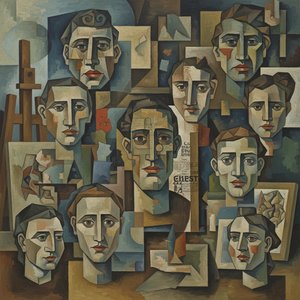
At the heart of the Cubist revolution lies the profound deconstruction of form into its fundamental geometric components. Where a classical painter might see the soft curve of a cheek or the delicate arc of a brow, the Cubist eye perceives cylinders, spheres, and cones. This process of simplification was not an act of destruction, or at least not one without purpose; it was an attempt to reach the architectural core of the human figure. Through the use of intersecting planes and overlapping shapes, artists were able to represent the subject in a state of flux, suggesting movement and time within a single, frozen frame.
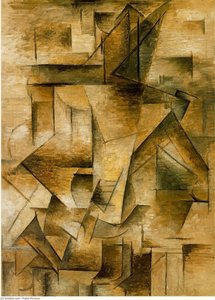
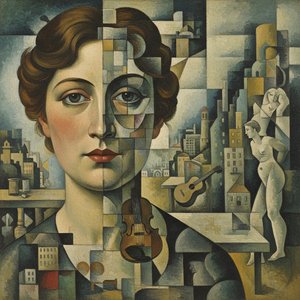
This evolution moved through distinct phases, most notably from the monochromatic, analytical rigor of early Cubism to the more vibrant, synthetic approach. In the analytical stage, the focus was on the intense dissection of form, often resulting in a complex web of lines that nearly dissolved the subject into abstraction. As the movement matured, it began to reintroduce color and texture, using collage-like elements to build up the image rather than tear it down. This multi-dimensional perspective allowed for a simultaneous representation of multiple sides of an object—the profile and the frontal view existing in the same space—creating a sensory experience that mirrored the fragmented nature of modern life itself.
Iconic Faces of Modernity: Analyzing Masterworks from Picasso to Malevich
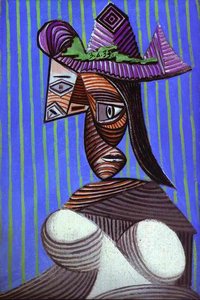
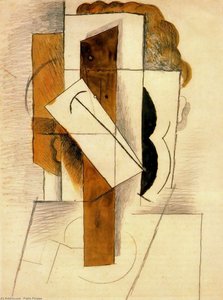
To truly grasp the magnitude of this revolution, one must look to the seminal works that defined its boundaries. Pablo Picasso’s Portrait of Gertrude Stein stands as a monumental bridge between the old world and the new. In this pivotal work, we see the transition toward a more structured, almost sculptural approach to the face, where the features begin to lose their soft edges in favor of a more profound, symbolic presence. Later, his Jacqueline’s Portrait (Profile) 2 demonstrates the full mastery of fragmented form and dramatic lighting, offering a glimpse into the complex, layered identity that only Cubism could articulate.
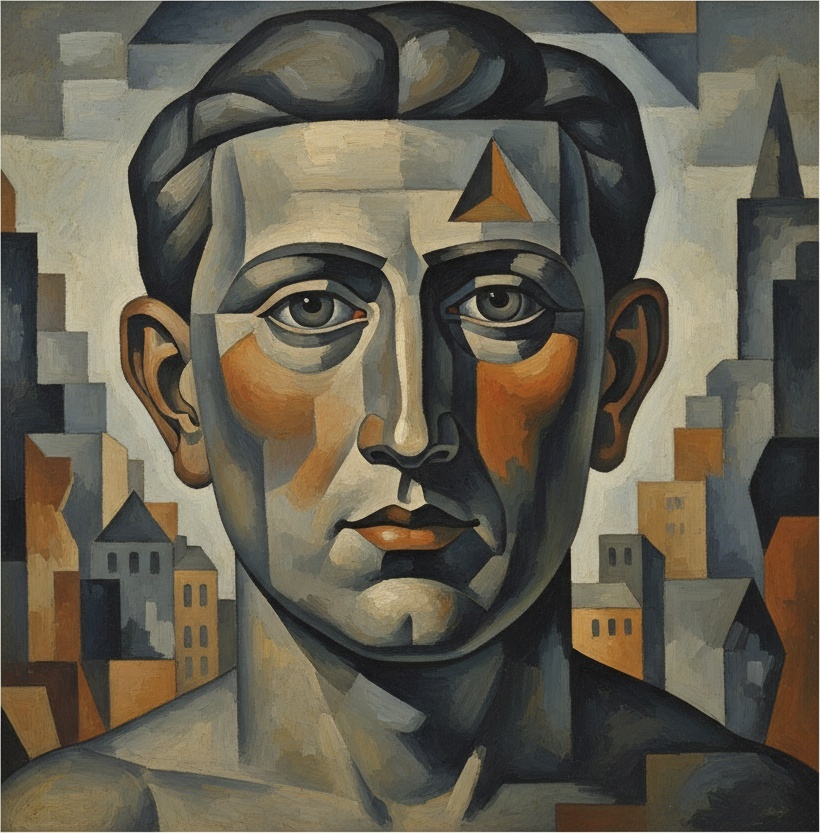
The reach of this movement extended far beyond the borders of France, influencing the Russian avant-garde with startling intensity. Kazimir Malevich, through his explorations in Cubo-Futurism, pushed the boundaries even further toward pure abstraction. His dynamic geometric studies of the human form utilize a rhythmic, energetic line to capture the sensory experience of motion and modernity. Even within the sphere of modernism, artists like the Uruguayan Rafael Barradas introduced "Vibrationism," blending geometric precision with vibrant colors to create a unique, pulsating energy. These masters did not merely paint portraits; they constructed new realities, using the human face as a canvas for the most radical ideas of their era.
Beyond the Surface: The Interplay of Light, Shadow, and Fragmented Planes
In a Cubist portrait, light does not function as a tool for modeling volume in the traditional sense; instead, it acts as a structural element that defines the edges of fragmented planes. In classical painting, light and shadow—chiaroscuro—are used to create the illusion of three-dimensional weight. In Cubism, however, light is often decentralized. It may strike one facet of a face with intense brilliance while leaving an adjacent plane in deep, opaque shadow, creating a rhythmic interplay that guides the eye across the composition's complex topography.
This manipulation of light serves to emphasize the flatness of the canvas while simultaneously suggesting a deeper, multi-layered space. The shadows are not merely absences of light but are often rendered as distinct geometric shapes that contribute to the overall structural integrity of the work. This creates a fascinating tension: the viewer is constantly reminded of the two-dimensional surface of the painting, yet they are drawn into a deep exploration of form and depth. It is through this sophisticated interplay of light and shadow that the Cubist artist achieves a sense of "living" texture, where the very atmosphere of the portrait feels as though it is vibrating with the energy of its own construction.
The Collector's Eye: Evaluating Cubist Portraits as Timeless Art Investments
For the discerning collector, acquiring a work that embodies the Cubist spirit is an engagement with the very foundation of modern art history. Evaluating such pieces requires more than an appreciation for aesthetics; it requires an understanding of the movement's technical complexity and its historical significance. A true Cubist masterpiece is characterized by its ability to balance abstraction with recognizable form, maintaining a structural tension that remains intellectually stimulating decades after its creation. Collectors look for the "soul" of the piece—the visible brushstrokes, the deliberate layering of pigments, and the way the artist has navigated the delicate boundary between representation and pure geometry.
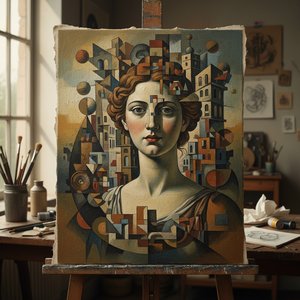
Investing in Cubist-inspired art or high-quality reproductions offers a unique opportunity to possess a fragment of the twentieth century's most profound intellectual achievement. Whether it is an original work or a meticulously crafted oil reproduction that captures the impasto texture and light-drenched planes of the masters, these pieces serve as anchors of sophistication in any collection. As we continue to find new ways to interpret and "remix" art history through modern technology and craftsmanship, the Cubist legacy remains a cornerstone for those who seek art that challenges the eye, engages the mind, and stands the test of time.
At ArtsDot.com, we celebrate this enduring legacy by providing access to the world's most iconic movements. From the profound depth of handmade oil reproductions to the precision of museum-grade Giclée prints, our mission is to bring the revolution of perspective into your personal space. Whether you are looking to commission a custom portrait in the style of Picasso or seeking an expert consultation to find the perfect modernist piece for your collection, ArtsDot offers a bridge between the masterpieces of the past and the connoisseurs of the future.