
Introduction
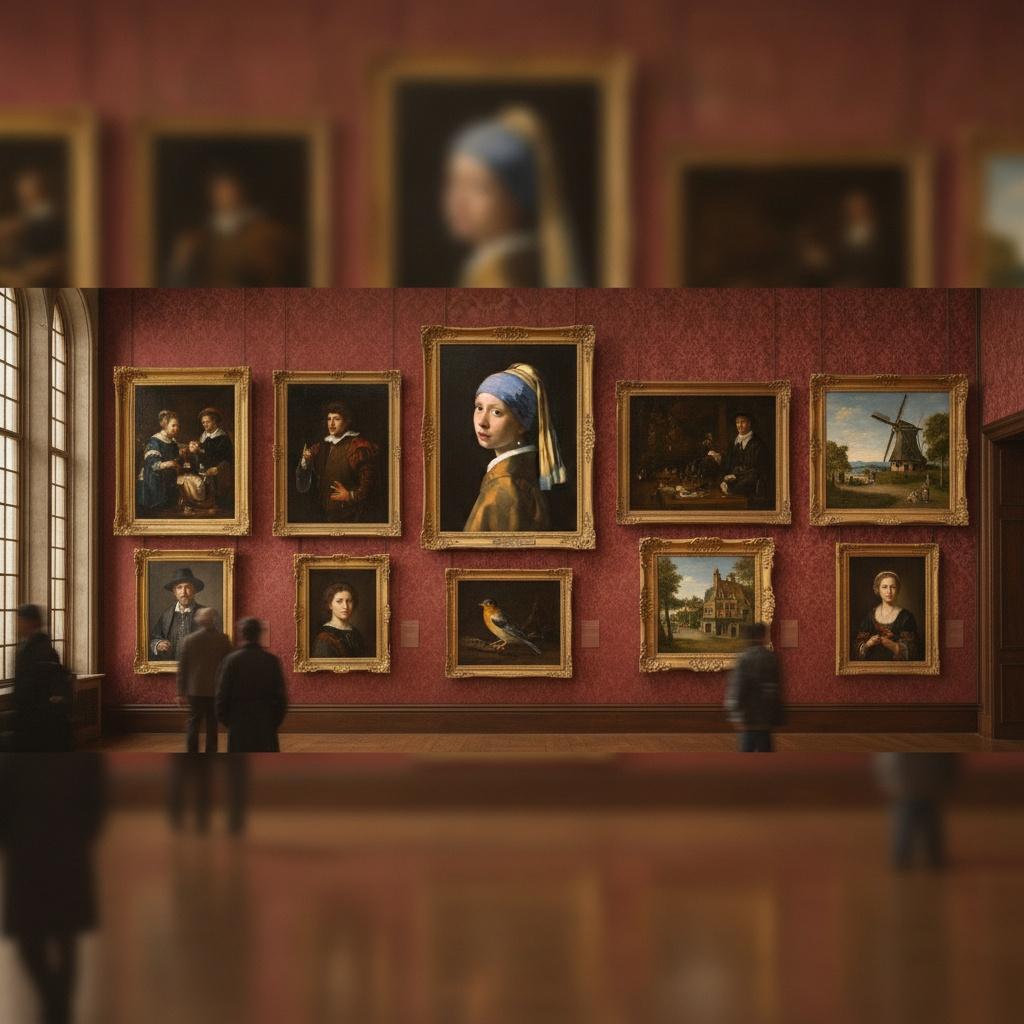
To step into the era of the Dutch Golden Age is to enter a world where light does not merely illuminate a scene, but breathes life into it. During the seventeenth century, while much of Europe remained draped in the heavy, dramatic shadows of religious iconography, the Netherlands underwent a profound cultural metamorphosis. A burgeoning merchant class, fueled by global trade and unprecedented prosperity, turned their gaze away from the heavens and toward the exquisite details of the earthly realm. This was an age where the scent of a single tulip, the glint of light on a pewter goblet, and the quiet dignity of a domestic interior became subjects worthy of the highest artistic devotion.
The masterpieces born of this period are far more than historical artifacts; they are windows into the human soul and the tactile reality of a civilization at its zenith. Through the mastery of chiaroscuro and an almost scientific devotion to texture, the Dutch masters captured the ephemeral—the way a shadow softens across a silk sleeve or how sunlight pierently pierces a cloudy sky. These works remain profoundly meaningful today because they celebrate the extraordinary within the ordinary, finding profound beauty in the quiet, unadorned moments of existence that resonate across centuries.
As we wander through this curated selection, we invite you to linger on the brushstrokes and feel the weight of history. We have selected ten definitive works that do not merely represent an era, but define the very essence of the Dutch Golden Age—each a testament to the unparalleled skill of artists who taught the world how to truly see .
The Girl with a Pearl Earring - Johannes Vermeer
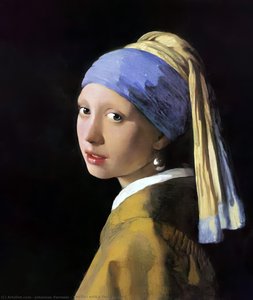 The Girl with a Pearl Earring - Johannes Vermeer
To stand before The Girl with a Pearl Earring is to encounter a gaze that has captivated the world since 1665. Johannes Vermeer does not merely present a portrait; he captures a fleeting, breathless moment of connection. As her eyes meet yours from the shadows, there is an immediate, profound intimacy—a psychological depth that transcends the centuries. This iconic work, a masterpiece of the Dutch Golden Age, utilizes the luminous interplay of light and shadow to pull the viewer into her enigmatic world.
The brilliance of Vermeer’s technique lies in his mastery of ultramarine blues and the soft, pearlescent highlights that dance across the subject's skin. The composition is a study in quietude, where the weight of the single, shimmering pearl serves as an anchor for the soul. Integrating such a powerful piece into your home does more than decorate a wall; it transforms a personal sanctuary into a space for profound reflection and calm. It invites a sense of timeless tranquility, making it an essential cornerstone for any collection celebrating the pinnacle of Dutch realism.
A Lady Drinking and a Gentleman and The Glass of Wine - Johannes Vermeer
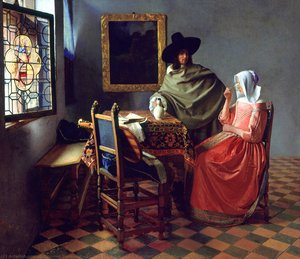 A Lady Drinking and a Gentleman and The Glass of Wine - Johannes Vermeer
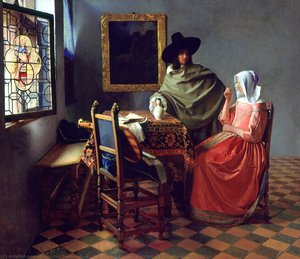
In A Lady Drinking and a Gentleman and The Glass of Wine by Johannes Vermeer, the deep, resonant crimson of the woman’s attire anchors the composition, casting a mood of quiet passion and refined warmth. This masterful use of color, paired with the soft, directional light filtering through stained glass, is precisely why this work remains a cornerstone of the Dutch Golden Age . Vermeer’s ability to balance vibrant pigments with subtle, pearlescent shadows creates a sense of living breath within the canvas.
For the discerning collector or interior designer, integrating this masterpiece into a modern space offers an unparalleled opportunity to curate atmosphere. The painting's palette—rich ochres, deep reds, and luminous whites—can serve as the emotional foundation for a sophisticated dining room or a contemplative study. By echoing its interplay of light and shadow, one can evoke a sense of timeless prestige and scholarly tranquility. This work does not merely decorate a wall; it introduces a window into an era of unparalleled elegance, transforming a contemporary interior into a sanctuary of historical depth and quiet luxury.
Girl Reading a Letter at an Open Window - Johannes Vermeer
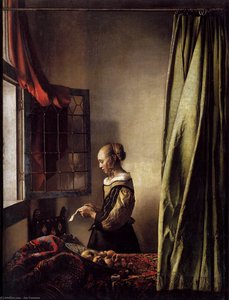 Girl Reading a Letter at an Open Window - Johannes Vermeer
In Girl Reading a Letter at an Open Window , Johannes Vermeer captures more than a mere domestic moment; he freezes the very essence of 17th-century intimacy. As a cornerstone of our selection of the Top 10 Masterpieces That Defined the Dutch Golden Age Art Movement , this work exemplifies the era's profound fascination with the quiet dignity of everyday life. Vermeer’s mastery of chiaroscuro allows light to stream through the window, illuminating the subject with a luminous, pearlescent glow that seems to breathe within the frame.
The painting invites us into a private sanctuary of longing and reflection. The subtle textures—from the heavy drapery to the soft, rumpled linens—create a sensory experience that transcends time, reminding us that beauty often resides in stillness. For the discerning collector or interior designer, the muted earth tones and serene composition offer a timeless elegance, capable of anchoring a modern room with a sense of historical depth and soulful tranquility. It is a profound meditation on communication and the human heart, making it an indispensable jewel in any curated collection.
Winter Scene on a Canal - Hendrick Avercamp
 Winter Scene on a Canal - Hendrick Avercamp
In Winter Scene on a Canal by Hendrick Avercamp, the muted, earthy ochres and cool, slate greys establish a profound sense of quietude, setting a contemplative yet communal mood. This mastery of a subdued palette is precisely why this work stands as one of the Top 10 Masterpieces That Defined the Dutch Golden Age Art Movement . Avercamp does not rely on vibrant hues to command attention; instead, he utilizes atmospheric perspective and delicate, diffused light to create a breathtakingly immersive landscape where every frozen figure tells a story of resilience.
For the discerning collector or interior designer, integrating such a piece into a modern residence offers an unparalleled opportunity to curate emotional depth. The painting’s soft, overcast lighting and neutral tones serve as a sophisticated anchor for a dining room or grand living space, providing a sense of historical weight without overwhelming contemporary decor. By echoing these wintry, desaturated tones through textiles or architectural accents, one can evoke the same warmth and nostalgic camaraderie found within this timeless Dutch masterpiece.
Allegory of Faith - Johannes Vermeer
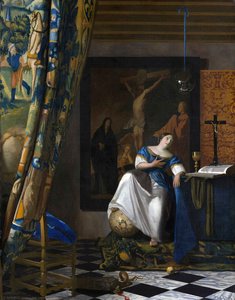 Allegory of Faith - Johannes Vermeer
In Allegory of Faith , Johannes Vermeer achieves a breathtaking mastery of chiaroscuro , where light does not merely illuminate but narrates the soul's journey. The scene is anchored by a dramatic interplay of shadow and brilliance; a soft, directional light washes over the central figure, catching the delicate textures of her attire and the reflective surface of a silver chalice. This sophisticated command of illumination creates a profound sense of three-dimensional depth, pulling the viewer into a private, sacred moment of contemplation.
As one of the top 10 masterpieces that defined the Dutch Golden Age , this work uses light to bridge the gap between the domestic and the divine. The way Vermeer captures the luminous glow against deep, somber blues and rich golds is nothing short of transformative. When brought into a contemporary setting, a faithful oil reproduction of this piece introduces an unparalleled layer of luxury and psychological depth. The visible brushstrokes and the interplay of light and shadow serve as a timeless focal point, adding a sense of historical prestige and quiet drama to any curated interior.
View of Delft - Johannes Vermeer
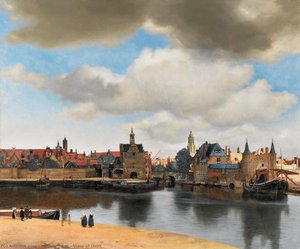 View of Delft - Johannes Vermeer
In View of Delft by Johannes Vermeer, the architecture of the Dutch Golden Age is rendered through a breathtakingly precise geometric harmony. The composition relies on a sophisticated balance of linear precision and organic softness; the verticality of the Nieuwe Kerk spire provides a structural anchor, while the horizontal expanse of the canal creates a tranquil, stabilizing foundation. Vermeer utilizes subtle atmospheric perspective, where distant shapes dissolve into soft, pale tones, lending the cityscape an infinite sense of depth and timeless perfection.
This mastery of spatial arrangement offers a profound connection to modern minimalist design. Much like a contemporary curated space, the painting’s reliance on clean lines, balanced proportions, and a muted, sophisticated palette allows it to ground a modern aesthetic without overwhelming it. The interplay of light reflecting off the water and the rhythmic placement of masts and buildings evokes a sense of quiet order and civic pride. For the discerning collector, this masterpiece serves as more than a historical window; it is an enduring study in equilibrium, bringing a serene, structured elegance to any refined interior.
The Large Forest - jacob isaackszoon van ruisdael
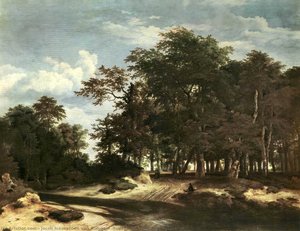 The Large Forest - jacob isaackszoon van ruisdael
In The Large Forest , Jacob van Ruisdael achieves a profound dialogue between the terrestrial and the sublime. This masterpiece captures the raw, untamed essence of the Dutch wilderness, where a dense canopy of ancient trees creates a sanctuary of dappled light and deep, atmospheric shadows. The painting is a cornerstone of our selection because it exemplifies the 17th-century shift toward landscape realism, moving beyond mere topography to evoke a visceral sense of solitude and the enduring strength of nature.
The artist’s masterful use of muted greens, earthy browns, and soft, diffused light creates a somber yet serene mood that resonates deeply with contemporary aesthetics. For the modern collector or interior designer, this work offers more than just visual depth; it provides an anchor of tranquility. The winding path and the subtle presence of a lone figure invite a contemplative gaze, making it an ideal focal point for sophisticated spaces seeking to infuse a sense of historical grandeur and natural elegance into a curated home environment.
Doctor Nicolaes Tulp's Demonstration of the Anatomy of the Arm - Rembrandt van Rijn
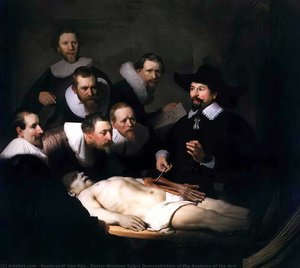 Doctor Nicolaes Tulp's Demonstration of the Anatomy of the Arm - Rembrandt van Rijn
In The Anatomy Lesson of Dr. Nicolaes Tulp , Rembrandt van Rijn transcends the traditional group portrait, transforming a clinical demonstration into a profound drama of human curiosity and scientific revelation. This masterpiece stands as a cornerstone of the Dutch Golden Age, capturing the intense, focused energy of scholars gathered around the cadaver. Through his legendary use of chiaroscuro , Rembrandt directs our gaze with surgical precision, using dramatic light to illuminate the tension in the physicians' faces and the intricate textures of the anatomical study.
The painting’s legacy lies in its ability to blend stark realism with a palpable sense of intellectual discovery. For the modern collector or interior designer, this work offers an unparalleled sense of gravitas and narrative depth. Its monochromatic intensity and dramatic interplay of shadow and light provide a sophisticated anchor for contemporary spaces, lending an air of historical prestige and academic elegance to any curated gallery wall or executive study.
Isaac and Rebecca, known as - Rembrandt van Rijn
 Isaac and Rebecca, known as - Rembrandt van Rijn
In Isaac and Rebecca , Rembrandt van Rijn achieves a breathtaking structural harmony that anchors this work within the top 10 masterpieces of the Dutch Golden Age . The composition is built upon a sophisticated geometry of interlocking forms; the gentle curve of Rebecca’s silhouette finds its balance in the sturdy, upright presence of Isaac. This careful arrangement of shapes creates a sense of timeless perfection, guiding the eye through a rhythmic dance of light and shadow.
Rembrandt utilizes his legendary chiaroscuro to sculpt the figures against a textured stone backdrop, where the warmth of the flesh tones contrasts with the deep, atmospheric shadows. There is a profound internal balance here that resonates with the principles of modern minimalist design ; by stripping away narrative clutter to focus on the essential emotional connection and clean, dramatic lighting, Rembrandt creates an aesthetic that feels remarkably contemporary. This mastery of weight and void allows the painting to ground any sophisticated interior, offering a soulful, historical anchor that remains as visually impactful today as it was in 1669.
Agatha Bas (1611-58) - Rembrandt van Rijn
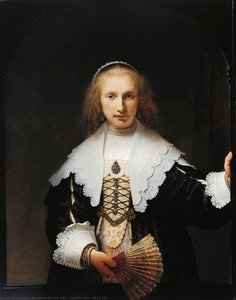 Agatha Bas (1611-58) - Rembrandt van Rijn
In the portrait of Agatha Bas , Rembrandt van Rijn does not merely capture a likeness; he orchestrates a profound encounter between the viewer and the subject. As one of the top 10 masterpieces that defined the Dutch Golden Age art movement , this 1641 work transcends traditional portraiture through its breathtaking use of trompe l'oeil . By painting an illusionistic ebony frame that appears to extend into our physical reality, Rembrandt blurs the boundary between the canvas and the room, inviting us into Agatha’s intimate space.
The sensory richness of the piece is unparalleled—from the delicate, incised lines of her blonde hairline to the luxurious textures of her black gown, patterned with gold floral silk and intricate lace. This mastery of light and shadow, or chiaroscuro, creates a psychological depth that remains strikingly modern. In today's curated interiors, where the interplay of texture and dramatic lighting defines luxury, Agatha Bas serves as a timeless inspiration, reminding us that true elegance lies in the sophisticated balance of presence, prestige, and the subtle art of illusion.
Conclusion
As the light fades on our journey through the seventeenth century, we are left with more than just a collection of historical milestones; we carry with us the quiet, enduring pulse of the Dutch Golden Age. These masterpieces do not belong solely to the museums that house them, nor to the era that birthed them. Instead, they exist in a continuous, breathing dialogue with every soul that pauses before them. Each deliberate brushstroke—the soft glow of a pearl, the dramatic shadow of a tavern corner, or the gentle light falling across a linen collar—serves as a bridge across centuries, connecting our modern lives to the profound human emotions of the past.
To invite these works into your own space is to welcome a living presence. They possess a unique ability to transform a room, turning a mere wall into a window onto a world of depth, texture, and timelessness. Whether through the tactile impasto of a hand-painted reproduction or the quiet elegance of a fine print, these paintings continue to shape our interiors and inspire our creative spirits, reminding us that beauty, when captured with such academic excellence, never truly fades. We invite you to continue this exploration and find your own connection within our full collection , where the legacy of the masters remains as vibrant and vital today as it was four hundred years ago.